Dubai: Asian stocks rose on Wednesday morning after the US Federal Reserve said it would keep interest rates on hold and Wall Street enjoyed its best day in two years.
The Dow Jones industrial average gained 492.92 points, or 3.98 per cent, to 11,239.77 at the close, the Standard & Poor's 500 Index rose 53.07 points, or 4.74 per cent, to 1,172.53 and the Nasdaq Composite Index climbed 124.83 points, or 5.29 per cent, to 2,482.52 following a rout that wiped out $1 trillion in the previous session.
The MSCI Asia Pacific Index climbed 2.9 per cent following the Fed’s announcement to keep its benchmark interest rate at a record low through mid-2013.
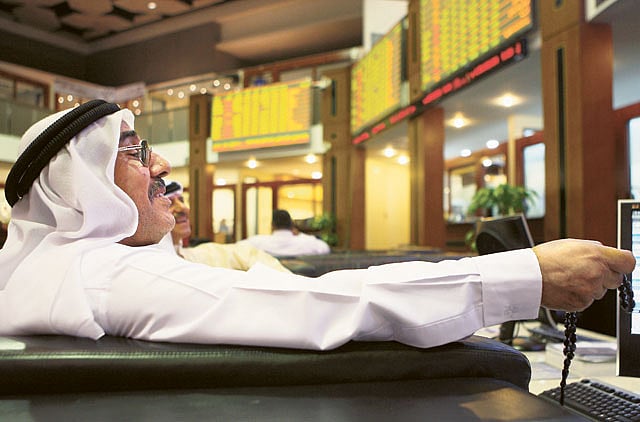
Local markets also bounced back with the Dubai Financial Market adding 1.90 per cent to 1,471.70 and Abu Dhabi’s bourse gaining 0.91 per cent to 2,601.24 at 11.33am UAE time.
The sovereign-debt crisis in Europe, stalling global economic growth, growing fears over another global recession and the United States' credit downgrade have all contributed to negative investor sentiment.
European markets were mixed with London's FTSE rose 1.89 per cent to 5,164.92 points after technically entering a bear market in early trading after falling more than 20 per cent from its closing high in February.
Paris' CAC was 1.63 per cent higher but Frankfurt's DAX was down 5,917.08 points, or 0.10 per cent.
"There is still some downside risk and I think global markets will fall a further 10 per cent. I just worry that people will be spoilt for choice [when equities start to recover]," said Gary Dugan, chief investment officer of private banking at Emirates NBD, the UAE's third largest bank by assets.
Dubai's benchmark index fell 1.95 per cent to a fresh five-month low of 1,444.29 and the Abu Dhabi Securities Exchange slipped 1.34 per cent to 2,577.76, its lowest close since March 8.
"We are at a stage where the volatile situation in global equities, rather than market fundamentals, is shaping investor sentiment," said Mohammad Ali Yasin, chief investment officer at CAPM Investment.
In a meeting Tuesday, the UAE Central Bank reviewed the report which showed that the UAE's banks are in a good position and will not be negatively impacted by the turmoil in international markets.
On the issue of the exchange rate policy, the Central Bank's Board of Directors affirmed that the dirham's peg to the dollar will continue.
Risk averse investors rush to safe havens as equities dive
Equity prices plunged around the globe Tuesday with large drops seen across Asia, Middle East and Europe as investors rushed to reduce their risk exposures and took refuge in safe havens.
Gold prices and safe-haven currencies rose sharply in Asia trade. Money continued to be poured into Swiss franc and Japanese yen Tuesday. The Swiss franc surged to an all-time high against the euro as investors' confidence was battered by extended falls in share prices.
The yen advanced while the dollar strengthened versus commodity currencies as Wall Street's biggest sell-off since December 2008 prompted a massive flight to safety.
"The Swiss franc and yen are still strengthening much to the chagrin of policy makers in Switzerland and Japan, as they both attempted to weaken their currencies last week," said Nick Stadtmiller, fixed income analyst at Emirates NBD.
Commodity currencies have fared poorly. Australian dollar is near parity at 1.0118; the pair traded above 1.10 as recently as last Tuesday. The US dollar vs Canadian dollar is also nearing unity, currently trading at 0.9957. Commodities, with the exception of gold, are struggling to find a footing lately.
Analysts said Tuesday that the equity sell-offs and rush to safe haven asset classes have more to do with fears about global economic growth rather than the downgrade of US credit rating by Standard & Poor's last week.
"The sharp sell-off is more driven by fears for a US recession, rather than the US credit rating itself, besides the $10.5 billion [Dh38.5 billion] lawsuit by AIG against Bank of America, which is a major issue on its own," said Jaap Meijer, Head of Banks Research and Senior Analyst at HC Securities.
"We are more concerned about the implications of the euro sovereign crisis than the US downgrade, even though the impact of the required medium- term fiscal consolidation is higher in the US than in the euro zone as a whole," said Meijer.
"Market strategists believe that the risk aversion can be arrested only by strong policy initiatives from the US and Europe. Our tactical view on asset prices remains "risk-off" until policy makers react to calm markets and boost growth optimism and until we believe investor positioning clearly shows that fear has become consensus," said Michael Hartnett Chief Global Equity Strategist of Bank of America Merrill Lynch.
Over the medium-term, Merril Lynch recommends investors to own assets tied to healthy corporate balance sheets, such as best of breed equities and corporate bonds, rather than assets tied to government and consumer balance sheets, such as sovereign debt and banks.
Meanwhile, global markets are closely watching policy decisions from the US and European central banks; the success of US Treasury & European sovereign debt auctions and the degree of redemptions from US money market funds.
The ECB's intervention in Italian and Spanish bond markets on Monday started on a strong note.
Markets were waiting for the outcome of the crucial Federal Reserve meeting at press time.
Sign up for the Daily Briefing
Get the latest news and updates straight to your inbox
Network Links
GN StoreDownload our app
© Al Nisr Publishing LLC 2026. All rights reserved.