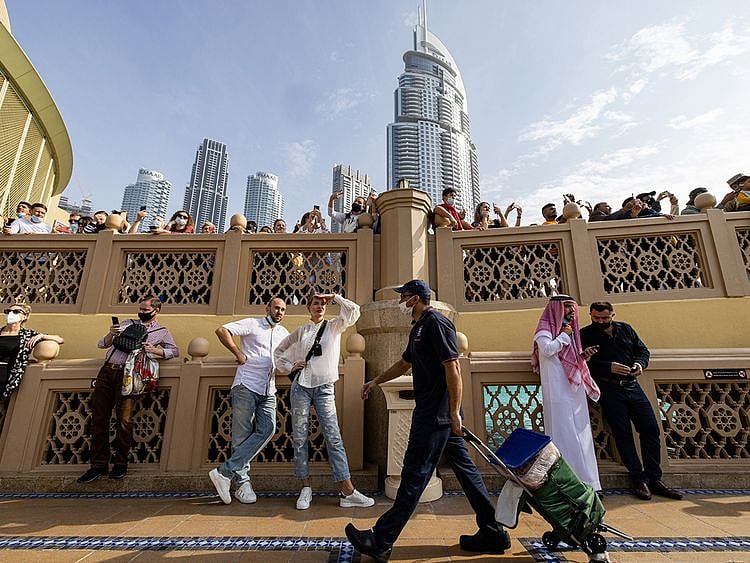
Dubai: Global investors are keeping faith in the Gulf despite recent regional tensions, with new surveys, bank research and equity flow data pointing to confidence in the region’s economic outlook and trade recovery.
A new investor poll by Consulum and HarrisX found that 82% of global investors are confident in the Gulf’s future economic outlook, while 69% rate the region as a good or great place to invest or do business right now.
Get updated faster and for FREE: Download the Gulf News app now - simply click here.
The survey covered 2,043 investors across the US, UK, Germany, France and China, and found the strongest confidence in China at 91%, followed by the US and UK at 84% each, Germany at 80% and France at 71%.
Gulf seen as a rising economic force
The findings come after a volatile period linked to the US-Iran conflict and disruption around the Strait of Hormuz, but investors appear to be treating the tensions as a manageable risk rather than a longer-term threat to the region’s growth story.
Consulum and HarrisX said 70% of international investors expect the GCC’s global economic importance to grow over the next five years. The UK led that view at 78%, followed by the US at 74%, China at 70%, Germany at 65% and France at 61%.
“The international investment community sees the Gulf’s economic story as one of sustained momentum," said James Davies, CEO of Consulum. "Investors are not reacting to a geopolitical moment - they are making a long-term verdict on the strength and resilience of what the GCC has built.”
The survey also found that 71% of global investors expect the US-Israel-Iran conflict to end in a negotiated agreement. A similar share wants Gulf states directly involved in that process, with 32% favouring their presence at the negotiating table and 39% backing a behind-the-scenes role.
"Global investors support a US-Iran deal that reflects input from the region and provides safe navigation in the Strait of Hormuz," said Dritan Nesho, CEO of HarrisX. "They are exhibiting patience, with a majority indicating they either see continued progress in the negotiations or optimistic a deal will likely succeed.”
Also Read
In UAE, DFM and ADX drop as investor fears grow over Middle East crisis reaching boiling pointBoom in the Gulf: Five reasons why the GCC is a magnet for foreign investmentOn UAE stocks, retail investors think long term – that is a good outcome This time, oil prices offer Gulf investors enough of a support systemUAE business activity expected to pick up
The investor confidence is being matched by signs of economic resilience in the UAE. Standard Chartered's latest economic analysis highlighted that UAE business activity is expected to accelerate in the third quarter of 2026, supported by domestic consumption, investment and a gradual recovery in external demand as regional trade flows normalise.
The bank said the UAE’s June S&P Global Purchasing Managers’ Index remained above the 50 mark, signalling continued expansion in non-oil activity even during the kinetic phase of the recent regional conflict.
“The UAE’s latest PMI reading reinforces the resilience of its non-oil economy and private sector activity through a period of regional uncertainty," said Rola Abu Manneh, Chief Executive Officer, UAE, Middle East and Pakistan at Standard Chartered. "Domestic consumption and investment continue to support growth, while the gradual recovery in external demand provides a more constructive outlook for the third quarter. These trends reflect the depth of the UAE’s economic fundamentals and its continued role as a leading hub for trade, investment and capital flows.”
Standard Chartered expects softer oil prices, a recovery in the job market and faster investment growth to support UAE momentum in the third quarter.
The bank also said the partial reopening of the Strait of Hormuz and earlier rerouting of oil exports had translated into a near full recovery in the UAE’s oil exports, while the wider regional recovery in oil exports was taking place more gradually.
Saudi momentum also improving
Saudi Arabia is also expected to enter the third quarter with stronger business momentum, according to separate Standard Chartered research.
The bank said the kingdom’s underlying activity stayed resilient despite regional uncertainty, with point-of-sale transactions rising 6% year on year in May and returning to January 2026 levels.
“Saudi Arabia’s economy has continued to demonstrate resilience through a period of heightened regional uncertainty, reflecting the strength of domestic demand and the progress of the Kingdom’s diversification agenda," said Mazen Bunyan, CEO and Head of Coverage, Saudi Arabia at Standard Chartered. "As regional conditions continue to improve, we expect this resilience to translate into stronger business momentum, creating further opportunities for investment and private sector growth during the second half of the year.”
Standard Chartered said Saudi growth in the third quarter would be supported by continued investment, easing inflationary pressures and an improving labour market.
The bank added that the partial reopening of the Strait of Hormuz had supported a near full recovery in Saudi oil exports, which should provide further support to trade and broader economic activity in the second half.
Foreign money returns to GCC equities
Investor interest is also showing up in equity flows. Iridium’s Foreign Flow Analysis showed GCC equities returned to net foreign inflows in June, recording $144 million after an $837 million outflow in May.
Saudi Arabia attracted $543 million of inflows in June, marking its 11th month of inflows in the past 12 months. The UAE also returned to positive territory with $93 million of inflows, driven by Abu Dhabi, which recorded $120 million. Dubai saw a smaller outflow of $26 million, a strong improvement from the previous three months.
Outflows continued in Kuwait and Qatar, at $268 million and $172 million respectively, showing that foreign allocations remain selective.
Year to date, GCC equities still have positive net foreign inflows of $1.3 billion, despite volatility around the US-Iran conflict and disruption linked to the Strait of Hormuz.
Iridium said June should be treated as the start of an allocation review, with the US-Iran memorandum of understanding and the reopening of Hormuz giving global investors a reason to revisit GCC exposure.
Confidence at home remains high
The global investor findings also mirror domestic sentiment in the Gulf.
A May survey by Consulum and HarrisX across the UAE, Saudi Arabia, Qatar and Bahrain found that 90% of respondents said their country was on the right track, while 89% expressed confidence in the future economic outlook.
Public confidence in national economies was above 90% across all four markets surveyed. In the UAE, 93% of the public said they trusted the government to protect the country from the consequences of the conflict, while 91% trusted the government to manage regional crises.
"Read alongside our May survey, two different audiences – global investors and the Gulf’s own residents – are reaching similar conclusions," noted Ranulph Murray, Head of Consulum Intelligence. "That alignment of outside capital and domestic sentiment is itself a measure of how confidence in the Gulf is structural and settled.”
Sign up for the Daily Briefing
Get the latest news and updates straight to your inbox
Network Links
GN StoreDownload our app
© Al Nisr Publishing LLC 2026. All rights reserved.