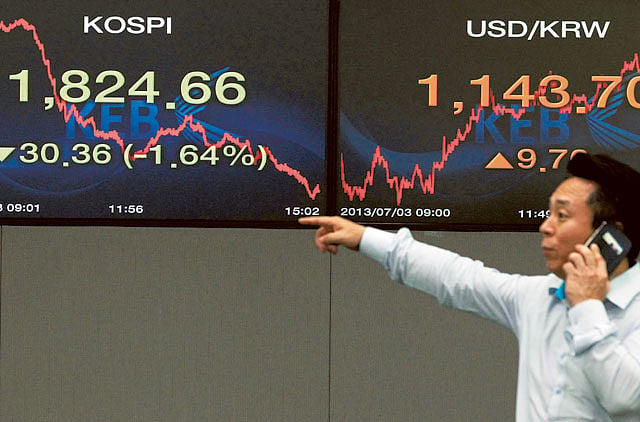
London: World shares pulled back on Wednesday as signs of slowing Chinese growth and escalating political tensions in Portugal, one of the euro zone’s crisis hot-spots, spooked investors.
European shares opened down 1.2 per cent and euro zone periphery bonds tumbled after two high profile government resignations in two days threatened to plunge Portugal into a political crisis.
Portugal’s bond yields surged more than 1 percentage point to 8 per cent. Spanish, Italian yields jumped too while nervousness over the state of Greece’s next tranche of bail-out money also caused jitters.
“With disorder and uncertainty over the political situation in Egypt threatening stability in the Middle East, and a Greek deadline looming to prove it can action its bail-out conditions before receiving the next tranche of aid, volatility is likely to be high,” Mark Ward, head of trading at Sanlam Securities, said.
It came after Asian stock markets had dropped overnight as official figures showed that growth in China’s services sector sagged to its weakest pace in nine months in June, adding to signs of a slowdown in the world’s second-largest economy.
The US dollar hit a one-month high against a basket of major currencies, staying firm after a recent string of generally solid US economic data supported the view that the Federal Reserve could scale back its monetary stimulus later this year.
The dollar index, which measures the greenback’s value against a basket of major currencies, rose to as high as 83.635, its highest level since late May, while the troubles in Portugal left the euro at its lowest level in a month.
In commodities markets, oil was hovering around $105 a barrel, a 14-month high, as political turmoil in Egypt where the army is looking to remove the president, threatened to destabilise the Middle East and disrupt oil supplies.
Asian shares extended their losses after an official survey showed that growth in China’s services sector sagged to its weakest pace in nine months in June, adding to signs of a slowdown in the world’s second-largest economy.
Regional shares fell broadly with MSCI’s broadest index of Asia-Pacific shares outside Japan tumbling 2.2 per cent, pulling away from a near two-week high set on Tuesday.
Hong Kong shares fell 1.7 per cent, while the Shanghai Composite Index slipped 0.9 per cent. Australian equities
fell 1.9 per cent.
“It’s been very tough telling clients to start looking at a tradeable rebound, it shows everybody is very pessimistic right now,” said Hong Hao, chief strategist at Bank of Communication International Securities.
European shares were seen likely to open lower. Financial spread betters expect Britain’s FTSE 100 to open down 0.6 per cent, Germany’s DAX to open down 0.6 per cent, and France’s CAC 40 to open down 0.7 per cent.
Equity investors were quick to take profits in recent gains following a soggy finish on Wall Street on Tuesday. Some positioning ahead of the US Independence Day holiday on Thursday and key US jobs report on Friday was also cited for the market’s cautious demeanour.
The Australian dollar plumbed a fresh three-year low against the greenback with markets interpreting as dovish comments from the head of the Reserve Bank of Australia.
The Aussie dollar fell to as low as $0.9068 in late Asian trade, its lowest level since September 2010, after RBA Governor Glenn Stevens said the bank stood ready to help support an economy that faced sub-par economic growth as the mining investment boom peaked.
The falling Aussie, eventually positive for Australia, was squeezing foreign investors on overall Australian assets including equities, said William Keenan, head of equities research at Lonsec in Melbourne.
“There seems to be a battle going on between offshore selling and domestic buying. On the day-to-day basis it depends on who has the momentum,” Keenan said, noting that domestic buyers held a more bullish view while foreign investors were more worried about slower growth in Asia.
The US dollar hit a one-month high against a basket of major currencies, staying firm after a recent string of generally solid US economic data supported the view that the Federal Reserve could scale back its monetary stimulus later this year.
The dollar index, which measures the greenback’s value against a basket of major currencies, rose to as high as 83.635, its highest level since late May.
Data on Tuesday backed stimulus-tapering expectations, as US new motor vehicle sales in June were on track for their strongest month in more than 5-1/2 years, while factories posted a second straight month of gains in new orders in May. Home prices also posted their biggest annual increase in more than seven years.
Ordinarily these numbers should bolster risk appetite and equities, but investors at this stage appeared to be more worried that the Fed will keep to its mantra of gradually withdrawing stimulus as the economic recovery continues.
In commodities markets, US oil hit a 14-month high as traders bet on a sharp drop in crude inventories in top consumer the United States, while tensions in the Middle East also cushioned prices.
Fears that political turmoil in Egypt could destabilise the Middle East and disrupt oil supplies helped lift US oil, which rose about 2 per cent to $101.58 a barrel and hit a high of $102.18 earlier on Wednesday.
Sign up for the Daily Briefing
Get the latest news and updates straight to your inbox
Network Links
GN StoreDownload our app
© Al Nisr Publishing LLC 2026. All rights reserved.