IMF urges bolder steps to sustain recovery
Policymakers urged by IMF to take bolder steps to sustain global recovery
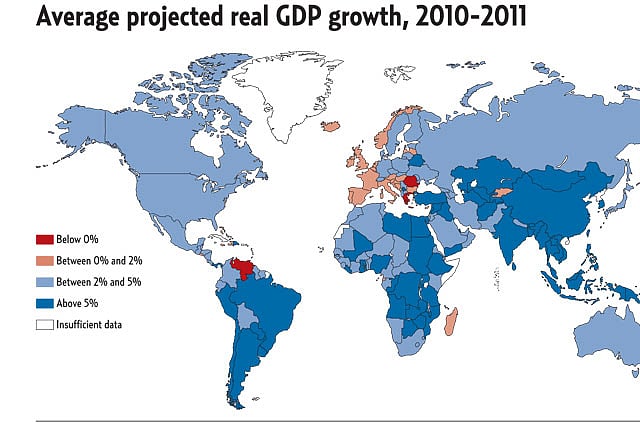
Dubai: The outlook for Asian economic growth continues to tell the tale of a polarised region. While China and India continue to be the bright spots, prospects for weaker nations are gloomy, the International Monetary fund (IMF) has said. Gulf News has obtained an advanced copy of the report.
The countries include Pakistan, where the recent floods have created macroeconomic and financial uncertainty, and Vietnam, which is at the lower end of the quality ladder in terms of manufacturing exports.
Japan's economic prospects remain weak, given lacklustre domestic demand and a lack of fiscal room to further boost the economy.
An export-led recovery in Japan since the second quarter of 2009 strengthened in early 2010 thanks to a stronger-than-anticipated recovery in the Western advanced economies and rising demand for capital goods from China.
Exports affected
However, sporadic appreciation of the yen and the recent cooling of the US economy will continue to affect exports. Although investment activity is projected to pick up — sparked by export-oriented businesses — the unwinding of fiscal stimulus and the sluggish labour market are likely to weigh on near-term growth.
Real GDP growth in Japan is projected at 2.8 per cent in 2010 and 1.5 per cent in 2011, although output will remain below its potential level, the IMF said.
"Japan remains a paradox within an enigma," said Paul A. McCulley, a managing director at California-based investment management firm Pimco.
"It's a very rich country with a shrinking working age population, mired in a deflationary liquidity trap.
"Japan has limited political willingness to boldly pursue reflationary policies, and they have major doubts as to the effectiveness of such measures, even if tried," McCulley said in a note sent to Gulf News.
In China, real GDP grew at 10.3 per cent year-on-year in the second quarter, compared with 11.9 per cent in the first, according to IMF data. "Sustained growth in retail sales and industrial production confirms that private sector activity has advanced beyond the lift from government stimulus," it said.
The IMF projects China's overall growth will average 10.5 per cent in 2010 and 9.6 per cent in 2011, driven by domestic demand.
"The slight moderation in recent activity is expected to continue through 2011 in light of tighter quantitative limits on credit growth, measures to cool the property market and limit bank exposure to this, and the planned unwinding of fiscal stimulus in 2011," it said.
"Policy efforts to limit overheating and asset price bubbles in China have proven mostly effective, though that is no guarantee of future success," McCulley said.
India's macroeconomic performance has also been vigorous, with industrial production at a two-year high. Leading indicators — the production manufacturing index and measures of business and consumer confidence — continue to point up.
Growth is projected at 9.7 per cent in 2010 and 8.4 per cent in 2011, led increasingly by domestic demand.
According to the IMF, "Robust corporate profits and favourable external financing will encourage investment.
"Recent [economic] activity was driven largely by investment, and the contribution from net exports is projected to turn negative in 2011, as the strength in investment further boosts exports."
US cooling
A bleaker picture was drawn by the IMF report of the US economy. It estimates that US economic growth will be much weaker this year and in 2011 than previously thought. That dims hopes for bringing down a very high unemployment rate anytime soon, the IMF said.
In a sober assessment of the US outlook, the IMF pulled down its estimate for 2010 growth to 2.6 pe rcent from the 3.3 per cent it published in July and said the GDP will expand 2.3 per cent in 2011 instead of 2.9 per cent.
"The most likely prospect for the US economy is for a continued but slow recovery, with growth far weaker than in previous recoveries, considering the depth of the recession," the IMF said. It added that the main reason the US recovery is so weak is that consumer spending is sluggish and suggests it is little wonder that is the case.
Sign up for the Daily Briefing
Get the latest news and updates straight to your inbox
Network Links
GN StoreDownload our app
© Al Nisr Publishing LLC 2026. All rights reserved.