Governments are investing in battery raw material supply chains, while battery manufacturers are forming alliances with mining companies. Expectations point towards a decline over time.
What China has that Elon Musk doesn’t: A state-backed solid-state battery push
China’s next EV power play: Beijing targets solid-state battery scale by 2030
Last updated:
5 MIN READ
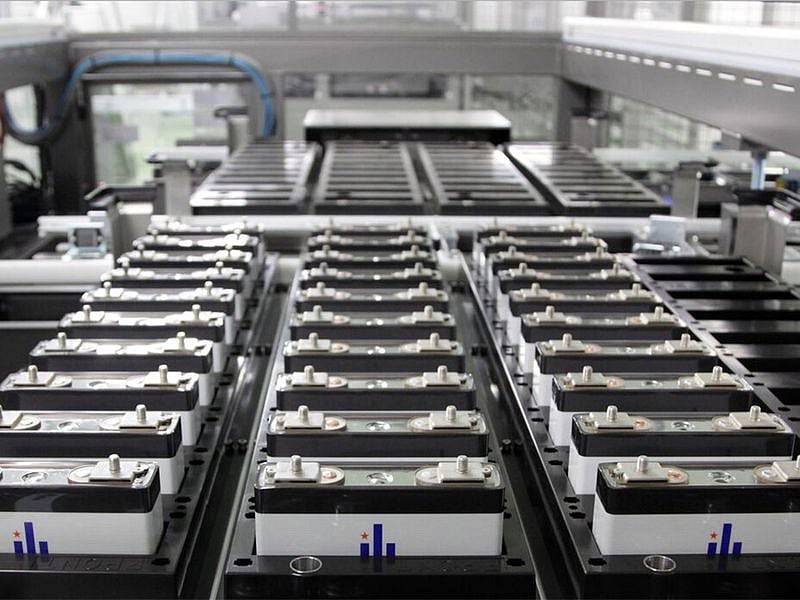
Governments are investing in battery raw material supply chains, while battery manufacturers are forming alliances with mining companies. Expectations point towards a cost decline over time, with China emerging as a dominant global battery manufacturing powerhouse using to government's drive and investments.
Bloomberg
Elon Musk has scale, capital and a global EV brand.
China has something harder to replicate: a vast, vertically integrated battery ecosystem now backed by a national plan to push all-solid-state batteries from the lab towards "initial large-scale" use by 2030.
Beijing’s latest roadmap aims to extend China’s existing lithium-ion advantage into the next battery era — where longer range, faster charging and safer cells could reset the electric-vehicle race.
Get it: Fast, verified news for FREE ... download the Gulf News app — simply click here
How Beijing turned batteries into strategy
China’s Ministry of Industry and Information Technology and six other government bodies issued a 2026–2030 plan that makes battery technology a national industrial priority.
It calls for breakthroughs in advanced electrode materials, new electrolytes and high-end auxiliary materials, as well as initial large-scale deployment of all-solid-state batteries by 2030.
The roadmap does not merely identify a destination.
It targets the technical bottlenecks holding solid-state batteries back: ionic conductivity, battery-cycle stability, electrode-electrolyte contact and manufacturing capability.
It also promotes production equipment — including isostatic presses — and calls for industrialisation technologies that can bring costs down while improving consistency.
China is also pursuing a broader battery portfolio, centred on lithium-ion cells but supplemented by sodium-ion, lithium-ion phosphate and flow batteries.
Grid-scale batteries
That matters because the future market will not be exclusively about EVs: the government’s strategy spans grid storage, ships, aviation, low-altitude aircraft, intelligent robots and heavy machinery.
Why solid-state batteries matter
Conventional lithium-ion batteries use a liquid electrolyte, whereas a true all-solid-state battery replaces it with a solid material.
In theory, this can enable higher energy density, quicker charging, longer service life and a lower fire risk — attributes especially valuable for electric vehicles, aviation and high-performance storage.
But the promise remains ahead of mass-market reality.
Solid-state vs sodium batteries
The EV and clean-energy revolutions do not need to wait for solid-state batteries, according to technology disruption think-tank RethinkX.
The organisation, co-founded by Stanford University strategist Tony Seba and James Arbib, argues that existing battery technologies are already capable of driving a rapid transformation of transportation and electricity markets.
Its thesis challenges the increasingly common industry narrative that solid-state batteries are essential for the next major phase of EV adoption.
RethinkX instead points to both lithium iron phosphate (LFP) and emerging sodium-ion batteries as technologies capable of delivering the lower costs and scalability required for mass adoption.
LFP batteries have become increasingly important because they avoid cobalt and nickel, are generally safer and offer long cycle life.
RethinkX sees the LFP chemistry as particularly important for stationary energy storage, where energy density is less critical than cost, durability and safety.
Sodium-ion batteries could further accelerate the transition, Seba has argued. Sodium is more abundant than lithium and does not require some of the critical minerals used in conventional lithium-ion chemistries.
Solid-state cells can fail where the solid electrolyte meets the electrodes; they also need much better ionic conductivity, stable interfaces and a manufacturing process capable of producing millions of reliable cells at competitive prices.
China’s plan recognises these constraints explicitly.
This is why it sets “initial large-scale application” rather than claiming blanket mass-market deployment by 2030.
China’s advantage over Musk
Tesla remains one of the most influential EV companies in the world, but it does not control a national battery supply chain.
China does — not through one company, but through a dense network of cell makers, materials processors, EV manufacturers, equipment suppliers, researchers and state agencies.
China manufactured more than 80% of the world’s batteries in 2025, according to the International Energy Agency (IEA).
It also accounted for about 85% of global lithium-ion battery production and more than 70% of global electric-car production, giving Chinese firms unmatched scale in materials procurement, cell manufacturing and deployment that competitors are still trying to match, according to the agency.
BATTERY PRICE DECLINE: Tesla Motors' CEO, Elon Musk, has asserted then that battery costs are gradually declining at a rate of 8 percent per year. From almost $1,200/kWh in 2010, battery prices fell to $137/kWh in 2020. This decline brought EVs into the mainstream. Two-wheeler and three-wheelers EVs have also seen rapid uptake.
That base gives companies such as CATL and BYD an advantage in testing new chemistries, building pilot lines, securing supply chains and lowering unit costs as production grows.
BYD has said it aims to begin mass manufacturing solid-state batteries for EVs by 2030, though it expects the technology to complement — not immediately replace — existing lithium-ion and LFP batteries.
China’s edge: Why it matters
The Lion's share of global battery manufacturing in 2025 took place in China, but that didn't happen overnight.
It reached this critical level through deliberate government policy, investments, clustering or "hubs" of battery manufacturing sites and ruthless domestic competition.
The result: Existing factories, suppliers and skilled labour can speed scale-up.
85% of global lithium-ion production
China has experience in high-volume cell production and cost reduction.
National 2026–2030 battery roadmap
Policy, research, industrial standards and investment are aligned behind commercialisation and exports.
Large domestic EV and storage markets
Manufacturers can test and deploy new technologies at home before expanding abroad.
Creating global champions (including CATL and BYD)
China has global-scale battery and EV champions positioned to commercialise breakthroughs, as per the International Energy Agency.
Using solid electrolyte instead of liquid, solid-state batteries offer potential for very high energy density.
The catch: Dominance is not a breakthrough
Beijing’s plan is a statement of intent, not proof that solid-state batteries have been solved.
The sector still faces high costs, performance trade-offs and manufacturing failures that have delayed commercial roll-outs around the world.
The success of China’s strategy will depend on whether it can make cells that are not only high-performing in controlled settings, but durable, safe and affordable at automotive scale.
There is also a risk that China’s present lithium-ion overcapacity simply evolves into a new tech race before demand fully catches up.
Yet the country’s experience in solar panels, EVs and lithium-ion cells suggests it has a familiar playbook: subsidise early development, build huge capacity, drive down costs and leverage a large domestic market.
For Musk and rival Western carmakers, China’s solid-state push means the competitive question is expanding beyond vehicle software, charging networks and branding.
The next contest may be over who controls the battery architecture powering post-fossil-fuel transport — and China has already started building the industrial runway.
So while traditional industrial nations debate the future of batteries, China already manufactures it at scale.
Network Links
GN StoreAbout Gulf NewsTerms & ConditionsReach by GNSitemapContact usPrivacy PolicyGN FocusHave your sayWork with usAdvertise with usGulf News epaperPrinting Services
Download our app
© Al Nisr Publishing LLC 2026. All rights reserved.