A new Tesla supercharger in Palo Alto, California, with 19 stalls.
Too many electric cars charging at night? Power grid may be overloaded
Daytime EV charging, new infrastructure needed to avoid overwhelming electricity grid
Last updated:
2 MIN READ
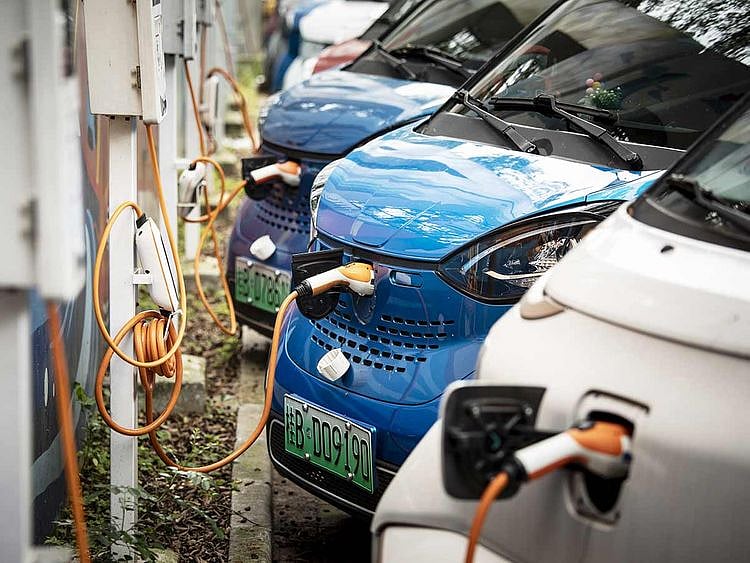
SAIC-GM-Wuling Automobile Co. electric vehicles (EVs) are plugged in at charging stations at a roadside parking lot in Liuzhou, China.
Bloomberg
If most drivers continue to charge their vehicles mostly at home overnight, the increase in electric car ownership could put a pressure on the power systems.
By 2035, it's predicted that 50% of drivers would be using electric vehicles. This makes daytime charging alternatives essential to help the western US power grid meet demand, according to a New Scientist report.
Power consumption models
This conclusion was reached using computer models to examine the impact that driver charging habits and the infrastructure for charging stations at home and in public may have on peak net electricity demand -- the highest electrical demand minus power from solar and wind sources.
Also Read
Uber plans to make 25% trips in UAE emission free by 2030Charge your EV in any of Dubai's 240 stations with QR codeVideo: Service Station of the Future opens at Dubai Expo 2020 siteWhen states reach 50% electric vehicle ownership, the peak net electricity demand could increase by 25% if drivers charge their cars mostly at home throughout the night.
“One of the big results from our study is that just making the shift of which charging infrastructure you build and where you encourage people to charge is a huge difference in the result for the grid,” New Scientist quoted Siobhan Powell as saying at the Swiss Federal Institute of Technology in Zurich, Switzerland. Powell led the research while at Stanford University in California.
Charging trends
In order to analyze charging trends from the actions of 27,700 electric vehicle drivers in the San Francisco Bay Area, Powell and her colleagues used computer simulation.
The models might anticipate the effects of an increased population of 48.6 million future electric vehicle owners on the western US power system, which supplies electricity to 11 states, including California.
According to Ram Rajagopal at Stanford University, the results also demonstrate how switching to daytime charging schedules could help the western US grid utilize its surplus solar electricity effectively.
Charging habits
Instead of forcing power grid operators to invest in greater energy storage to store daytime solar electricity for nighttime charging, daytime charging can use solar power when it is instantly accessible.
According to computer simulations, incentivising more drivers to charge during the day might cut the grid's energy storage needs by $700 million to $1.5 billion when compared to the status quo, when most drivers charge at home at night.
By 2035, 50% of personal vehicles becoming electric looks ambitious, according to Gil Tal from the University of California, Davis, who was not engaged in the study.
He said that as more people are working from home, some electric cars might be charged at home during the day, which could help to reduce some of the predicted spike in overnight charging demand.
However, he claims that overall the study's results are positive, indicating a future driven by renewable energy and transport.
Sign up for the Daily Briefing
Get the latest news and updates straight to your inbox
Network Links
GN StoreAbout Gulf NewsTerms & ConditionsReach by GNSitemapContact usPrivacy PolicyGN FocusHave your sayWork with usAdvertise with usGulf News epaperPrinting Services
Download our app
© Al Nisr Publishing LLC 2026. All rights reserved.