A BYD battery electric vehicle in the Philippines. As of March 2025, the country had 912 publicly accessible charging stations nationwide, mostly concentrated in Metro Manila. The Department of Energy targets 7,000 public charging stations by 2028, and millions of EVs on local roads.
EXPLAINER
Philippines EV charging snags: Red tape, patchwork rules despite surging demand — here's the way forward
Regulatory bottlenecks, uneven LGU rules, slow permitting drive investor reluctance
Last updated:
4 MIN READ
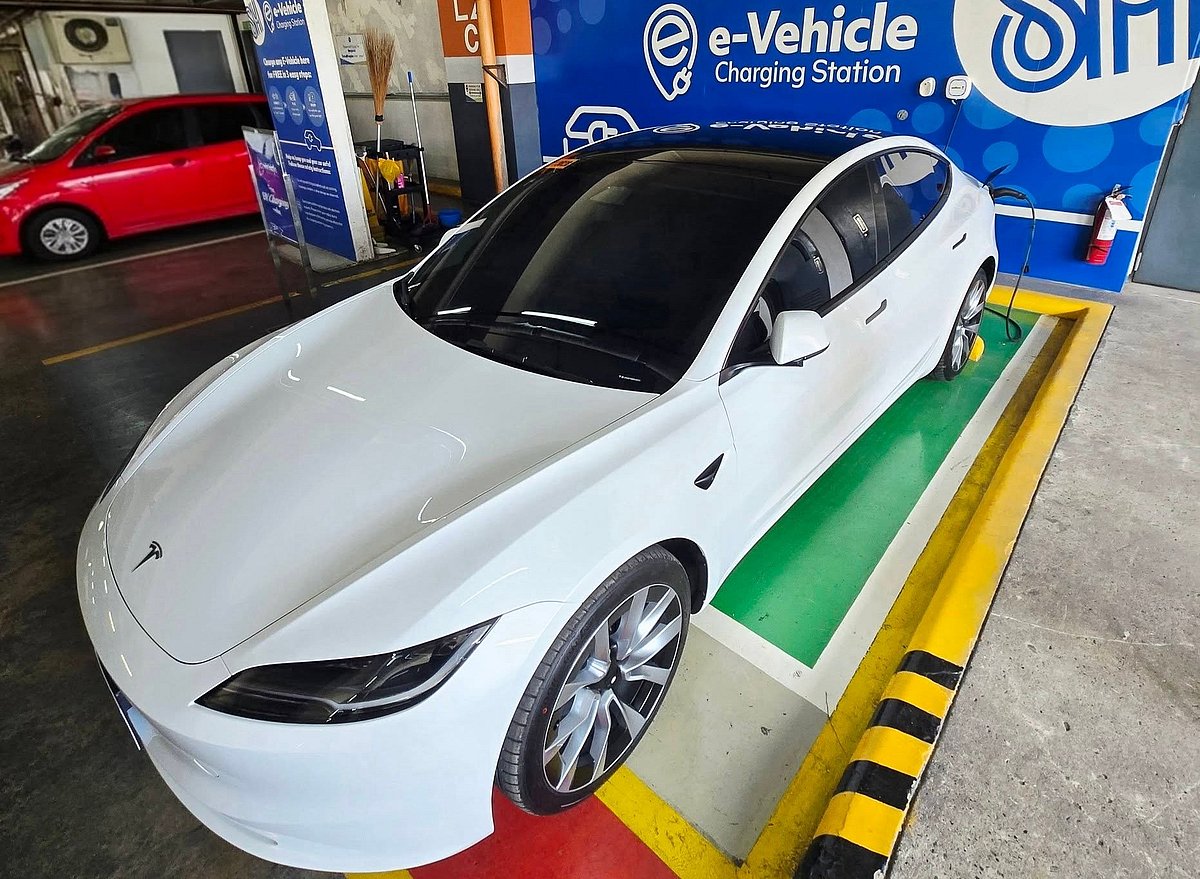
Filipino businessman Glenn Cuarto, a former OFW from the UAE, charges his Tesla Model 3 at a local mall (SM City Iligan, in Mindanao). Plug-in car sales have jumped 600% in February alone, before the Middle East war erupted.
Glen Graciel Sabangan Cuarto | FB
Manila: The rollout of electric vehicle (EV) charging stations in the Philippines has been slowed by a mix of regulatory bottlenecks, uneven local government rules, slow permitting, grid and safety concerns — fueling investor uncertainty despite strong EV sales growth.
Industry officials say demand for EVs is rising faster than the country’s charging infrastructure, exposing gaps in implementation of the Philippines’ landmark Electric Vehicle Industry Development Act or EVIDA (RA 11697).
While Vietnam zoomed ahead with electrification, the Philippines has propped up internal combustion engine (ICE) cars for decades.
Recently, President Ferdinand Marcos Jr. vetoed ₱92.5 billion in "unprogrammed appropriations" in the 2026 national budget, cancelling a government drive aimed at propping up ICE models like Vios and Mirage in exchange for local jobs.
The government then vowed to take money from the Department of Public Works and Highways (DPWH) to honour its previous commitments under the now-scrapped Revitalising the Automotive Industry for Competitiveness Enhancement (RACE) program and the Comprehensive Automotive Resurgence Strategy (CARS), covering mostly Japanese automakers.
Now, the Marcos team made a U-turn toward Electric Vehicle Incentive Strategy (EVIS), prioritising EV manufacturing over ICE.
EV charger: Electrical upgrade or building renovation?
One of the biggest complaints from EV companies is the lack of uniform rules among local government units (LGUs).
According to Vietnamese EV maker VinFast, different LGUs classify charging stations differently, leading to inconsistent permit requirements.
Some cities treat EV charger installation as a simple electrical upgrade, while others classify it as a building renovation requiring additional permits, inspections and clearances.
Antonio Zarra III, VinFast’s Southeast Asia CEO, explained that, depending on the city, even installing a charger in a parking lot can trigger multiple "layers" of approvals.
The result: a fragmented system
In practice, it means investors in EV charging networks must navigate different engineering, fire safety, zoning and business permit processes in every locality.
This creates uncertainty, increases costs, curbs expansion — and widens room for corruption.
VinFast had earlier announced plans to install around 15,000 chargers nationwide, but by May 2026 had rolled out only about 1,000.
Zarra contrasted that with Vietnam’s roughly 100,000 chargers and Indonesia’s nearly 3,000 VinFast charging stations.
Beyond paperwork
The issue goes beyond paperwork.
Charging station operators also face:
Slow accreditation and registration;
Varying electrical inspection standards;
Unclear interconnection rules with distribution utilities;
Delays in securing power capacity from utilities;
Uncertainty over technical standards for fast chargers;
High upfront capital costs;
Lack of suitable commercial spaces; and
Concerns over grid reliability outside major cities.
Slow investment in charging network
The Department of Energy (DOE) itself has acknowledged that EV charging investment had been “quite slow” in earlier years, with only a handful of providers initially completing registration requirements.
Another problem is that many EV users still rely primarily on home charging, masking weaknesses in the public charging network.
Industry groups such as the Asean Federation of Electric Vehicle Associations (AFEVA) say the current network is “adequate for now” largely because most EV owners make short trips and charge at home or in malls.
Forward planning
But they warn this may become unsustainable as EV adoption accelerates.
Some EV owners and online communities have also pointed to uneven charging access in condominiums and provincial cities, where building managers or local authorities may restrict installation of private wall chargers.
What the Department of Energy says
The DOE says it is trying to solve the problem through standardisation and streamlined regulations.
Energy officials have been drafting new implementing guidelines covering:
charger installation standards;
interoperability rules;
technical specifications;
obligations of charging station providers; and
mandatory charging infrastructure in certain establishments and gasoline stations.
DOE guidlines
The DOE’s proposed Implementing Guidelines on Obligations of EV Charging Station Providers and EVCS Requirements, Specifications and Interconnectivity (IG-ORSI) aim to create a more predictable national framework for charger deployment.
DOE officials have also said the Marcos administration’s declaration of a national energy emergency could help simplify permit processing and reduce red tape.
The agency has set ambitious targets: more than 7,000 charging stations by 2028, alongside broader goals for millions of EVs on Philippine roads.
The way forward
Where to go from here? Industry players say several solutions are needed simultaneously:
Nationally-standardised permitting
EV companies want uniform national rules so LGUs cannot impose conflicting requirements. Many are calling for a single permitting template coordinated by the DOE, the Department of the Interior and Local Government, and building regulators.
Faster approvals
Developers want fixed approval timelines similar to the government’s recent streamlining of rooftop solar and net-metering permits.
Expanded grid capacity
Charging operators say distribution utilities must prepare substations and transformers for growing EV loads, especially in fast-growing urban areas.
More private-sector incentives
Industry groups want tax breaks, subsidies and lower import duties for charging equipment to encourage investment. EVIDA already provides incentives, but companies say implementation must become faster and clearer.
Public-private partnerships
Officials and industry leaders increasingly favor partnerships with malls, gas stations, condominium developers and local governments to rapidly expand charger availability nationwide.
Clear safety standards
LGUs often justify stricter permits on safety grounds. The DOE says stronger technical standards and inspections can address those concerns without creating excessive delays.
The broader challenge for the Philippines is balancing rapid EV adoption with a regulatory system still adapting to new technologies.
While EV sales are rising amid high fuel prices and energy security concerns, infrastructure deployment has struggled to keep pace — leaving the country behind regional neighbors such as Vietnam and Indonesia in charger rollout.
Sign up for the Daily Briefing
Get the latest news and updates straight to your inbox
Network Links
GN StoreAbout Gulf NewsTerms & ConditionsReach by GNSitemapContact usPrivacy PolicyGN FocusHave your sayWork with usAdvertise with usGulf News epaperPrinting Services
Download our app
© Al Nisr Publishing LLC 2026. All rights reserved.