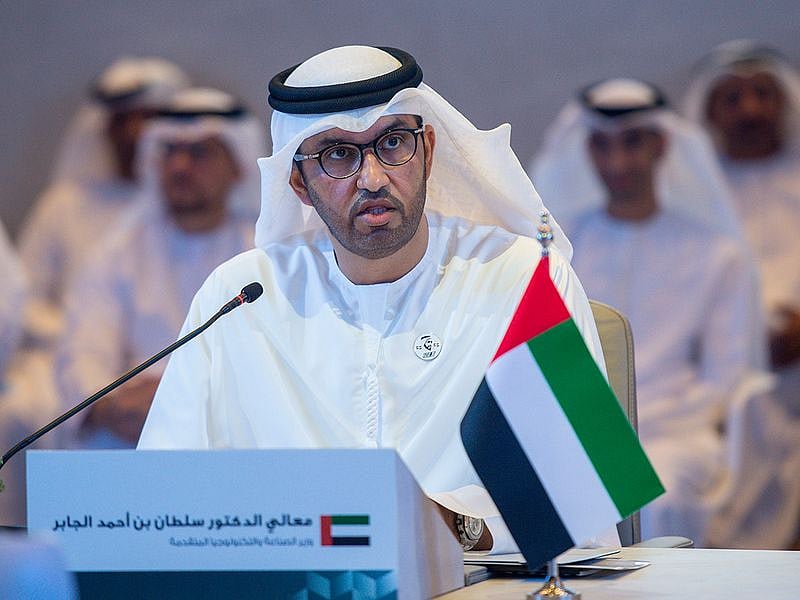
Dubai: Iran’s disruption of energy flows through the Strait of Hormuz amounts to “global economic extortion” that risks destabilising economies far beyond the Middle East, according to Dr Sultan Ahmed Al Jaber.
The UAE Minister of Industry and Advanced Technology, Managing Director and Group CEO of Abu Dhabi National Oil Company, Chairman of Masdar, and Executive Chairman of XRG made the remarks in a post on LinkedIn.
The effective closure of the strategic waterway is “a threat the world cannot tolerate,” he said, calling for coordinated international action. “The world must act — together — to protect the free flow of energy and safeguard economic stability,” Al Jaber wrote.
Get updated faster and for FREE: Download the Gulf News app now - simply click here.
Global chokepoint
The Strait of Hormuz, a narrow 33-kilometre shipping corridor between Iran and Oman, handles roughly one-fifth of global traded oil and gas supplies.
Disruptions in the passage have already begun to ripple through global markets:
Brent crude has risen about 42% since the conflict began
Energy price volatility has intensified amid uncertainty over the conflict’s duration
Supplies of key industrial inputs, including fertilisers and metals, have been affected
Oil prices eased slightly on Wednesday after Donald Trump indicated that US military involvement could wind down within weeks, though markets remain highly sensitive to developments.
‘Not just about oil’
Al Jaber warned that the consequences extend well beyond crude supply, framing the disruption as a broader cost-of-living shock.
“Iran’s actions in the 33km-wide Strait of Hormuz are not a regional issue,” he wrote on LinkedIn. “They represent global economic extortion — a threat the world cannot tolerate.”
He pointed to early signs of strain across Asian economies, including reduced working hours, fuel rationing, fewer flights and cuts to air conditioning usage due to energy shortages.
The impact is now spreading westward, with rising food and fuel prices feeding into inflation across Europe.
“Disrupting Hormuz hits food prices, air fares, energy bills, medicine costs and much more,” he said. “This is not about oil supply; it’s about everyday affordability for billions of people.”
Beyond energy
The waterway is also critical for non-oil commodities.
Around 50% of global sulphur supply transits through Hormuz, while roughly 30% of global liquefied petroleum gas (LPG) flows through the corridor.
Sulphur is widely used in fertiliser production and pharmaceuticals, while LPG remains essential for cooking fuel in many regions.
Disruptions to these flows risk amplifying pressure on global food production and household energy costs.
“When Hormuz flows, energy moves and economies grow. When it is disrupted, everyone pays,” Al Jaber said.
Escalating rhetoric
Al Jaber’s latest remarks build on earlier statements in which he accused Iran of “weaponising” energy flows and described the disruption as “economic terrorism” during remarks to the CERAWeek conference in Houston.
His comments come as global markets grapple with conflicting signals on the trajectory of the conflict, with investors weighing the possibility of a near-term de-escalation against ongoing risks to supply.
International action
Al Jaber urged adherence to international law to ensure the passage remains open, calling for enforcement of a United Nations Security Council resolution to guarantee free navigation through the strait.
The appeal underscores growing concern among energy producers and policymakers that prolonged disruption could deepen inflationary pressures and slow global growth.
With no resolution yet in place, the Strait of Hormuz remains central to both geopolitical tension and market volatility — a narrow passage with outsized influence on the global economy.

Sign up for the Daily Briefing
Get the latest news and updates straight to your inbox
Network Links
GN StoreDownload our app
© Al Nisr Publishing LLC 2026. All rights reserved.