Not just cars: BYD's battery-powered trucks are electrifying logistics & slashing carbon emissions. These haulers — packing max weight, over long trips — are prime for the EV revolution.
Ignore batteries at your own peril: Trucks, buses, cars, hydrofoils, ferries, tug boats, diggers, earth movers, harvesters
Electric vehicles revolutionise heavy-duty industries
Last updated:
4 MIN READ
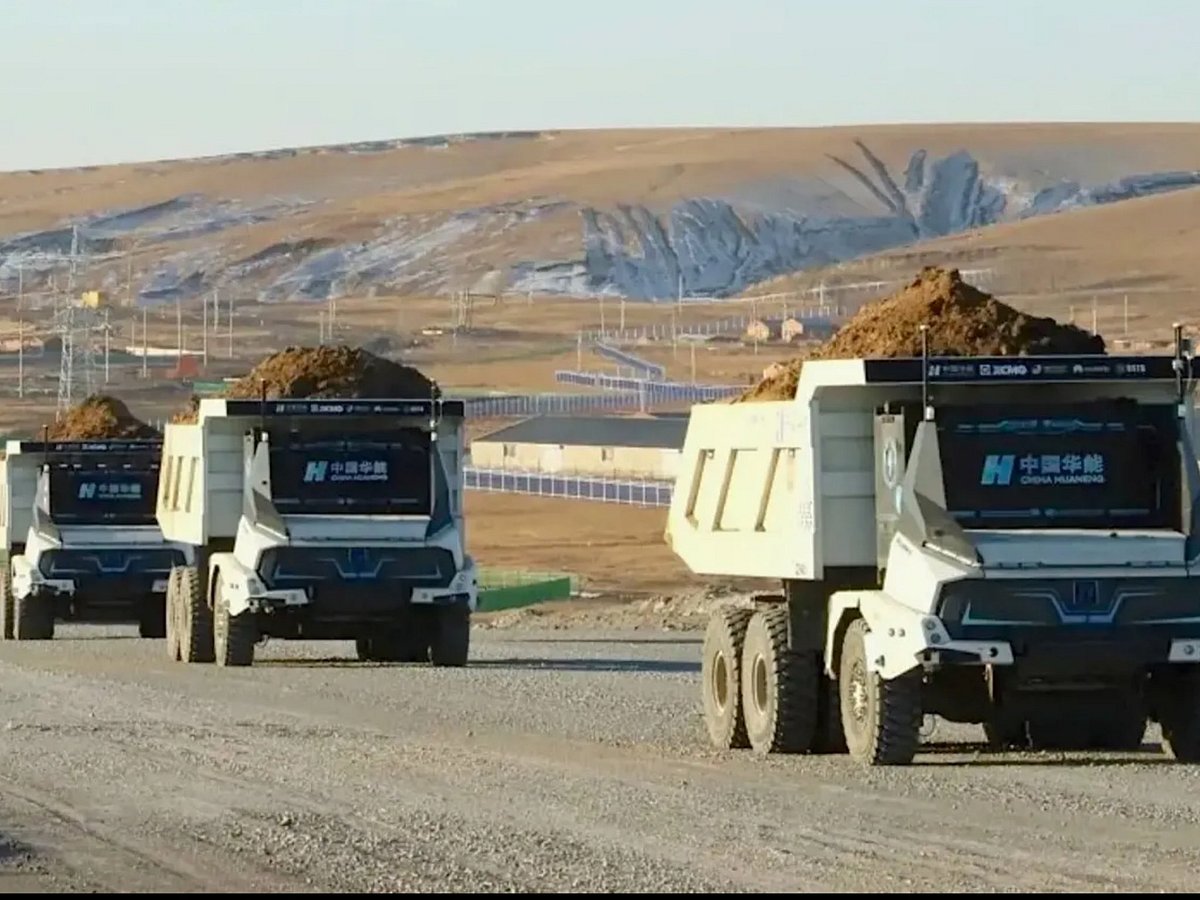
Many electric trucks in China are now driverless. Autonomous trucks are particularlly useful in mines and at closed factory sites. China sold "231,000" new energy heavy vehicles in 2025 - an increase of 182%, according to one report. This development is driven by government mandates and by the new battery swapping technology. It takes five minutes to swap batteries. Electric trucks are also substantially cheaper to run than diesel trucks.
X | @ErikSolheim
Batteries are rapidly becoming one of the most transformative technologies of the 21st century.
They sit at the heart of the global shift toward electrified transport, and more resilient power systems.
In a word: a game-changer.
At the most basic level, batteries solve a fundamental problem: energy supply doesn’t always match demand.
Solar panels only generate power when the sun shines, and wind turbines depend on weather conditions.
Long-duration energy storage (LDES), including pumped-storage hydrelectric power (PSH) store excess energy when it’s abundant and release it when needed, turning intermittent renewables into reliable power sources.
This ability alone is reshaping how electricity systems are designed and operated.
In land and marine transportation, batteries are driving the race.
By replacing internal combustion engines with electric drivetrains, they eliminate emissions, cut dependence on oil, and lower operating costs over time.
As battery technology makes dramatic improvements — in quick charging, cost, weight, and energy-density — EVs are becoming increasingly competitive with traditional vehicles.
Batteries also enhance energy security.
The upsides of the energy storage revolution are hard to ignore.
At its core, it is driven by explosive demand and rapid innovation. Global battery markets have surged past $150 billion, with deployment six time higher than in 2020, according to industry data.
While electric vehicles account for over 70% of demand, grid storage, and applications (like utility trucks) is rising fast.
Meanwhile, new technologies are emerging: Solid-state batteries (longer range, safer), while sodium-ion batteries (cheaper, abundant materials).
This is rapid innovation unseen in other energy-oriented industries. The result: batteries are becoming the backbone of everything from cars to power grids, to ports and AI data centres.
Countries that rely heavily on imported fossil fuels can reduce exposure to volatile global markets by pairing local renewable energy with storage.
This is especially important for island nations or regions with fragile grids, where stable power supply is critical for economic growth.
Beyond large-scale systems, batteries empower individuals and communities.
Solar with battery storage cut electricity bills and provide backup power during outages or high demand, replacing "peaker" plants powered by dinosaur juice.
This decentralisation shifts energy from a top-down model to a more flexible, distributed system.
Perhaps most importantly, batteries unlock new value across the entire energy ecosystem. They stabilise grids, reduce peak demand, and defer costly infrastructure upgrades.
Batteries are not just storage devices — they are enablers of a cleaner, smarter, and more resilient energy future.
As oil once again pushes past $100 (Murban is at $148/barrel, Brent at $112 as of March 22) — and with real risks of spiking higher amid the Hormuz drama — a familiar pattern is emerging.
Western automakers are pulling back from EVs just as the economics of electrification are becoming undeniable.
The result: a widening policy and industrial gap in which Western companies are steadily handing strategic advantage to Asia.
And while US President Donald Trump doubles down on “Drill, baby, drill,” China and its regional peers — from BYD to VinFast and Tata Motors — are accelerating a very different agenda: electrify, scale, dominate.
Asians (excluding the Japanese) be like: "Charge, baby, charge".
The parallels to Detroit after 1973 are hard to ignore.
Then, legacy players dismissed fuel-efficient Japanese cars.
Today, they risk repeating the same mistake with Chinese EVs — just as consumers begin turning away from internal combustion in a high-oil-price world.
With breakthroughs like 600-mile ranges and ultra-fast charging, the technology curve is no longer the constraint.
Policy is, and that's the heart of the problem.
The West leads in battery science, software, and autonomy — but innovation without deployment is a losing strategy.
Example: In China, electric trucks incredibly reached 29% of the market; Europe is still at 2%. China sold 231 000 new energy heavy vehicles in 2025 — a 182% jump.
While the "Five Eyes" effort on electric vertical take-off and landing (eVTOL) aircraft is a good model of collaboration in policy, collab in manufacturing, which requires sorting the underlying supply chains and skill sets needed, is even more critical.
Even the next-gen air taxis, following rigorous safety certification, need batteries, too. If battery supply chains starting from critical minerals needed to make them are blocked or limited, they cannot scale.
As the International Energy Agency (EIA) has warned, battery manufacturing and supply chains are rapidly concentrating in Asia.
Meanwhile, BloombergNEF data shows EV cost parity arriving faster than expected, and International Renewable Energy Agency (Irena) underscores that storage — not fossil fuels — will anchor future energy systems.
This is no longer just an auto industry story.
It is about who leads the transition to a higher-energy civilisation.
On the Kardashev Scale, progress is defined by how efficiently societies harness and store energy.
Ignore batteries — and you don’t just lose the EV race. You fall behind in the next stage of civilisation itself.
Sign up for the Daily Briefing
Get the latest news and updates straight to your inbox
Network Links
GN StoreAbout Gulf NewsTerms & ConditionsReach by GNSitemapContact usPrivacy PolicyGN FocusHave your sayWork with usAdvertise with usGulf News epaperPrinting Services
Download our app
© Al Nisr Publishing LLC 2026. All rights reserved.