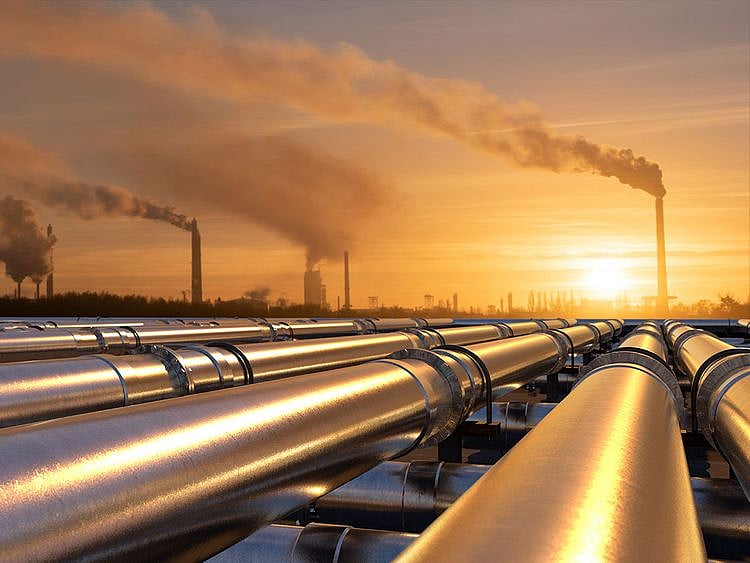
Dubai: Gulf countries are accelerating plans to move oil through routes that bypass the Strait of Hormuz, as international institutions warn that prolonged disruption to shipping through the vital waterway could threaten fuel security, economic growth and food supplies worldwide.
Get updated faster and for FREE: Download the Gulf News app now - simply click here.
Among the biggest beneficiaries of that shift is Fujairah, the UAE's east coast energy hub, which sits outside the Strait of Hormuz and has become increasingly important to Gulf export strategies.
Record depletion
The heads of the International Monetary Fund (IMF), World Bank and International Energy Agency (IEA) said on Friday that global oil inventories were being depleted at a record pace as markets responded to a major loss of supply moving through Hormuz.
"If shipping flows do not return to normal, continued rapid depletion of global oil inventories ahead of peak summer oil demand in the Northern Hemisphere would present increasing risks for fuel security, market conditions, and broader economic resilience," the agencies said in a joint statement.
The warning comes as Gulf producers increasingly look beyond Hormuz, seeking long-term alternatives to a shipping route that carries around one-fifth of the world's energy supplies.
"The biggest story is no longer oil supply itself but the race to reduce dependence on Hormuz," said Stephen Innes, managing partner at SPI Asset Management in Singapore.
Long-term strategy
The US-Israel war with Iran has transformed what was once viewed as a geopolitical risk into a direct challenge for global energy logistics.
Iran's retaliation against U.S. and allied interests has severely disrupted traffic through Hormuz, raising concerns about the reliability of one of the world's most important trade corridors.
While the strait remains open, the conflict has exposed the risks of concentrating such a large share of global oil exports through a single waterway.
Analysts say Gulf governments are increasingly treating that vulnerability as a long-term strategic problem rather than a temporary wartime disruption. "What started as a military conflict is rapidly evolving into an infrastructure story," Innes said.
Building a 'Plan B'
The UAE's Fujairah energy hub has emerged as a central part of those efforts.
Located on the country's east coast outside the Strait of Hormuz, Fujairah already serves as a major oil storage, bunkering and export centre and offers Gulf producers direct access to international markets without passing through the narrow shipping lane.
"The UAE's east coast energy hub sits outside the Strait of Hormuz, already functions as one of the world's most important bunkering and crude loading facilities, and represents one of the few strategic escape valves available to Gulf producers when Hormuz becomes compromised," Innes said.
Innes said the strategic importance of the hub has grown as Gulf producers seek to diversify export routes and reduce exposure to disruption in the strait.
"The UAE's existing Abu Dhabi-to-Fujairah pipeline has become one of the most strategically valuable pieces of energy infrastructure on the planet," he said.
Strategic vulnerability
Saudi Arabia's East-West Pipeline, which transports crude from the kingdom's eastern oil fields to terminals on the Red Sea, has also gained strategic importance.
Industry discussions increasingly focus on additional pipeline projects, expanded storage facilities in Oman and new routes for refined petroleum products.
For Gulf producers, the objective is straightforward: reduce reliance on a single export route that has become a recurring source of geopolitical risk.
"Long-term, every additional bypass pipeline reduces Iran's leverage," Innes said. "Short term, Hormuz remains the single most important geopolitical risk premium embedded in oil markets."
Oil flows hold up
Despite the disruption, energy exports have remained more resilient than many traders initially feared.
According to JPMorgan's emerging markets strategy team, vessel crossings through Hormuz have stabilised at around 25 daily transits in recent days, while exports remain stronger than expected given the level of regional tension.
Refined product and chemical tanker traffic has also recovered from earlier declines. Innes said the bank's data suggests actual energy flows may be more robust than publicly available ship-tracking information indicates.
"If vessels are increasingly crossing with AIS systems disabled or operating under modified routing procedures, traditional tracking methods may undercount actual traffic," he said.
Ships near Oman
AIS, or Automatic Identification System, allows ships to broadcast their location and movements. Bloomberg has reported that some commercial vessels are sailing closer to Oman's coastline and limiting electronic visibility during portions of their voyages.
The report also suggested U.S. military assets may be providing coordination and security support to commercial shipping without launching a formal escort operation.
"The U.S. appears to be running a quieter version of Project Freedom, supporting vessel movements without formally escorting tankers," Innes said.
Risks still rising
While oil-producing countries are investing in long-term solutions, the economic consequences of the conflict are already being felt across energy-importing nations.
The IMF, World Bank and IEA warned that higher energy prices are placing particular strain on lower-income economies, many of which rely heavily on imported fuel.
The agencies also highlighted growing concerns over fertilizer supplies, which have been disrupted alongside energy markets. "Higher fertilizer prices are of particular concern as many countries enter the planting season," they said.
Countries across South Asia and Southeast Asia, which depend heavily on oil and gas imports from the Gulf, are among the most exposed to prolonged disruptions. Higher fertilizer costs also threaten food production and food security in import-dependent nations.
Earlier this year, IMF Managing Director Kristalina Georgieva said the conflict had contributed to a downgrade in the global growth outlook and estimated that vulnerable economies could require between $20 billion and $50 billion in financial assistance to cope with the fallout.
This week, the IMF said Bangladesh had requested financial assistance and that discussions were underway on a support programme for the South Asian economy.
Hormuz still critical
The IMF, World Bank and IEA established a joint coordination group in April to respond to the economic effects of the conflict, particularly in vulnerable economies.
Yet even as governments and institutions respond to the immediate crisis, Gulf producers are preparing for a future in which Hormuz is no longer their only option.
New pipelines, storage facilities and export terminals will take years to build and require billions of dollars in investment.
Until then, the Strait of Hormuz remains indispensable to global energy markets. "The market is transitioning from a wartime trading story to an infrastructure investment story," Innes said. "Those themes can coexist for years."

Sign up for the Daily Briefing
Get the latest news and updates straight to your inbox
Network Links
GN StoreDownload our app
© Al Nisr Publishing LLC 2026. All rights reserved.