People stand in a queue at a filling station as they wait to fill their containers with gas in Karachi, Pakistan, Thursday, April 2, 2026.
Endless lines, empty wallets: World’s poorest nations buckle under $155 billion fuel burden
Amid pain of global fuel crunch, poor nations look for ways to slash import dependence
Last updated:
5 MIN READ
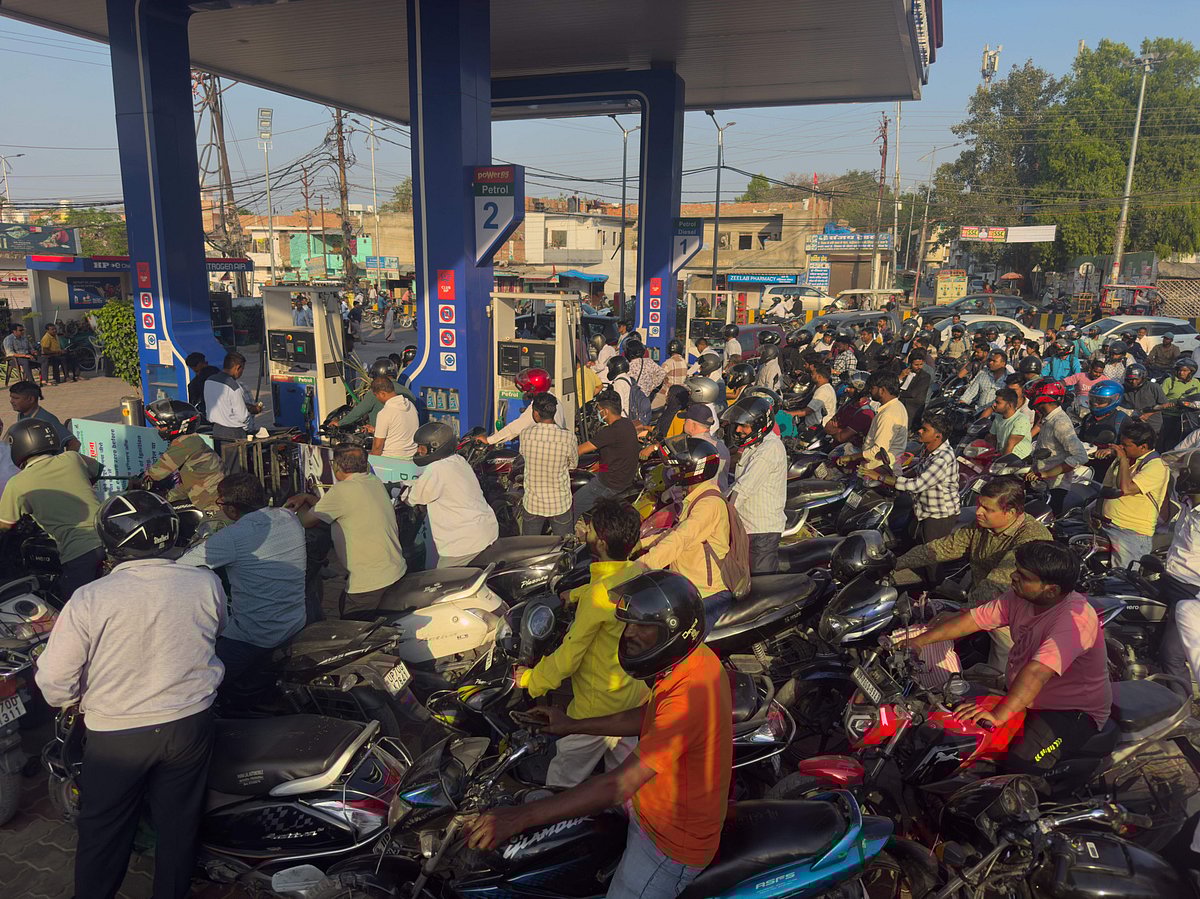
Commuters wait in long queues for fuel at a petrol station in Prayagraj, India, Thursday, March 26, 2026, amid fears of shortages following the escalation of the U.S.-Israel-Iran conflict. (AP Photo/Rajesh Kumar Singh)
AP
Amidst the global fuel crunch, a stark economic and humanitarian reality confronts the world's most vulnerable.
A relentless cascade: fuel prices spiraling, household budgets breaking, roads falling silent — and snaking queues at the pump growing longer by the hour.
"Poorest nations pay $155 billion/yr in fossil fuel imports," energy policy veteran John Raymond Hanger stated in an X post.
"A crushing burden, leaving 1 billion people with no or highly unreliable electricity," stated Hanger, a former Pennsylvania Department of Environmental Protection (DEP) Secretary, and longtime advocate for competitive energy markets and climate action.
An employee (C) pumps liquefied petroleum gas (LPG) into a customer's container at a fuel station in Phnom Penh on March 23, 2026.
"Fossil fuels failed them," claimed Hanger, also a former Public Utility Commission commissioner and longtime advocate for competitive energy markets and climate action.
A chart preparted by energy think-tank Ember illustrates the scale of the problem: "Climate Vulnerable Forum" (CVF) nations — 74 low- and lower-middle-income countries home to over 1.7 billion people — collectively spend more than $155 billion annually on fossil fuel imports.
Motorcyclists queue to refuel at a gas station operated by Pertamina, Indonesia’s state-owned oil and gas company, as the closure of the Strait of Hormuz by Iran disrupts energy flows and global oil prices rise, prompting Indonesia to consider a weekly work-from-home policy to cut fuel use, in Yogyakarta on March 28, 2026.
In 19 of these nations, those imports account for over 50% of the trade deficit. Countries like Tanzania (nearly 200% of trade deficit), Sri Lanka, Tunisia, Morocco, Pakistan, and Bangladesh bear the heaviest loads, according to an Ember reported released on April 1, 2026.
Kashmiri residents queue up at a fuel station in Srinagar, on Sunday.
Compelling case
The Ember report, titled "The Electric Fast-Track" for Emerging Markets, makes a compelling case that these nations are uniquely positioned to bypass the traditional fossil fuel path entirely.
Produced in partnership with the CVF and V20 Finance Ministers, the analysis argues that rapidly falling costs in "electrotech" — solar power, battery storage, electric vehicles, and related technologies — enable a direct jump from biomass reliance to modern electricity.
India has tax buffer to avoid retail fuel price hike up to $110 a barrel: Report.
Crushing cost of fossil dependence
CVF countries, which represent about one-fifth of the global population but less than 5% of global GDP and electricity demand, are overwhelmingly net fossil fuel importers located in the sunbelt.
In 2024, their collective import bill hit $155 billion. A prolonged Middle East conflict pushing oil to $100 per barrel could inflate that figure by another $30 billion or more by 2026. ember-energy.org
Pakistan increases price of kerosene, light diesel oil (File image)
700 million still lack electricity access
The human toll is even more severe.
Roughly 700 million people worldwide lack any electricity access: CVF nations account for about two-thirds of that number, with around 500 million in Africa alone still unconnected.
Another 500 million endure frequent blackouts, as per Ember data.
Commuters wait in long queues for fuel at a petrol station in Prayagraj, India, Thursday, March 26, 2026, amid fears of shortages following the escalation of the U.S.-Israel-Iran conflict. (AP Photo/Rajesh Kumar Singh)
Electricity meets just 16% of final energy demand in these countries, and per-capita consumption in low-income CVF nations has actually declined since 2010.
Hundreds of millions still rely on biomass for cooking and heating, contributing to 2.9 million premature deaths annually from indoor air pollution.
Motorcyclists queue to refuel at a gas station operated by Pertamina, Indonesia’s state-owned oil and gas company, as the closure of the Strait of Hormuz by Iran disrupts energy flows and global oil prices rise, prompting Indonesia to consider a weekly work-from-home policy to cut fuel use, in Yogyakarta on March 28, 2026.
How 'electrotech' changes the game
Ember's core argument is that electrotech isn't just cleaner—it's now economically superior and better suited to the fragmented, low-capital realities of emerging markets.
Solar power, for instance, now requires less upfront capital than fossil fuel plants, a complete reversal from a decade ago when it cost up to five times more. Batteries are cheaper than extending transmission lines for remote communities.
Motorists queue to pump gasoline into their vehicle at a gas station in Hanoi on March 10, 2026.
Electric two-wheelers, cooling systems, and appliances have dropped 30–95% in price over the past 10 years.
More than 95 countries have reported oil price increases since the start of the on-going Middle East war. Photo shows a scene at petrol pump in the Philippines taken on March 30, 2026.
The leapfrogging is already happening
Nearly half of CVF nations (measured by electricity demand) have surpassed the United States in solar penetration.
Countries like Namibia generate 35% of their power from solar; Togo reaches 18%.
EV adoption is surging in Nepal (70% of two-wheelers) and Sri Lanka (64%).
Between 2020 and 2025, CVF nations imported 138 GW of solar panels from China — enough to generate 218 TWh of electricity annually and displace $20 billion in LNG or $42 billion in diesel imports.
Consumer prices rise 2.2% in South Korea on surging oil prices.
Leapfrogging fossil fuels, into renewables
Unlike the centralised, capital-intensive fossil infrastructure built in wealthier nations over the past century, electrotech scales incrementally and bottom-up.
A household can start with a single solar panel and light, then expand as incomes grow — mirroring how mobile phones bypassed fixed-line infrastructure in the developing world.
Bangladeshis queue at a gas station in Dhaka after government has increased fuel prices on August 5, 2022.
Economic and geopolitical upside
The report outlines a virtuous cycle: reliable electricity boosts productivity in schools, hospitals, and factories; cuts import dependency and exposure to global price shocks.
And it frees up fiscal resources for development.
CVF nations also hold "leverage" through critical minerals (such as cobalt in the Democratic Republic of Congo), strategic manufacturing locations, and massive consumer markets as the US, China, and Europe compete for supply chains.
Commuters wait in long queues for fuel at a petrol station in Prayagraj, India, Thursday, March 26, 2026, amid fears of shortages following the escalation of the U.S.-Israel-Iran conflict. (AP Photo/Rajesh Kumar Singh) (Photo: AP)
Building ecosystems
Ember urges deliberate policy action — industrial strategies like Vietnam's electronics push or Morocco's battery materials hub — to capture value rather than simply importing hardware.
It also stresses the need to address maintenance gaps and build local repair ecosystems to sustain the transition.
A volunteer directs vehicles and manages queues at a petrol station during a fuel shortage in Addis Ababa on March 27, 2026.
A third way forward
Hanger's tweet and the Ember analysis present electrotech not as an environmental imperative alone, but as a pragmatic development strategy.
For nations long trapped in energy poverty, the data suggests the fossil fuel era was never the necessary stepping stone it appeared to be for richer economies.
Instead, these countries stand at the frontier of a faster, cheaper, and more sovereign path to prosperity.
Cars queue to refuel at a gas station operated by Pertamina, Indonesia’s state-owned oil and gas company, as the closure of the Strait of Hormuz by Iran disrupts energy flows and global oil prices rise, prompting Indonesia to consider a weekly work-from-home policy to cut fuel use, in Yogyakarta on March 28, 2026.
Whether the rest of the world — and its chorus of skeptics — will embrace this “fast-track” remains an open question.
But the direction of journey is unmistakable.
The old model has already failed millions, while a new, electric pathway is beginning to prove — quietly but decisively — that it can deliver.
And for now, the contrast is stark: as the future accelerates elsewhere, millions still wind through serpentine fuel lines, waiting just to keep life moving.
Sign up for the Daily Briefing
Get the latest news and updates straight to your inbox
Network Links
GN StoreAbout Gulf NewsTerms & ConditionsReach by GNSitemapContact usPrivacy PolicyGN FocusHave your sayWork with usAdvertise with usGulf News epaperPrinting Services
Download our app
© Al Nisr Publishing LLC 2026. All rights reserved.