How India overtook Japan as world’s 4th-largest economy: What is the ‘Goldilocks’ phase
Robust domestic demand, urban consumption cushion subcontinent against global headwinds
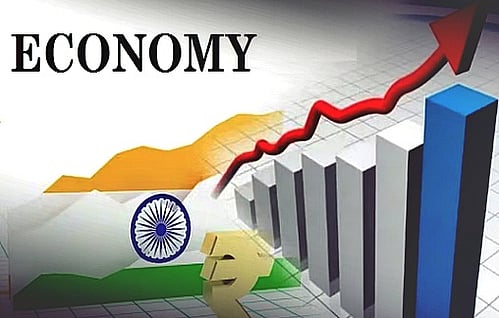
India has surged past Japan to become the world's fourth-largest economy at $4.18 trillion, positioning itself to eclipse Germany for the third spot by 2030, according to a government release.
Highlighting on-going reforms, New Delhi has cited India’s rapid, domestically-driven growth, strong consumption, structural reforms, and favourable demographics as major economic drivers, entering the so-called "Goldilocks" phase of economic dynamism.
The news came in late 2025 and Japan briefly slipped behind Germany earlier, with India now on track to potentially surpass Germany by 2030, becoming #3.
Growth amid global headwinds
India’s economic surge past Japan comes amidst tariff uncertainties amid US President Donald Trump’s recent moves, even as US House Democrats passed a resolution to terminate the 50% tariff on imports from India, which they describe as “illegal” and “economically damaging”.
With blistering growth, India claims the title of the fastest-expanding major economy.
Real GDP jumped 8.2% in Q2 of 2025-26 — up from 7.8% in Q1 and 7.4% in the prior fiscal's Q4 — defying global trade turbulence through resilient domestic drivers like surging private consumption.
Key drivers driven by strong domestic demand and resilient urban consumption. Inflation remains contained below RBI's tolerance band — dipping to record lows like 0.25% in October — enabling rate cuts and supportive financial conditions with healthy business credit.
"With GDP valued at $4.18 trillion, India has surpassed Japan to become the world's fourth-largest economy, and is poised to displace Germany from the third rank in the next 2.5 to 3 years with a projected GDP of $7.3 trillion by 2030,” the government release states.
The US leads globally, followed by China and Germany.
Bullish forecasts
Global forecasters are bullish: World Bank eyes 6.5% growth in 2026; Moody's pegs India as G20 pacesetter at 6.4% next year and 6.5% in 2027.
IMF upgraded to 6.6% for 2025 and 6.2% in 2026; OECD forecasts 6.7% in 2025 and 6.2% in 2026.
S&P sees 6.5% in 2025 and 6.7% in 2026.
The Manila-based Asian Development Bank (ADB) reckons India’s economy will hit 7.2% in 2025; while Fitch lifted FY26 to 7.4% on consumer strength.
"India is among the world's fastest-growing major economies and is well-positioned to sustain this momentum. With the ambition of attaining high middle-income status by 2047- the centenary year of its independence, the country is building on strong foundations of economic growth, structural reforms, and social progress," the government affirmed.
Economic fuel
India’s growth is fuelled by a potent mix of high-octane GDP growth exceeding 8% in recent FY 2025-26 quarters, making it the fastest among major players.
Robust domestic demand, powered by urban private consumption, cushions it against global headwinds, while supportive financials — healthy business credit and tame inflation — create a rare “Goldilocks” phase, as per the Times of India.
This ascent draws strength from India's demographic dividend: a vast, youthful workforce contrasting Japan's aging population, providing both labour and market muscle.
Ongoing reforms, including digital powerhouses like UPI and import substitution, cement self-reliance and efficiency, helps propel the nation forward, the BBC cited.
Key factors for India’s rise
High GDP Growth: India is the world's fastest-growing major economy, with its GDP expanding over 8% in recent quarters of FY 2025-26.
Strong Domestic Demand: Robust private consumption, especially in urban areas, is a major driver, even amidst global uncertainties.
Supportive Financials: Healthy credit growth to businesses and contained inflation create a "Goldilocks" environment, as noted by the Times of India.
Demographic Dividend: India's large, young population provides a strong workforce and market, contrasting with Japan's aging demographics, say sources like ABP Live.
Ongoing Reforms: Structural reforms, digital initiatives (like the UPI payment system), and import substitution policies build self-reliance and efficiency, notes the BBC.
Japan's context
Aging population & weak yen: Japan's economy is hampered by an aging, shrinking populace and a weak currency, leading to slower growth and higher debt, as reported by The Guardian.
The bigger picture
This shift reflects Asia's growing economic influence, with India poised to potentially overtake Germany for the third spot by 2030.
Sign up for the Daily Briefing
Get the latest news and updates straight to your inbox
Network Links
GN StoreDownload our app
© Al Nisr Publishing LLC 2026. All rights reserved.