Derailed Europe can learn lessons from Asia's speedy recovery
Can offer examples in worker attitudes and work practices
Dubai: Recession-derailed Europe can get back on track by looking to the speedy recovery of Asia as its economic muse and engaging with firms in emerging economies to expand its markets and cut costs, according to a recent survey of European chief executives.
Encouraging technological innovation and restoring consumer confidence in the single market were among the top remedies recommended by business leaders.
The European bloc is the second largest contributor to the UAE's foreign trade with 25.5 per cent between 2005 and 2009, according to a July study by the Ministry of Foreign Trade.
With non-oil foreign trade contributing 73 per cent of GDP, the UAE is interlinked with the world economies through its numerous commercial ties, it added.
A survey of 250 CEOs of large and small companies in Europe titled Putting Europe Back on Track was carried out by global management consulting firm Accenture and graduate business school INSEAD.
With Asia recovering from the crisis more quickly than Europe in the past two years, there a few lessons that Europe can learn from Asia, the survey suggested.
Last May the European Commission forecast GDP growth in Europe would average a modest one per cent this year.
By comparison, Asia is leading the global economic recovery as business activity continued to rebound swiftly in 2009 and the first quarter of 2010, according to the International Monetary Fund in its Regional Economic Outlook for Asia and Pacific in April .
Mindset
By the end of 2009, output in most of Asia returned to its pre-crisis levels — even in those economies hit hardest by the crisis, it said.
Little surprise then that the greatest consensus among CEOs in the survey is that the Asia/Pacific region would emerge the strongest market from the recession.
"When you go to Asia, there is a mindset — a hunger for success. There isn't the slightest element of complacency or satisfaction with where they are. There is continuous ambition," said one CEO in the survey's in-depth interviews.
European business leaders said the main strengths of emerging economies are their entrepreneurial spirit, lack of complacency, and innovations that draw on new technologies to develop sustainable solutions for everyone, the survey said.
They believe the more European firms engage with companies in emerging economies, the more likely they are to combat these comebacks.
A quarter of CEOs believe that building relations with emerging economies to expand markets and cut costs is one of the first means to put Europe back on track. Asia can offer Europe lessons in strategy, partnership, worker attitudes and work practices, CEOs said.
For instance, many European business leaders saw China's economic strength as admirable. However, many saw the looming Chinese economic giant as a threat. One respondent pointed to Chinese firms' quick brand development, marketing, and sustainable strategy of innovation and creativity.
Getting back on track also requires resorting to the old cliche of thinking outside the box.
Innovation was named a priority by 62 per cent of large firms and 67 per cent of small and medium businesses.
European business leaders said clusters and innovation strategies would make the EU a leading innovation economy.
Almost half the CEOs said labour market flexibility was a high priority for putting Europe back on track.
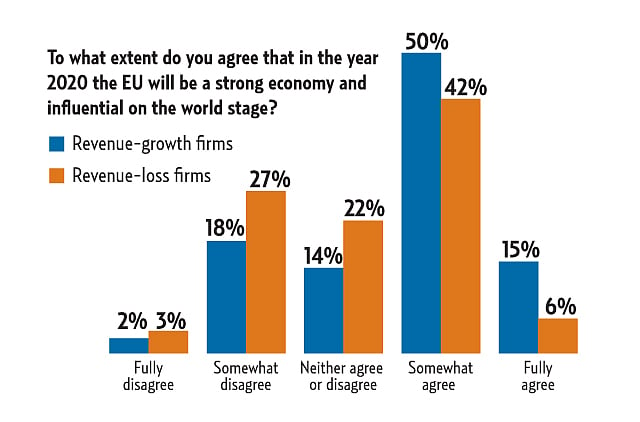
Despite its currency woes, Europe's business leaders, including those of companies hit hardest by the recession, were optimistic about Europe's future.
The majority of CEOs believed that Europe "will be a strong economy, recognised and influential on the world stage."
Role to play in recovery
Small and medium enterprises (SMEs) play a major role in putting Europe on the road to economic recovery and fighting the problem of unemployment, the majority of chief executives said in the survey.
A whopping 95 per cent of CEOs considered it important to take action to encourage and support the growth of SMEs. But there is red tape tripping up small business entrepreneurs along the way.
The biggest barrier to SME growth is bureaucracy, according to 71 per cent of the CEOs surveyed. This is followed by a lack of access to credit and a lack of flexibility in the labour market.
SMEs make up 99 per cent of all companies in the EU and provide two out of three jobs in Europe. With the 20 million currently unemployed, there is a major role for SMEs to fill.
Public and private sector leaders need to be more active in implementing the principles of Europe's Small Business Act, the survey noted. This includes creating an environment in which entrepreneurship is rewarded.
"If you ask Chinese and Indian people ‘what is your desired type of job' on average you get 70 to 80 per cent who respond that they would like to build a company. If you ask Europeans the same questions, you're moving down to somewhere between eight to a maximum of 20 per cent who want to start their own business," said one respondent.
The survey also recommends adapting public policy tools to SMEs' needs, giving them access to finance, developing a legal environment that supports timely payment in commercial transactions, and promoting skills upgrades and innovations in all forms.
Giving SMEs a helping hand, 31 per cent of CEOs said big businesses are supporting SMEs by paying them promptly. Another 18 per cent said they have supply policies that encourage them to use SMEs and 17 per cent said they provide mentoring and coach leaders.
Sign up for the Daily Briefing
Get the latest news and updates straight to your inbox
Network Links
GN StoreDownload our app
© Al Nisr Publishing LLC 2026. All rights reserved.