Iranian rial in free-fall: How future looks for the currency, economy
Inflation above 42% and weak growth push economists to assess Iran’s battered rial outlook
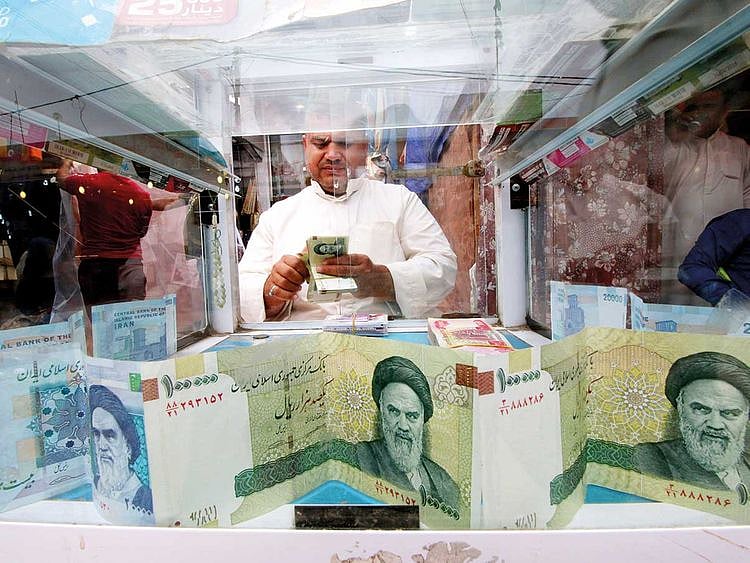
Dubai: Iran’s currency, the rial, has been in free-fall, crashing to a historic low of 1.4 million per US dollar on the open market. This rapid decline is not just a financial statistic; it marks a critical turning point for the nation’s economy.
The latest slide follows another year of sharp depreciation. Market trackers estimate the rial lost about 45% of its value in 2025 alone, extending a long-term collapse that has steadily eroded purchasing power, savings and confidence in the domestic financial system.
Annual inflation reached 42.2% in December, according to official figures, locking in one of the highest inflation rates globally. Prices for food, housing and imported goods have continued to climb, intensifying pressure on households and businesses.
For economists, the currency’s trajectory now hinges on whether Iran can stabilise inflation, secure reliable foreign exchange inflows and restore some measure of trust in monetary management.
Currency resets lower
At the time of Iran’s 1979 revolution, the dollar traded at about 70 rials. More than four decades later, the exchange rate has breached 1.4 million, meaning the rial has lost roughly 20,000 times its value.
The pace of decline has not been linear. Periods of relative calm have been punctuated by sharp sell-offs, often when inflation accelerates or access to foreign currency tightens.
The most recent slump reflects a familiar pattern. As prices rise, households and companies move savings into dollars, gold or property to protect value. That demand drains liquidity from the rial, pushing the exchange rate lower and feeding back into higher import costs.
Unless inflation eases materially, economists say the pressure on the currency is likely to persist.
Inflation as central driver
Inflation remains the core variable shaping the rial’s outlook.
The International Monetary Fund estimates consumer price growth averaged around 42% in 2025, up from about 33% the year before. Food, rent, transport and healthcare have all recorded double-digit increases.
Such inflation differentials with trading partners mechanically weaken the currency over time. As domestic prices rise faster than those abroad, more rials are needed to buy the same foreign goods, embedding depreciation into everyday transactions.
For import-dependent sectors, the feedback loop is immediate. Iran sources large volumes of wheat, cooking oil, animal feed and pharmaceutical ingredients from overseas. A weaker rial pushes up costs for importers, who raise prices to protect margins.
That dynamic complicates efforts to stabilise the exchange rate without first breaking inflationary momentum.
Fragile growth outlook
Iran’s economic growth prospects offer limited near-term support for the currency.
The World Bank projects GDP could contract by 1.7% in 2025 and a further 2.8% in 2026, citing constrained trade, weak investment and pressure on public finances.
Oil exports remain the state’s main source of foreign exchange. Yet revenue fluctuates with global prices and the discounts applied to Iranian crude sold through non-traditional channels.
Brent crude averaged around $60 a barrel last year, well below the level economists say Iran needs to balance its budget. Lower receipts restrict the government’s ability to intervene in currency markets or boost imports that could help ease domestic shortages.
Without stronger export income or alternative inflows, foreign currency supply is expected to remain tight.
Obstacles to stability
Beyond short-term factors, analysts point to deep structural issues that cloud the rial’s medium-term outlook.
State-dominated industries, limited foreign investment, ageing infrastructure and chronic water shortages have weighed on productivity and non-oil exports. Manufacturing and agriculture struggle to generate the hard currency needed to diversify inflows.
The exchange rate regime itself adds complexity. Iran operates a multi-tier system, with subsidised rates for certain essential imports alongside the open market.
While designed to shield consumers, economists say the system distorts pricing, encourages arbitrage and undermines confidence in official rates. Businesses often default to the open market as the true signal of value, reinforcing volatility.
Reforming this structure would be politically and socially sensitive, yet without changes, the gap between official and market pricing is likely to persist.
What could alter trajectory
For the rial to stabilise meaningfully, economists say several conditions would need to converge.
Sustained disinflation would be central, requiring tighter control over liquidity growth and more predictable fiscal management. That could slow the steady erosion of purchasing power that drives dollar demand.
Improved foreign currency inflows would also be critical. That could come from higher oil revenues, growth in non-oil exports, or renewed foreign investment that brings both capital and technology.
Confidence effects matter too. Households and businesses that believe the exchange rate has found a floor are less likely to rush into dollars at the first sign of price increases.
Absent such shifts, most analysts expect the rial to remain under downward pressure, with periodic stabilisation efforts offering only temporary relief.
For now, the new record low reinforces a reality Iranians have lived with for years: the currency remains a barometer of deeper economic strains, and its future path will depend less on short-term market moves than on whether those underlying conditions begin to change.
- With input from Agencies

Sign up for the Daily Briefing
Get the latest news and updates straight to your inbox
Network Links
GN StoreDownload our app
© Al Nisr Publishing LLC 2026. All rights reserved.