Goldman denies 'betting against clients'
Bank issues eight-page letter to shareholders justifying its conduct before, during and after the financial crisis
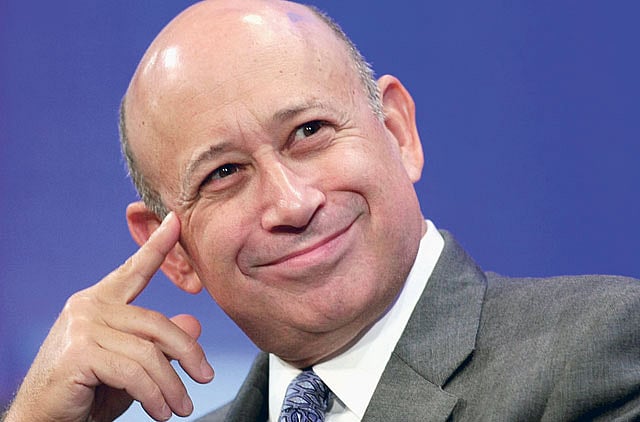
New York: Nine months after being labelled "a great vampire squid wrapped around the face of humanity", Goldman Sachs has issued a wide-ranging justification of its conduct before, during and after the financial crisis.
In a letter to shareholders issued alongside Goldman's 2009 annual report, the Wall Street bank denied that it "bet against its clients" when it changed its position in the housing market in 2007, shortly before prices began to collapse.
The eight-page letter, signed by chief executive Lloyd Blankfein and president Gary Cohn, also contained a detailed defence of the $12.9 billion (Dh47 billion) payout which Goldman received from American International Group (AIG) after the failed insurance giant was bailed out by the US government.
The letter appears to be a detailed response to some of the allegations made nine months ago by Rolling Stone journalist Matt Taibbi. His article, which argued that Goldman had repeatedly profited by inflating unsustainable fin-ancial bubbles, received widespread coverage. It included the claim that the company was "a great vampire squid wrapped around the face of humanity, relentlessly jamming its blood funnel into anything that smells like money".
One of Taibbi's key charges was that Goldman had helped to fuel the housing boom during the last decade by packaging hundreds of millions of dollars worth of housing loans into complicated financial products such as collateralised debt obligations (CDOs). These CDOs were sold on to other banks and investors such as pension funds, who suffered big losses when the sub-prime housing bubble burst. Goldman, though, actually profited from the fiasco by short-selling the market before the credit crunch struck in summer 2007.
In the letter Blankfein and Cohn attempt to rebut this charge. They admit that Goldman "went short" in the housing market while simultaneously continuing to trade mortgage-backed securities to its clients. They deny, though, that this was wrong, arguing that various sophisticated investors simply took differing views.
"We certainly did not know the future of the residential housing market in the first half of 2007 any more than we can predict the future of markets today. We also did not know whether the value of the instruments we sold would increase or decrease.."
"Although Goldman Sachs held various positions in residential mortgage-related products in 2007, our short positions were not a ‘bet against our clients'. Rather, they served to offset our long positions. Our goal was, and is, to be in a position to make markets for our clients while managing our risk within prescribed limits."
Goldman was the biggest beneficiary from the US government's bailout of AIG in autumn 2008. Goldman claimed at the time its exposure to AIG was "immaterial", but in March 2009 it emerged it actually received $12.9 billion of the $44 billion handed to various counterparties who had taken out insurance contracts with AIG.
The letter lays out in some detail why Goldman received so much from the collapse of AIG. They said $4.8 billion of the money was paid in return for securities which could otherwise have been sold for the same price, while $2.5 billion covered existing debts owed because of the deteriorating market.
Another $5.8 billion was handed over to settle credit default swaps, or insurance contracts, on the CDOs that had helped to create the crisis.
Sign up for the Daily Briefing
Get the latest news and updates straight to your inbox
Network Links
GN StoreDownload our app
© Al Nisr Publishing LLC 2026. All rights reserved.