What really happens to your suitcase after airport check-in? Inside the hidden world of baggage handling
Connecting flights accounted for 39 per cent of baggage mishandling cases in 2025
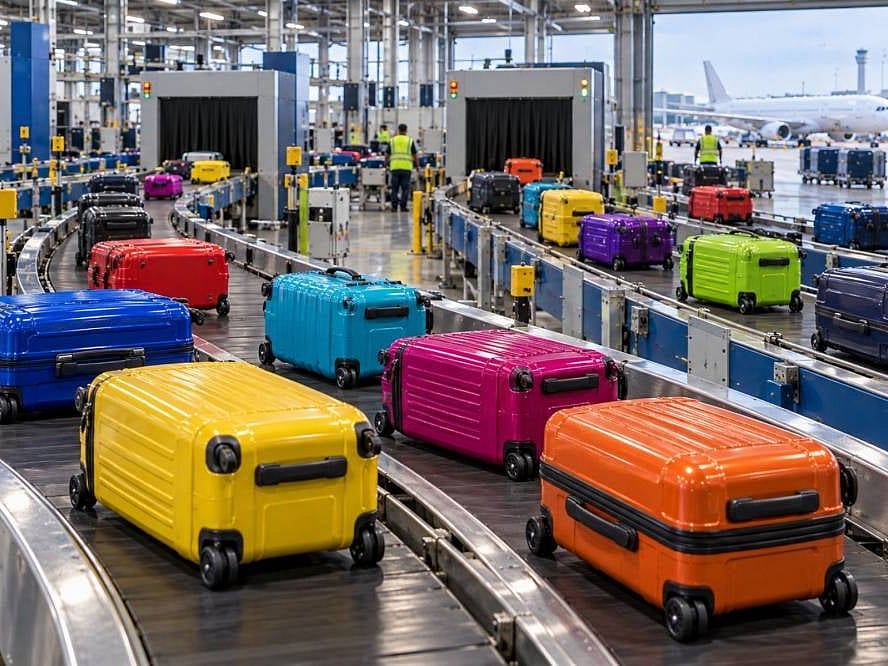
Dubai: Once a suitcase disappears behind an airport check-in counter, it begins a journey through an elaborate network of conveyor belts, security scanners and automated sorting systems before baggage handlers load it into the hold of an aircraft.
Yet despite advances in aviation technology, getting luggage to the right destination remains a major logistical challenge. Nearly 24 million bags were lost, delayed or misdirected in 2025, according to figures from aviation technology company SITA.
Get updated faster and for FREE: Download the Gulf News app now - simply click here.
Behind those figures lies a complex operation involving thousands of machines, multiple computer systems and airport workers operating under tight deadlines.
A 10-digit code that determines a bag’s journey
The journey begins at check-in, when a baggage tag carrying a unique 10-digit identification number is attached to the suitcase.
The tag links the bag to flight details, its final destination and any connecting flights through electronic messages exchanged between airlines and airport systems.
Once checked in, the suitcase enters a network of conveyor belts running through the airport, where laser scanners and cameras read its tag and determine where it needs to go next.
Security checks before boarding
Before reaching the aircraft, luggage undergoes security screening using advanced X-ray equipment capable of producing three-dimensional images of its contents to detect potentially dangerous materials and explosives.
If further inspection is required, the images are referred to security personnel. Bags may be removed from the system and opened under camera surveillance if the contents cannot be cleared electronically.
Once cleared, the luggage passes through automated sorting systems that direct each bag to the collection area assigned to its flight.
From conveyor belts to baggage handlers
Airport workers then load the suitcases onto baggage carts or into specialised containers used on larger aircraft. Each bag is electronically scanned to confirm that it is being loaded onto the correct flight.
Specialised vehicles transport the luggage across the airport apron, where mobile conveyor belts or container loaders are used to move it into the aircraft’s hold.
This is one of the most time-sensitive stages of the operation, with baggage handlers working to complete loading before departure and ensure compliance with baggage reconciliation procedures.
Connecting flights: Where things often go wrong
The risk of luggage being delayed or lost increases when passengers have connecting flights. Bags must be unloaded from the first aircraft, returned to the airport’s sorting system and redirected to another flight, sometimes within an hour.
According to SITA, baggage transfers accounted for 39 per cent of all mishandling incidents in 2025, down from 41 per cent the previous year.
Multiple handling stages, differences between airline operating systems and tight connection times can complicate the process.
Denver airport’s costly technological failure
The experience of Denver International Airport in the United States illustrates the challenges of automating baggage handling.
In 1994, the airport tested an ambitious automated baggage system designed to transport luggage through an underground network of carts and tracks with minimal human intervention.
Testing exposed serious operational problems. Carts derailed, suitcases were damaged and luggage was delivered to the wrong destinations.
Problems with the system contributed to a 16-month delay in the airport’s opening. United Airlines eventually abandoned the technology in September 2005, returning to conventional baggage handling methods.
A $6.3 billion annual problem
Despite significant improvements in baggage handling, lost, delayed and damaged luggage continues to cost the aviation industry billions of dollars.
SITA’s 2026 Baggage IT Insights report found that the baggage mishandling rate fell by 23 per cent in 2025, even with global passenger numbers reaching approximately five billion.
Nevertheless, baggage mishandling costs the industry an estimated $6.3 billion annually, averaging $260 for each affected bag.
Delayed luggage accounts for about 70 per cent of the total cost, largely because of expenses associated with locating, rerouting and delivering bags to passengers.
How technology is helping airlines recover missing luggage
Airlines and airports are increasingly adopting electronic tracking technologies to monitor luggage throughout its journey.
Resolution 753, introduced by the International Air Transport Association (IATA), requires member airlines to track baggage at four key stages: acceptance at check-in, loading onto the aircraft, transfers between flights and arrival at the destination.
Airports are also adopting radio-frequency identification (RFID) technology, which allows baggage information to be read without requiring scanners to be pointed directly at a barcode. Airports using the technology include Harry Reid International Airport in Las Vegas and Hong Kong International Airport.
The integration of Apple’s Find My service with SITA’s WorldTracer baggage recovery system has also helped reduce cases of permanently lost luggage by 90 per cent within the scope of the integration during its first year, according to SITA.
Network Links
GN StoreDownload our app
© Al Nisr Publishing LLC 2026. All rights reserved.