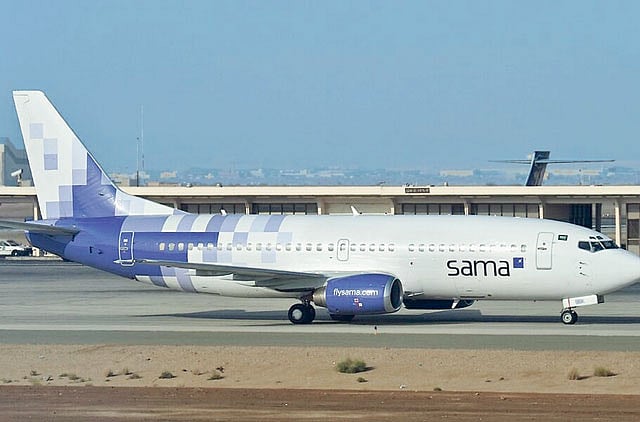
Dubai: Saudi Arabia-based low-cost carrier Sama Airlines will find it difficult to resume operations without a substantial capital infusion, industry analysts said Monday.
The airline announced Monday that it would discontinue all flight operations as of Tuesday. It is seeking arrangements to accommodate passengers affected by flight cancellations through arrangements with other airlines.
"The decision to stop flying was not taken lightly, but we have spent many months seeking alternatives, and now this is the only option remaining to us," Bruce Ashby, Sama CEO, said.
"We had been awaiting a significant aviation relief package with respect to fuel subsidies, subsidies for PSO routes, a gradual lifting of domestic fare caps, and additional funds to support the past losses and growth of our business.
"In addition, we sought for, and found, more than one potential new equity investor willing to inject cash into the business. Unfortunately, none of these alternatives came together in the required timeframe."
The apparent ‘collapse' of the airline raises serious questions about the sustainability of private airlines in an industry dominated by government-owned airlines.
The aviation industry in the GCC is the second highest growth market after Asia-Pacific region.
"Collapse of an airline in such high growth market where Emirates, Etihad, Air Arabia, Qatar Airways and Jazeera Airways are expanding services, raises questions on the management of the airline," an analyst said, requestiing anonymity.
"It also raises doubts on the sustainability of privately owned airlines. However, it appears, the case of Sama Airlines is a pure operational and financial failure. The airline could revive with a bit of financial re-engineering and cash injection."
Sama, and all other airlines throughout the region, experienced very low fares and somewhat slow demand for regional travel during the winter season (October 2009 through March 2010), Ashby said.
Heavy losses
"Although revenues were up sharply during the summer peak season, it has not been enough to offset the heavy losses we suffered during the winter.
"We deeply regret any inconvenience caused to our customers, but we must do what is necessary to preserve the integrity of our operations.
"Since January 2009 we have run a safe, reliable airline that flies on time and we have received broad-based support for our plan of measured growth. We remain hopeful that a financial solution will be found that will allow us to restart operations in the coming few days," Ashby said.
Sama will make notifications to all passengers booked on flights from August 24 onwards to the status of their itineraries at the contact numbers provided when the booking was made.
Last year, Sama, which launched operations in 2007, said it signed agreements to buy 58 Airbus A320s and 12 787s in the next three years.
Prince Bandar Bin Khaled Bin Faisal is chairman of Sama, which competes with state-owned Saudi Arabian Airlines and low-cost carrier National Air Services.
The General Authority of Civil Aviation has been informed by Sama of its plan, GACA spokesman Khalid Al Khaybari said. The decision was taken after the airline recorded a loss of 1 billion Saudi riyals, said a board member, who declined to be identified.
The airline, which received 200 million riyals as a loan from the government to cover fuel costs and 500 million riyals from shareholders, fell short of 300 million riyals to keep operations on track, the board member said.
Sama faced competition from the state-owned Saudi Arabian Airlines, which received government support and subsidised fuel.
The airline operated to 10 destinations within the kingdom and neighbouring countries with 164 weekly flights, according to its website. "A substantial capital infusion seems to be the only way to keep Sama flying," an analyst said.
"The airline's precarious situation demonstrates how important it is to have a good financial management, as demonstrated by other low-cost airlines such as Air Arabia, which is thriving.
"Sama tried to get government fuel subsidies and price limits on domestic routes but it never materialized and the company incurred 266 million dollars of debt," the analyst said.
A promising start
Sama was founded by Investment Enterprises, chaired by Prince Bandar, with the support of Mango Aviation Partners, a UK firm specialising in low fare airline start-ups. Initial investment was received from 30 major Saudi private and institutional investors including Olayan Financial Company, Xenel Industries, Saudi Industrial Services, Sara Development Company and Modern Investment Company for Trade and Industries.
Mango Aviation was established by senior executives with many years of experience in the UK and European low fares airline industry.
The airline was initially focused on domestic flights, which was expanded to international destinations during 2008. Another major restructuring occurred during 2009 when the airline's timetables were optimised towards high aircraft utilisation. Unprofitable routes were dropped, and frequencies for successful destinations increased.
Sama's fleet consists of six Boeing 737-300 aircraft with an average age of 18.6 years. Sama partnered with Lufthansa Technik to perform maintenance on its fleet of six Boeing 737-300 aircraft. The contract covered all material operations.
— With inputs from Bloomberg
Sign up for the Daily Briefing
Get the latest news and updates straight to your inbox
Network Links
GN StoreDownload our app
© Al Nisr Publishing LLC 2026. All rights reserved.