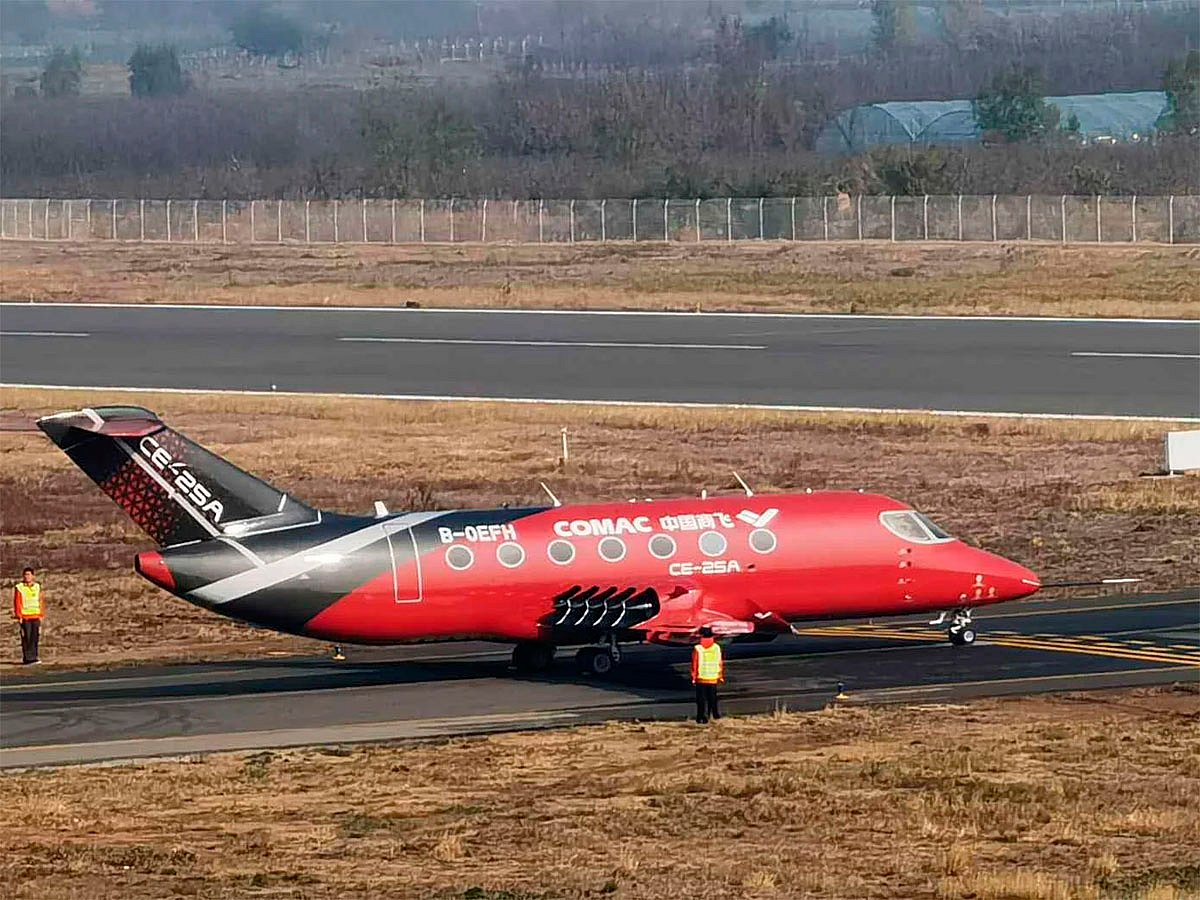
China has completed the first piloted flight of its 19-seat electric passenger aircraft, marking a new milestone in the development of battery-powered aviation.
The CE-25A, a 10-tonne electric aircraft developed by the Commercial Aircraft Corporation of China (COMAC), took to the skies on November 14 in Binzhou, Shandong province, with two pilots and a flight-test engineer onboard.
The aircraft remained airborne for 16 minutes and 38 seconds, covering 60.4 kilometres during the test. The entire test operation lasted 57 minutes and 46 seconds, according to reports by Xinhua News Agency and China Daily.
COMAC said the aircraft operated normally during the flight, with all performance indicators meeting expectations.
The development is significant because the aircraft is designed to carry up to 19 passengers, potentially opening the way for electric-powered aircraft to serve short regional and intercity routes.
The CE-25A is designed primarily for short-distance commercial journeys between cities. According to specifications released by COMAC, it has a maximum take-off weight of 10 tonnes and a stated range of 400 kilometres.
The aircraft has a cruising speed of 300 km/h and a cruising altitude of 2,400 metres. Its capacity of 19 passengers places it in the small regional aircraft category rather than the larger commercial airliners used for international travel.
Unlike conventional passenger aircraft that rely on fuel-powered engines, the CE-25A uses an electric propulsion system featuring 10 ducted fans mounted along its wings. Electric motors power these fans.
The distributed propulsion design is a key feature of the aircraft, setting it apart from conventional turboprop and jet-powered passenger planes.
The aircraft is being developed through a partnership involving COMAC, Chinese battery manufacturer CATL, Shanghai Jiao Tong University and other organisations.
The collaboration brings together aircraft manufacturing, battery technology and academic research as China explores the potential of electric propulsion for commercial aviation.
The November flight was not the aircraft's first test. The CE-25A completed its first uncrewed autonomous flight on February 2, 2026, and subsequently underwent 19 unmanned flight-validation exercises before carrying a crew.
The latest test marks its first flight with people onboard.
Despite the successful test, the CE-25A is not yet cleared to carry paying passengers.
China's Civil Aviation Administration has accepted COMAC's application for a type certificate, beginning the regulatory assessment process. The aircraft must still complete the required certification and testing before it can enter commercial passenger service. No commercial launch date has been announced.
The aircraft's stated 400km range also needs to be viewed in context: its first piloted test covered 60.4km, not the full advertised range.
For now, the CE-25A represents an important step in China's efforts to develop electric passenger aviation, but further testing and regulatory approval remain necessary before travellers can book a seat.
With inputs from Agencies
Network Links
GN StoreDownload our app
© Al Nisr Publishing LLC 2026. All rights reserved.