What is Comac? All about China’s plane maker challenging Boeing, Airbus
Comac’s C919 still lacks Western certification but orders and ambition are growing fast
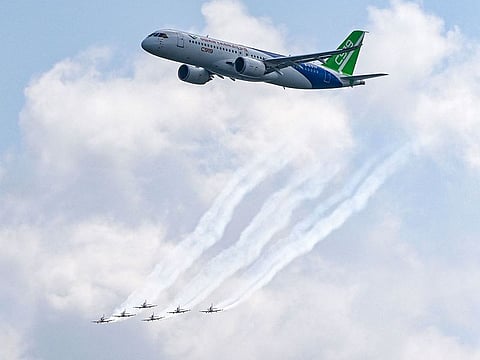
Dubai: China’s Comac (Commercial Aircraft Corporation of China) is the country’s state-owned aircraft manufacturer that aims to rival aviation giants Airbus and Boeing in the global airliner market.
Comac was founded in May 2008 in Shanghai to design and build passenger jets that could compete with the Western duopoly. Its headquarters and main production lines are in Shanghai’s Pudong district.
How did it begin?
Comac’s first commercial aircraft was the ARJ21 regional jet, launched in the early 2010s. It has since been rebadged as the C909 model and is flying with airlines in Indonesia and Southeast Asia.
But the centrepiece of COMAC’s ambitions is the C919 — a medium-range, narrow-body jet built to compete directly with the Airbus A320neo and Boeing 737 MAX family.
What aircraft it makes
C919
Launched: first flight in 2017
Commercial service: 2023
Seats: about 158–168 passengers
Competitors: Airbus A320 and Boeing 737 MAX
The jet is designed and assembled in China but still uses many foreign parts, including its engines (made by a joint venture between GE Aviation (USA) and Safran- France).
Comac is also working on wide-body jets like the C929 — intended to challenge larger aircraft such as the Airbus A330neo and Boeing 787 Dreamliner — but that is still in development.
Why Comac hasn’t been flying everywhere
Despite its big ambitions, COMAC faces several major challenges.
First, it has limited international certification. And this is one of the most important things in aviation — and it affects safety, prices, routes and even which planes you end up flying on.
The C919 has only been certified by Chinese regulators so far. It still lacks certification from top Western authorities, such as the European Union Aviation Safety Agency (EASA) and the US Federal Aviation Administration (FAA), meaning most foreign airlines cannot operate it in their home countries.
European regulators say the approval process could take three to six years, even if Comac keeps pushing for it.
Foreign parts, trade tangles
About 40 per cent of the C919’s systems come from Western suppliers, including engines and avionics. This makes Comac vulnerable to export controls, geopolitical disputes and supply-chain hiccups.
Production, delivery slowdowns
Comac has struggled to increase production to match Western manufacturers, partly because parts were constrained by past export bans and by supply bottlenecks.
Most of its orders (over 1,000) are from Chinese carriers or leasing firms, with a few from overseas buyers.
Why are Airbus, Boeing worried?
Comac is suddenly being taken more seriously for a few key reasons.
Huge domestic market: China accounts for about 20 per cent of global aircraft demand, giving COMAC a strong base even before it expands internationally.
Western delays and backlogs: Production delays at Airbus and Boeing have created openings for new players, and some industry leaders in the Gulf and Asia are watching closely.
In fact, flydubai CEO Ghaith Al Ghaith said in 2024 that it is about time the aviation industry gets a third, maybe even fourth aircraft manufacturer to break the dominance of Airbus and Boeing in the aviation industry.
Global ambition: Comac is not just building jets; it’s displaying them internationally (including at the Dubai Airshow) and investing in global sales, support and training networks.
New models on the way: In addition to the C919, Comac is developing larger jets and even supersonic designs — an indication that its strategy goes far beyond small beginnings.


