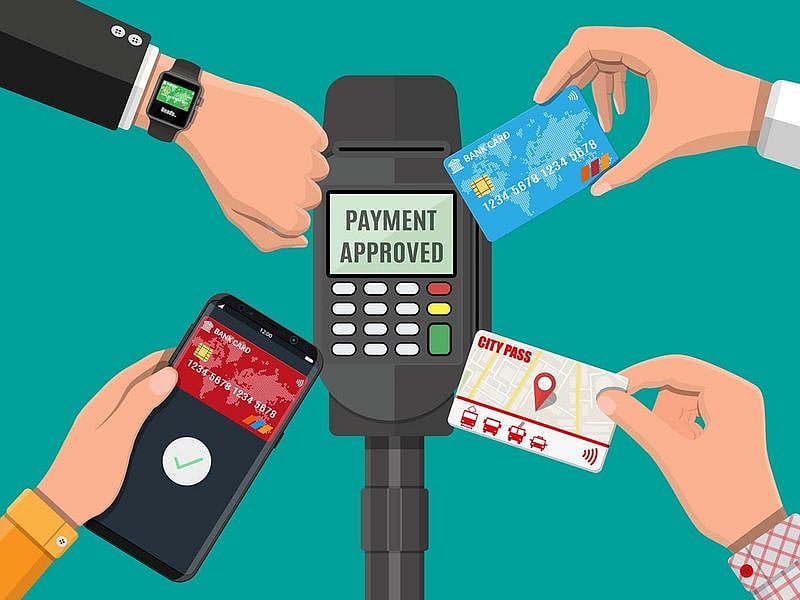
Last year, cash slipped below 20% of in-person retail spend globally for the first time. In the UAE, contactless and digital payments already dominate the checkout. Saudi Arabia which had set a target of 70% non-cash transactions by 2025, crossed that threshold in 2023.
Get updated faster and for FREE: Download the Gulf News app now - simply click here.
The world is going cashless faster than almost anyone predicted, driven by a powerful coalition of banks, card networks, fintechs, and governments who all benefit from the shift. The global digital payments market is projected to exceed $3 trillion by 2028. The direction of travel is right: digital payments are faster, safer, and more transparent than cash. But speed has a way of outrunning equity. The real question is not whether cash will disappear, but whether the transition will be designed for everyone, or only for those already inside the financial system.
Blueprint: What India got right
No country better illustrates the potential, and the deliberate design required, than India. A decade ago, over 90% of its transactions were in cash. Then came a sequence of structural interventions: the Jan Dhan programme brought over 500 million previously unbanked citizens into the formal system; Aadhaar provided universal digital identity; and the Unified Payments Interface, launched in 2016, built a real-time interoperable payment rail open to any bank, wallet, or fintech. UPI now processes more than 20 billion transactions a month, many by first-time digital users: street vendors, smallholder farmers, domestic workers.
Crucially, the architecture was designed for inclusion from day one: no minimum balance, no smartphone required for basic functionality, and access in 20 Indian languages. India did not digitise payments for the middle class and hope the rest would follow. It engineered access for the underserved as a founding principle. That distinction matters enormously.
Lessons from North America, Asia
The contrast elsewhere is instructive. In the United States, over 5 million households remain unbanked despite high overall digital adoption. As cash-free businesses proliferated post-pandemic, cities like New York were forced to legislate mandatory cash acceptance because the market’s natural incentive, eliminating cash-handling costs, conflicted with public access obligations. Canada has navigated this more thoughtfully, maintaining an explicit central bank commitment to cash while embedding financial inclusion as a primary objective in its digital currency research.
Asia tells a similar story of deliberate architecture. China’s Alipay and WeChat Pay achieved mass rural adoption through simple QR-code infrastructure requiring minimal merchant investment. Singapore’s PayNow, launched in 2017, achieved mass adoption within a few years through deliberate public-private collaboration. The common thread in every successful transition is government-anchored architecture, mandated interoperability, and explicit inclusion targets.
MENA: Opportunity, obligation
The GCC stands at an inflection point. The UAE already ranks among the world’s most cashless societies, with digital payments now the majority of point-of-sale volumes. Saudi Arabia’s Vision 2030 has set ambitious cashless targets, with the Mada network growing rapidly alongside STC Pay and emerging open banking frameworks.
The opportunity is real: digital payments can dramatically reduce remittance costs for the GCC’s 30 million-plus migrant workers, who send more than $100 billion home each year. Reducing that cost by even a percentage point returns billions to families across South Asia and Sub-Saharan Africa.
But the obligation is equally real. The GCC’s unique social composition, where migrants constitute roughly 40% to nearly 90% of the resident population, means a cashless transition calibrated only for citizens and high-income residents would exclude many of the people who actually live and work here. Documentation barriers, language access, and smartphone dependency are meaningful walls for low-income workers navigating an unfamiliar system. Across the broader MENA region, where unbanked adult populations in Egypt, Morocco, and Iraq still exceed 50%, digital payment infrastructure must be built alongside financial identity infrastructure, not ahead of it.
Where responsibility lies
The fix is straightforward, and the responsibility is shared. Banks must design entry-level accounts with no minimum balances and multilingual interfaces. Not as charity, but as strategy, since the underserved represent the largest remaining growth opportunity in the region.
Networks must mandate interoperability so no consumer is excluded by incompatible systems. Regulators must embed financial inclusion metrics into licensing conditions, alongside capital and liquidity requirements. The UAE Central Bank’s recent directive mandating low-cost Universal Accounts is a good example. Governments must preserve meaningful cash access for as long as significant populations depend on it.
India has demonstrated that digital payments can reach a billion people across every income level when the architecture is built with intention. The GCC and wider MENA can chart an equally ambitious course. The technology exists. The regulatory levers exist. What is required is the collective will to ensure this revolution is designed for everyone, and the recognition that financial inclusion is not a social obligation separate from the business of banking. It is, in fact, the business.
Network Links
GN StoreDownload our app
© Al Nisr Publishing LLC 2026. All rights reserved.