Last week, Standard & Poor's lowered Japan's bond rating to AA-, the fourth-highest level. By that standard, the US got away with a slap on the wrist from Moody's Investors Service, which warned merely that "the probability of assigning a negative outlook in the coming two years is rising".
If you look at the US budget trajectory with an eye on the lessons from Japan's recent history, there's a strong case that the US rating should be cut immediately.
It's true that the US, with total government debt equal to 98.5 per cent of gross domestic product, according to Organisation for Economic Cooperation and Development data, has many years of unrestrained deficits ahead before it reaches the crisis point of Japan, which has debt of 204 per cent of GDP.
A more plausible target, however, is 135.4 per cent of GDP. That was Japan's debt in 2000, just before S&P first downgraded it from AAA in February 2001.
If the US makes no fiscal progress, and continues to run annual deficits at the 2011 level of $1.48 trillion, (Dh5.43 trillion) it will take just six years to reach a debt level of 135.3 per cent of GDP. The Japan precedent suggests the US would lose its sacrosanct AAA rating at that point, if not sooner.
To be fair, the Congressional Budget Office (CBO), in its forecasting, predicts that the US will do better than that, in part because revenue should increase as the economy recovers.
Day of reckoning
CBO's wholly unrealistic baseline forecast suggests the day of reckoning is far off. Don't believe it.
The budget agency's somewhat more grounded "alternative fiscal scenario" reflects "fixes" likely to be passed by lawmakers, such as higher payment rates to doctors under Medicare. If we use this alternate forecast, and factor in CBO assumptions that high debt levels would crowd out capital investment, then the US hits the 135 per cent debt mark in 2020 or 2021.
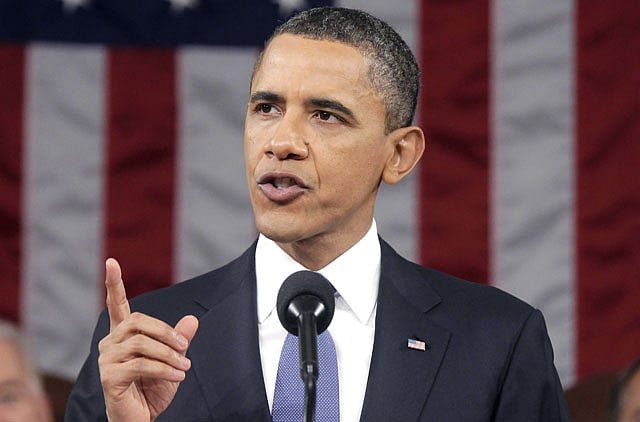
Be happy that Japan, not Greece, is the logical point of comparison here. The US could depart from the collision course with a downgrade if it took serious steps to reduce its deficit. But US President Barack Obama's State of the Union address offered pitifully small spending cuts while floating Obama's fiscal commission out to sea on an iceberg.
I may be old-fashioned, but all of this should mean that rating of US long-term debt should be downgraded — today.
A report from S&P last October estimated that "absent policy and other changes" the US could be rated A — two rungs below Japan's current status — by 2020. So start the process now, for goodness sake.
I should add two important caveats:
First, gross government debt numbers might not be the best measure of country-specific risk. A US with debt of 135 per cent of GDP might reasonably still be a safer place to stick money than an equally indebted country. Still, governments everywhere play the same kind of trust-fund games the US plays, so the OECD data provide the best readily available apples-to-apples comparison.
Types of debt
Also, focusing on gross debt may make the situation look better than it really is for the US, since Japan's is so high relative to debt held by the public. Japan's publicly held debt was 66.3 per cent of GDP when it lost its AAA rating, compared with the current US level of 72.7 per cent.
Second, one might argue that it is unthinkable that the US would ever default, so it should always have a solid AAA rating.
Think again. As debt levels rise, a fiscal situation can become simply impossible, making default inevitable.
And it can happen here.
Since its founding, the US has defaulted on its debt twice. The first time, in 1790, it deferred payments on money owed stemming from the Revolutionary War. While the dollar values were eventually repaid — 10 years later — the delay was technically a default.
No gold
The second time, in 1933, the US blatantly broke its obligation with creditors by refusing to repay loans in physical gold. Existing contracts stated that lenders could request payment in either dollars or gold, but president Franklin Delano Roosevelt and Congress, with plans to significantly inflate the dollar, passed a law forbidding repayment in gold. Again, the dollar values were repaid, but unilaterally changing the terms of a contract is the equivalent of a default.
The failure of the ratings companies to identify the riskiness of real estate loans clearly contributed to the financial crisis. If, given the evidence, they fail to act responsibly and change the US credit rating soon, they will be setting investors up for yet another fall.
- Kevin Hassett, director of economic-policy studies at the American Enterprise Institute was an adviser to Republican Senator John McCain in the 2008 presidential election. The opinions expressed are his own.
Sign up for the Daily Briefing
Get the latest news and updates straight to your inbox
Network Links
GN StoreDownload our app
© Al Nisr Publishing LLC 2026. All rights reserved.