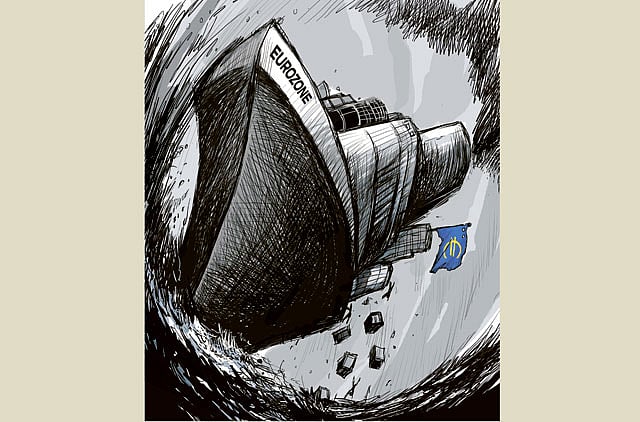
How gloomy should we be about the European Union? Are its problems manageable, or is it headed for systemic collapse? My answer is yes — the problems are manageable, and the EU's leaders are behaving so recklessly that collapse is all too possible. I don't know whether that makes me an optimist or a pessimist.
The Peterson Institute for International Economics just hosted a debate about Europe's prognosis. Four well-known economists, all deserving to be taken seriously, argued for and against the doomsday scenario. Let's review their positions.
Peter Boone and Simon Johnson were the pessimists. Europe's problems are worse than generally acknowledged, they said, and there's no "credible path out of crisis". (Boone and Johnson summarised their thinking in an op-ed for Bloomberg View, and the institute published their essay, The European Crisis Deepens.
Fred Bergsten and Jacob Funk Kirkegaard think such talk is overblown. "Europe's overriding political imperative to preserve the integration project will surely drive its leaders to ultimately secure the euro and restore the economic health of the continent."
Neither side is too precise in its predictions. Boone and Johnson don't think that systemic collapse is certain, and Bergsten and Kirkegaard aren't saying it's impossible. It's a question of probabilities, and neither side gives odds. Still, Boone and Johnson think the economic hole is deeper and the politics of getting out more difficult than Bergsten and Kirkegaard maintain. Let's consider the economics and the politics in turn.
The economics boils down to this: How many EU countries, in addition to Greece, are insolvent as opposed to merely illiquid? Insolvency implies that defaults are inescapable and playing for time won't work.
Insolvency risk
More concisely, is Italy solvent? Boone and Johnson controversially include it, along with Greece, Ireland and Portugal, in their list of countries that "appear to be insolvent" once risk premiums are taken into account. This makes a huge difference, because it vastly enlarges the defaults that could ensue. Italy accounts for €1.9 trillion (Dh9.15 trillion) of Europe's €8.4 trillion in sovereign debt.
If Italy is about to fall, Europe's problem is far bigger than many believe — but Boone and Johnson are only getting started. Suppose the European Central Bank (ECB) finally stepped forward, as many analysts have urged, and made itself explicit lender of last resort to Europe's governments. That won't work, they say. Supplying distressed governments' demands for new loans as debts roll over wouldn't convince investors that the sovereign debt they already hold is safe. The bank would also have to buy, say, three-quarters of the existing stock of debt. Otherwise, interest rates in the secondary market for sovereign debt would continue to include a big risk premium, and insolvent countries would stay insolvent.
Add Spain to the list of bankrupt states, and the cost of the bank's required debt purchases might be anywhere from €2.5 trillion if all went well and €4.5 trillion if it didn't. Germany's share would expose its taxpayers, in the central case, to credit risk of €1.2 trillion, or 45 per cent of Germany's GDP. That, Boone and Johnson say, isn't going to happen.
Competitiveness issue
Suppose it did. It wouldn't help anyway. Once the European Central Bank commits to this approach, markets would panic over the potential cost if the trouble spreads to other countries. Also, none of this addresses the European periphery's competitiveness problem. To deal with that, governments would have to cut public spending and wages deeply — again, politically impossible. Meanwhile the unelected ECB would find itself negotiating budget programmes and structural economic reforms with euro-area governments.
The size of the risk premium on distressed sovereigns' debt is the key to solvency: Boone and Johnson are right about that. It's true that perceptions of risk in the European sovereign bond market have changed for good. Default risk was set at nothing before the crisis. Those days are over. Europe's outrageous dithering is compounding the problem. If EU leaders began to act more decisively, perceived risks would abate.
An ECB commitment to act as lender of last resort would also reduce risk premiums: not to zero, but with luck by enough to make the difference. Outlays on the colossal scale envisioned by Boone and Johnson wouldn't be needed, so long as investors believed the bank's promise to commit huge sums if required. Alongside other measures — credible budget stringency, pro- growth structural reforms and fiscal expansion in Germany and the rest of Europe's northern core — a lower risk premium would make Italy solvent.
Leadership vacuum
For these reasons I agree with Bergsten and Kirkegaard that the situation is retrievable. But this brings us to the politics. The question is whether EU leaders can actually bring themselves to retrieve it.
Here, I think, Bergsten and Kirkegaard are a bit too blithe. Don't panic, they say. They quote Jean Monnet, architect of the EU: "Europe will be forged in crises, and will be the sum of the solutions adopted for those crises."
This time, they could be right, but I'd underline two things. First, as the EU has expanded it has also become more closely integrated and far more financially complex. Making policy on the brink of disaster has become more hazardous. Boone and Johnson rightly emphasise the point: The problems are tougher than before and aligning governments behind solutions is more difficult, too.
Second, the resolution of this crisis will involve further erosions of national sovereignty. Central oversight of fiscal policy must increase. The EU's ‘democratic deficit' — the distance between its citizens and their rulers — will grow still larger.
If Europe's leaders can finally stir themselves, Europe may emerge from its current turmoil with the euro intact, and even with some of its economies strengthened. But as its political institutions move on to the next emergency, they will be less legitimate and hence more fragile.
— Bloomberg
Sign up for the Daily Briefing
Get the latest news and updates straight to your inbox
Network Links
GN StoreDownload our app
© Al Nisr Publishing LLC 2026. All rights reserved.