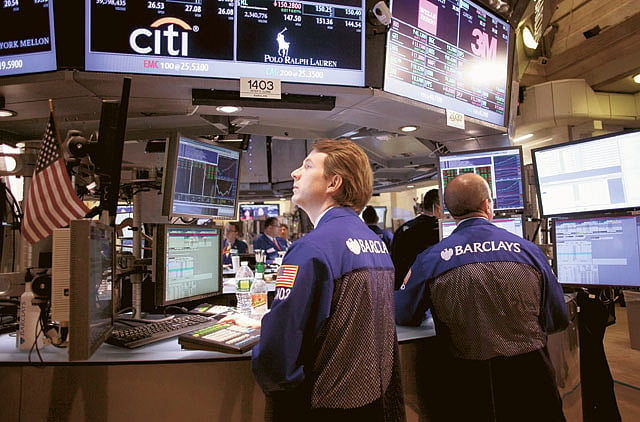
Think Wall Street is the land of plenty when it comes to compensation? Think again. If pay to top executives is a window into the Wall Street compensation machine, then compared with other industries — the entertainment media, for instance — the bloom is definitely off the rose.
Last year, the best-paid Wall Street chief executive officer was Jamie Dimon at JPMorgan Chase. He got $23 million (Dh84.45 million) in total compensation. John Stumpf of Wells Fargo got $17.9 million, while Lloyd Blankfein at Goldman Sachs Group had to settle for $16.2 million.
Although Vikram Pandit at Citigroup received $14.9 million, 55 per cent of Citigroup's shareholders voted for a non-binding resolution that would have denied him that pay. James Gorman at Morgan Stanley took home $10.5 million, a pay cut of 25 per cent from the previous year. Brian Moynihan at Bank of America got $8.1 million.
I understand that this is a great deal of money. And that it remains true that Wall Street firms pay out a larger percentage of their annual revenue as compensation to employees than any other industry where companies are publicly traded — generally between 40 per cent and 50 per cent, although Lazard has been averaging a payout ratio of 63 per cent of revenue for the past two years.
Yet there is a clear pattern: Absolute levels of Wall Street pay, in relation to some other fields, have been coming down in recent years.
A sea change
There are good reasons for this, of course. Generally, profits have been down, return on equity is down, revenue growth is down, stock prices are down and regulation is up. And the prospects for finding ways out of this conundrum are minimal. While few tears will be shed for Wall Street's executives, or for anyone else fortunate enough to work there — after all, where else can so much money be made without having to put in any of your own capital? — these trends may bring a sea change at the big banks.
For more than a generation, Wall Street has been able to recruit the world's best and brightest mostly by promising them more money than they can possibly make elsewhere. Indeed it is the rare Wall Street employee, especially among those just starting out, who admit to being motivated by anything other than the fat pay cheques they have been promised. But when that promise can no longer be kept, or when pay cheques are smaller than expected, the best and the brightest begin voting with their feet.
The money trail
Where do they go? Well if the theorem is true that they follow the money, then there should be a stampede back into professions such as the media industry, where top executives quietly hauled down a fortune in compensation last year. For instance, Les Moonves, the CEO of CBS, was paid $69.9 million last year. David Zaslav of Discovery Communications received $52.4 million, while Philippe Dauman at Viacom was paid $43 million. Walt Disney's Robert Iger got $31 million. Jeff Bewkes, at Time Warner, was paid $26 million last year.
Even the top executives at Comcast, Brian Roberts and Steve Burke, received compensation of $27 million and $24 million, respectively, despite their pay being cut 13 per cent and 32 per cent, respectively, from the previous year. Six media executives wound up in the top 15 of the Associated Press's list of highest-paid executives released last week; not a single banker joined them. No doubt these talented executives are worth every penny of their exorbitant pay: Profits at their companies are up, as are stock prices.
Paradigm shift
But one would be hard-pressed to remember the last time that the top pay at media companies outstripped that of Wall Street.
This apparent paradigm shift occurs infrequently, and could well signal the beginning of a new era — the first in generations — when the pay potential is no longer highest on Wall Street. When you combine that with just how miserable it is to work at one of those banks on a day-to-day basis, there may be value for the leaders of Wall Street to rethink not only their business models but also what they will need to do to continue to attract the best and the brightest when offering the highest pay is no longer an option.
— Bloomberg
Sign up for the Daily Briefing
Get the latest news and updates straight to your inbox
Network Links
GN StoreDownload our app
© Al Nisr Publishing LLC 2026. All rights reserved.