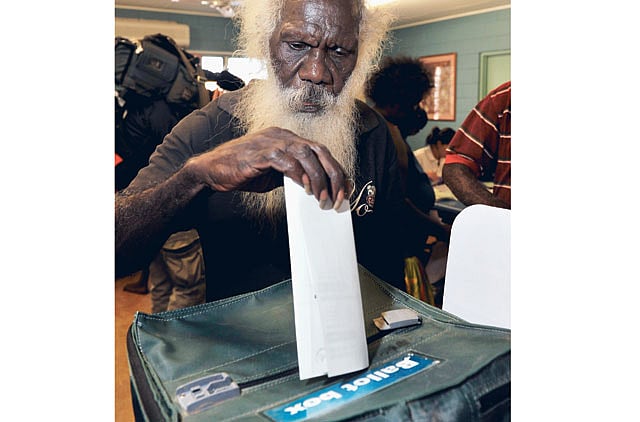
Canberra: As Australian voters head to the polls today, it is still anyone's game and the result may not be known until tomorrow till all the votes in every seat are counted.
The latest Newspoll published yesterday had the ruling Australian Labor Party of Prime Minister Julia Gillard deadlocked at 50 per cent with the Opposition Liberal-National Coalition led by Tony Abbott.
If the opinion polls are reflected accurately in the voting booths, a hung Parliament looks increasingly likely, with the three Independent MPs — Bob Katter, Tony Windsor and Robert Oakeshott — set to play a key role in the formation of the new government.
Either side has to win 76 seats in the 150-member House of Representatives to be able to form the government. More than 14.5 million Australians are eligible to vote in today's election, with about one million having already cast their ballots in early voting.
The hitherto marginal Australian Greens are tipped to have an MP in the new Parliament. If elected from the seat of Melbourne in Victoria state, Adam Bandt will also be a key player in the post-election scenario.
Mood negative
The mood of the electorate is decidedly negative, with many voters expressing the desire to "get it all over with so we can enjoy the footy".
Indeed the upcoming finals season of the Australian rules football (AFL) and National Rugby League (NRL) competitions was a major factor in PM Gillard deciding on the date of the election. Australians love their sport and no prime minister would dare call an election in the middle of the footy finals season. That would be tantamount to committing political suicide.
The voters' disenchantment with the election campaign is palpable.
Lucy Baker, 48, a Canberra mother of four, said yesterday that she would definitely be voting for fellow redhead Gillard, "because it is a great moment for us women".
"Both sides of politics haven't come up with any fantastic or inspiring policies, so I might as well vote along feminist lines," she said, before adding "and thank God it will all be over tomorrow so we can all go back to our normal lives."
Australian National University students Tully Fletcher, 24, Sue-Lin Wong, 21, and Sebastien Willis, 22, are also not impressed by what they have seen from the rival leadership candidates.
Fletcher said the campaign was "uninspiring", while Wong said she would like to see more "robust debate" on the big issues.
Fletcher said he was most concerned about climate change, which is the "issue for our generation" and Australia's role in the Asia-Pacific region.
He said there had been no serious discussion about foreign policy in this campaign.
Wong said she was concerned about education, especially speculation that the Liberals supported offering university places to full-fee-paying domestic students, climate change and the "scare campaign" about asylum-seekers and boat people waged by both major parties.
Focus on environment
Willis said he wanted a sharper focus on environmental issues, including tackling climate change, ending logging in old growth forests and dealing with the drought-stricken Murray-Darling River Basin - the country's agricultural lifeline.
Willis said he was "extremely disappointed" with the major parties' lack of focus on policy.
Community sector workers Chris Wagner, 35, and Brendan Maher, 33, said they were concerned about the spiralling cost of living.
Maher's said his "honest answer" on the election was "I wish it was over". He said the campaign was like a reality television show and he condemned the over-the-top coverage by some sections of the media.
Wagner said he was "absolutely appalled" by some media outlets that were running opinion masquerading as reportage. "I think the media has paid too much attention to the circus and the sideshows and not enough on candidates and the policies."
He also believed that it was a "boring" campaign dominated by fear. "I find it ironic that one party has been talking about fear and smear when both parties have been focussed on fear and smear."
Wagner said he was also "extremely disappointed" with the major parties' approach to asylum-seekers.
‘The Mad Monk’ opposes a range of issues
- A pugnacious and socially conservative Catholic, Abbott became leader of the Liberal-National coalition in 2009 by rallying opposition to a carbon trading scheme. He took over an opposition trailing in opinion polls but has reversed his party's fortunes and may return it to power after its 2007 defeat.
- The London-born Abbott opposes a range of issues, including a push to make Australia a republic, embryonic stem cell research, same-sex marriages and carbon trading to combat climate change. His book on Australian conservative politics published in 2009 was titled "Battlelines".
- Graduated from the University of Sydney with a law and economics degree. He was a Rhodes Scholar at Oxford University, majoring in politics and philosophy, and won two Blue awards in boxing.
- Trained to be a priest at St Patrick's Seminary, Sydney, in the mid-1980s. Abbott was later given the nickname "The Mad Monk" by his political critics.
- Journalist at Australia's now defunct The Bulletin and The Australian.
- Press secretary and political adviser to the Liberal party's opposition leader, John Hewson, 1990-93.
- Executive Director of Australians for Constitutional Monarchy from 1993-94, opposing moves for Australia to become a republic and replace its constitutional monarch, Queen Elizabeth II, with an Australian president.
- Entered parliament 1994. Minister for Employment Services in 1988 and promoted to cabinet as Minister for Employment, Labor and Small Business in 2001. Minister for Health and Ageing from 2003.
- After the conservative government lost office in 2007, Abbott held a series of shadow ministerial roles ranging from housing to indigenous affairs.
- In December 2009, became leader of the Liberal-National opposition coalition by rallying opposition to a carbon trading scheme.
An old school Labor politician
- Gillard, 48, is Australia's first female prime minister. Her early political career was forged by Labor's left wing, but her ascendency to prime minister was the result of right-wing powerbrokers in the party. Seen as an economic conservative, she has promised to return the budget to surplus by 2012-13.
- Arrived in Australia, aged four, in the 1960s from south Wales, a cradle of Britain's own Labour movement. Late British Labour politician Nye Bevan, a former Welsh coal miner and chief architect of the National Health Service, remains one of her political heroes.
- Graduated with a law degree 1986 from the University of Melbourne. Became involved in politics via the Labor Club at the University of Adelaide and then led the Australian Union of Students at Melbourne University.
- Joined law firm Slater & Gordon, which specialises in class actions and personal-injury cases, in 1987 and became a partner at age 29 in 1990. Became a political adviser in the late 1990s.
- First elected to parliament in 1998 and quickly rose to become a leading light of the Labor left, appointed shadow minister for population and immigration in 2001 and shadow health minister in 2003 and later became deputy Labor leader in 2006.
- Appointed deputy prime minister 2007 when Labor won office and became minister for education, labour and social inclusion.
- Toppled then prime minister Kevin Rudd on June 24, 2010 in a Labor party coup.
- Quick-witted, with a broad Australian accent and a working-class pedigree, Gillard is in many ways an old-school Labor politician, more reminiscent of Labor prime ministers from the 80s and 90s.
- Gillard is known as a strong negotiator with an ability to consider alternative views and draw rivals into agreement. She ended a politically damaging row with global miners BHP Billiton, Rio Tintoand Xstrata within days of being appointed prime minister by agreeing to water down a new resource tax.
Sign up for the Daily Briefing
Get the latest news and updates straight to your inbox
Network Links
GN StoreDownload our app
© Al Nisr Publishing LLC 2026. All rights reserved.