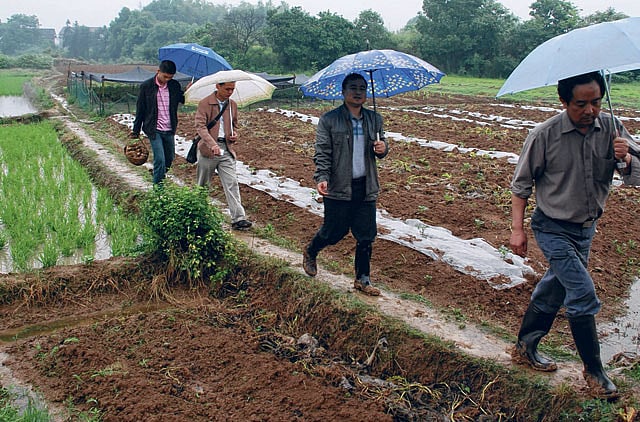
The Chinese government has begun ramping up research, production and training related to the potato, and hopes are high that the humble spud could help alleviate poverty and serve as a bulwark against famine.
The challenge of feeding a growing nation on a shrinking supply of arable land while confronting severe water shortages has long been a major concern here. China has to feed one-fifth of the world's population on one-tenth of its arable land, and the nation's expanding cities are consuming farmland at breakneck speed. China estimates that by 2030, when its population is expected to level off at roughly 1.5 billion, it will need to produce an additional 100 million tonnes of food each year.
That statistical reality could change eating habits here. Potatoes need less water to grow than rice or wheat, and they yield far more calories per acre. In rice-cultivating regions of southern China, farmers can squeeze a round of fast-growing potatoes into their rice fields in between planting seasons. In some of the poorest parts of arid northern China, potatoes are among the few crops that grow.
"Potatoes have so much potential here," said Xie Kaiyun, a leading potato scientist at the Chinese Academy of Agricultural Sciences, a government think tank. "Rice, wheat, corn — we've gone about as far as we can go with them. But not the potato."
Ever keen to seize opportunity, Chinese entrepreneurs are turning potatoes into forms more familiar to Chinese palates: buns, noodles, cakes. They are developing exotic varieties and have even sent seeds into orbit, saying that zero gravity makes them more nutritious and charging astronomical premiums for the seeds' offspring back on Earth.
Potatoes won't replace rice or wheat as mainstays of Chinese cuisine any time soon, if ever. They are eaten as side dishes, and the government has not yet named them a staple, a distinction that would mean preferential treatment in domestic markets and would carry significant cultural weight.
But they are increasingly seen here as an underutilised resource.
With that in mind, the government in February signed an agreement with the International Potato Center, a research organisation, to jointly launch a major potato research centre in Beijing. Part of the centre's broad mandate will be to develop varieties that grow quickly and dependably in specific regions throughout China. Recently, the State Council announced subsidies for farmers who grow high-yield seed potatoes. And government-funded pilot programmes have been expanding in nearly every province, training farmers in innovative methods that raise crop yields and, with them, rural incomes.
"It's unusual to see a country explicitly name a commodity as an instrument of development," said Pamela Anderson, director general of the International Potato Center. "It shows how seriously the Chinese government is taking its commitment to food security."
China has a long-standing policy of food self-sufficiency, growing 95 per cent of the grain required to feed its people. The country's sheer size means that a major crop failure or other food emergency here could have international ramifications, overwhelming world food markets with sudden demand. "Were China to need to import a large amount of grain, it would have a very dramatic impact on world food prices," said Anthea Webb, director of World Food Program China.
China produces and consumes more potatoes than any other country. But that's largely because of its huge population. The Chinese lag in per capita terms, eating one-third the amount of potatoes that Russians do and two-thirds the amount Americans eat.
The average acre of potato plants in China yields far fewer edible spuds than in other developing countries, mostly because farmers plant cheap, disease-prone seed. China's national and local governments are trying to change that by increasing potato funding, hoping the investments will raise rural incomes and help maintain social stability by keeping farmers on their land in the country's poorest areas.
Researchers from Hunan Agricultural University started working with the province's potato farmers in 2005 and last year used government grant funds to provide training and seeds. Farmers plant in rice fields during the winter, when the land would otherwise produce nothing; potato plants then improve the soil for the next season's rice cultivation.
It's a good time to be in the Chinese potato business. Wholesale prices increased 85 per cent from November to April, thanks in part to a severe drought in the nation's southwest that has limited supply.
"We earn the same from one potato crop that we get from three rice crops" or 10 cabbage crops, said Huang Weihua, 40, the leader of the local farmers association. He pointed across a terraced field of flowering potato plants to his house, a two-storey brick-and-tile structure. His son was hard at work remodelling the first floor — potato money, Huang said.
But if potatoes are to become a key to China's food security, the market for them must expand even more.
"Chinese don't know enough about potatoes and their nutritional benefits," said Xie, the potato scientist. "If they eat one more potato dish every day — well, there are 1.3 billion of us. That's a huge new market.
Sign up for the Daily Briefing
Get the latest news and updates straight to your inbox
Network Links
GN StoreDownload our app
© Al Nisr Publishing LLC 2026. All rights reserved.