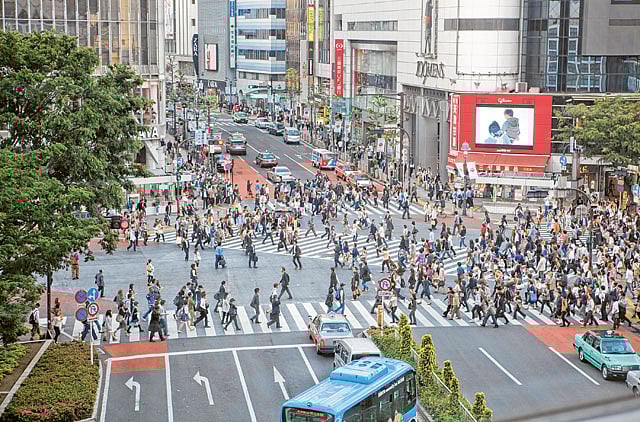
Everyone waited, the pressure building, potential energy set to become kinetic. Suddenly, the light changed and vehicles vanished from the vast intersection in Tokyo's Shibuya district. For one eye-blink, the crossing was a no man's land. Then the pedestrian masses on the four corners surged forward.
Seen from above, they were great armies entering battle, each moving with determination towards their point of contact. But there was no clash.
In the middle, they came together in fluid movement. For nearly a minute, the intersection was a sea of humanity. Then it reverted to the throb of vehicle traffic, another cycle of Shibuya synchronicity complete.
"It's an unrehearsed choreography," said Tsuyoshi Yamada, an unofficial expert on the history and idiosyncrasies of the crosswalk. "It's a dance." Twice each weekday, on his way to work and home again, Yamada negotiates the intersection, perhaps the most peopled and yet the most orderly one on the planet.
It is known as the Scramble, and for good reason. The crossing, a ten-lane traffic interchange half the size of a football field, is in the heart of the youth-dominated Shibuya, a barometer of this city's edgy teen culture with its ever-shifting fashions and often-wacky trends.
At its rush-hour height, the Scramble is flooded with 2,500 pedestrians with a single change of a traffic signal. But in this polite nation, the passing bodies seem less chaotic than in, say, Beijing or New York, moving with the cool predictability of a stopwatch.
Yamada, 64, is a student of the crossing's place in Japanese culture, likening its ballet to North Korea's Mass Games, in which thousands of gymnasts take part in a spectacle of rhythm and order. "It's more than just a feat of engineering," said Yamada, a deskbound records-keeper with the title of data management officer. "It reflects the pulse of Tokyo."
Yamada said the Japan-ese seem as proud of its smooth inner-workings as they are of any Toyota or Honda. "It's elegant and works well, and I think people here like that," he said.
On a recent afternoon, television photographer Yuzo Yamamoto set up his camera on a sidewalk at the Scramble's edge. He was shooting a summertime feature on new styles of sunglasses and said there was no better place to get the story.
Yamamoto said the Scramble captures the contradiction of modern Japan: Although so many young people seek to stand out in the crowd with the latest, zaniest fashion, their upbringing still demands civility: They may look counterculture but they are still bound to step back and offer a stranger the right of way. "I just like to stand here sometimes and watch the bodies flow," Yamamoto said. "It's amazing."
Shibuya's Scramble is just outside the area's bustling train station.
Although there are 300 Scramble crossings nationwide, the idea is not Japanese, Yamada acknowledges; the notion was born in the 1940s when a Denver traffic engineer sought to reduce car-people collisions.
Henry Barnes's idea was to alternate the right of way between cars and pedestrians: One minute autos would take charge of an intersection, walkers the next. Users called it the X-crossing, diagonal crossing and even the Barnes Dance, because pedestrians were reportedly so happy with their newfound freedom, they danced in the streets.
In his 1965 autobiography, The Man with the Red and Green Eyes, Barnes said the idea came to him while watching his daughter make a dangerous dash to school across the street.
"As things stood now, a downtown shopper needed a four-leaf clover, a voodoo charm and a St Christopher's medal to make it in one piece from one curbstone to the other," he wrote. "As far as I was concerned — a traffic engineer with Methodist leanings — I didn't think that the Almighty should be bothered with problems which we, ourselves, were capable of solving."
As Yamada tells it, a Tokyo city official saw a TV documentary and marvelled at the simplicity of the solution to handle pedestrian traffic.
The city's first Scramble was established in the Ginza district, followed by Shibuya. Yamada is not sure what year but by comparing old black-and-white photographs, he has narrowed it to between 1970 and 1976. Since then, Shibuya's Scramble has become a symbol of the habitability of a metropolis of 35 million.
The crossing has become a mainstay in tourist guidebooks. Many times each day, pedestrians threading the Scramble's needle make visitors wonder how they pull it off.
"Foreigners are amazed by the smaller scale of things here," said William Bodiford, a UCLA professor of Asian languages and culture. "Natives get used to negotiating tighter spaces. They are raised to be very aware of one another and notice their surroundings."
Sign up for the Daily Briefing
Get the latest news and updates straight to your inbox
Network Links
GN StoreDownload our app
© Al Nisr Publishing LLC 2026. All rights reserved.