In this pool photograph distributed by the Russian state agency Sputnik, Russia's President Vladimir Putin, China's President Xi Jinping and US President Donald Trump arrive for a trilateral meeting at Kylin Villa on the sidelines of the Asia-Pacific Economic Cooperation (APEC) Summit in Shenzhen, in China's southern Guangdong province, on November 19, 2026.
'No winners in nuclear war': Trump, Xi, Putin pledge dialogue after Shenzhen summit
Trump, Xi, Putin reaffirm nuclear war's catastrophic stakes at Shenzhen summit
Last updated:
2 MIN READ
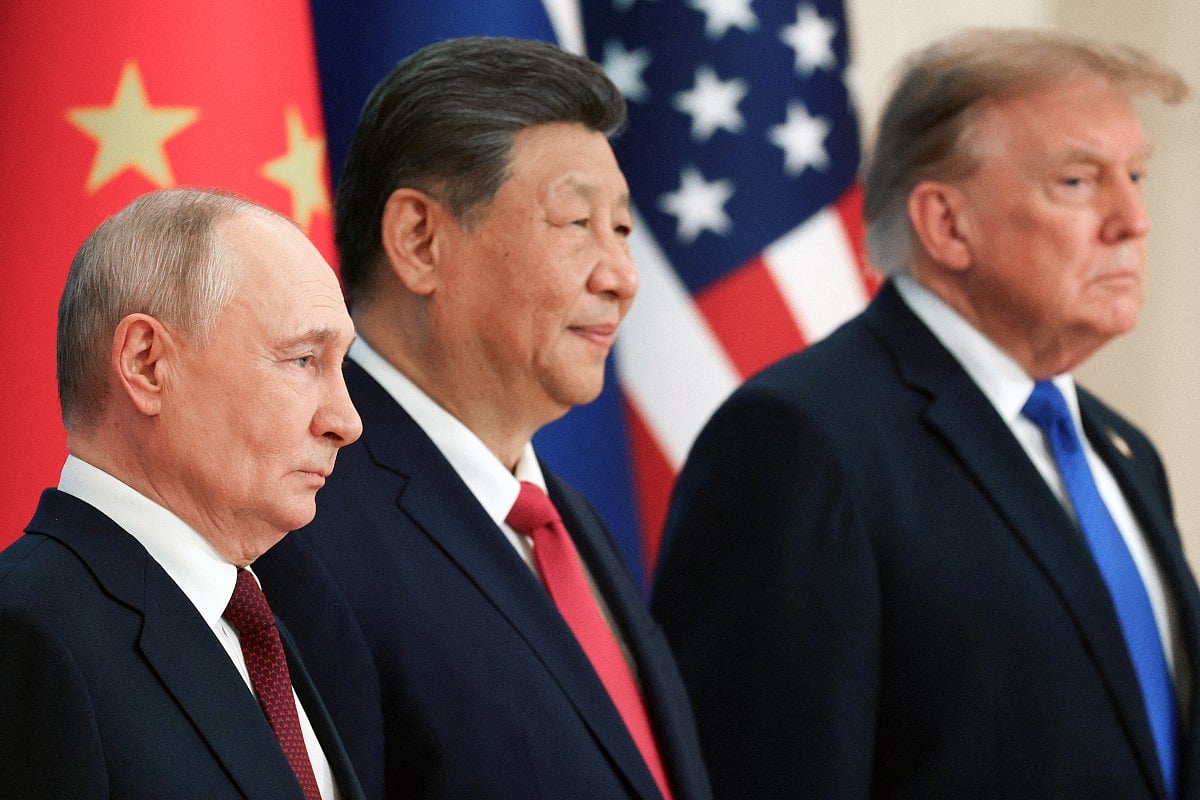
In this pool photograph distributed by the Russian state agency Sputnik, Russia's President Vladimir Putin, China's President Xi Jinping and US President Donald Trump pose for photos as they arrive for a trilateral meeting at Kylin Villa on the sidelines of the Asia-Pacific Economic Cooperation (APEC) Summit in Shenzhen, in China's southern Guangdong province, on November 19, 2026.
AFP
US President Donald Trump, Chinese President Xi Jinping and Russian President Vladimir Putin said late on Thursday that “there can be no winners in a nuclear war and that it must never be unleashed.”
The three leaders issued a joint declaration after an unprecedented trilateral meeting in Shenzhen.
They, however, stopped short of announcing a timetable or framework for nuclear arms-control talks.
Get it: Fast, verified news for FREE ... download the Gulf News app — simply click here
Dialogue on reducing nuclear risks
The statement said the United States, China and Russia would “conduct a dialogue on reducing nuclear risks and preventing the proliferation of nuclear weapons.”
It gave no deadline, negotiating format or commitment to a new treaty.
First trilateral meeting
The meeting was the first time the leaders of the world’s three largest nuclear powers had sat down together in a trilateral format.
It took place on the sidelines of the Asia-Pacific Economic Cooperation (APEC) summit, amid wars involving Iran and Ukraine, trade tensions and intensifying technological competition
Trump said the three countries were “uniquely positioned” to reduce global nuclear stockpiles and lessen the risk that such weapons would ever be used.
Xi called for nuclear weapons to be comprehensively prohibited and destroyed.
Significant declaration
The declaration is symbolically significant because it reaffirms a principle that has underpinned nuclear deterrence since the Cold War: nuclear war would be catastrophic and unwinnable.
But the absence of concrete arms-control measures limits its immediate practical value.
The last US-Russia nuclear arms treaty, New START, expired in February, and there is no agreed successor framework involving China.
What was agreed
Beyond nuclear language, the leaders committed to:
Reforming the United Nations and increasing the supply of refined petroleum products.
They also pledged closer cooperation on issues including trade, artificial intelligence and regional conflicts.
The roughly 70-minute meeting produced no announced breakthrough on the wars in Ukraine or Iran.
NUCLEAR RISK REDUCTION: The three governments are expected to begin a dialogue on nuclear risk reduction and nonproliferation, though the declaration did not specify when, where or at what level. The key test will be whether that dialogue produces verifiable limits on nuclear arsenals, delivery systems and proliferation risks.
What it means
For the world, the statement offers a measure of reassurance that the major nuclear powers still recognise the catastrophic stakes of nuclear conflict.
For arms-control advocates, it is a starting point rather than a breakthrough.
The meeting also underscores the importance of preventing great-power rivalry from spilling into regional conflicts.
While the trilateral meeting that nuclear war must never be fought and pledged dialogue on reducing nuclear risks, it announced no concrete arms-control framework.
Network Links
GN StoreAbout Gulf NewsTerms & ConditionsReach by GNSitemapContact usPrivacy PolicyGN FocusHave your sayWork with usAdvertise with usGulf News epaperPrinting Services
Download our app
© Al Nisr Publishing LLC 2026. All rights reserved.