US Navy blockade on Iran: Could economic squeeze force a policy shift — or 'regime change'?
Washington leans on maritime pressure to force change on Iran’s Hormuz stance
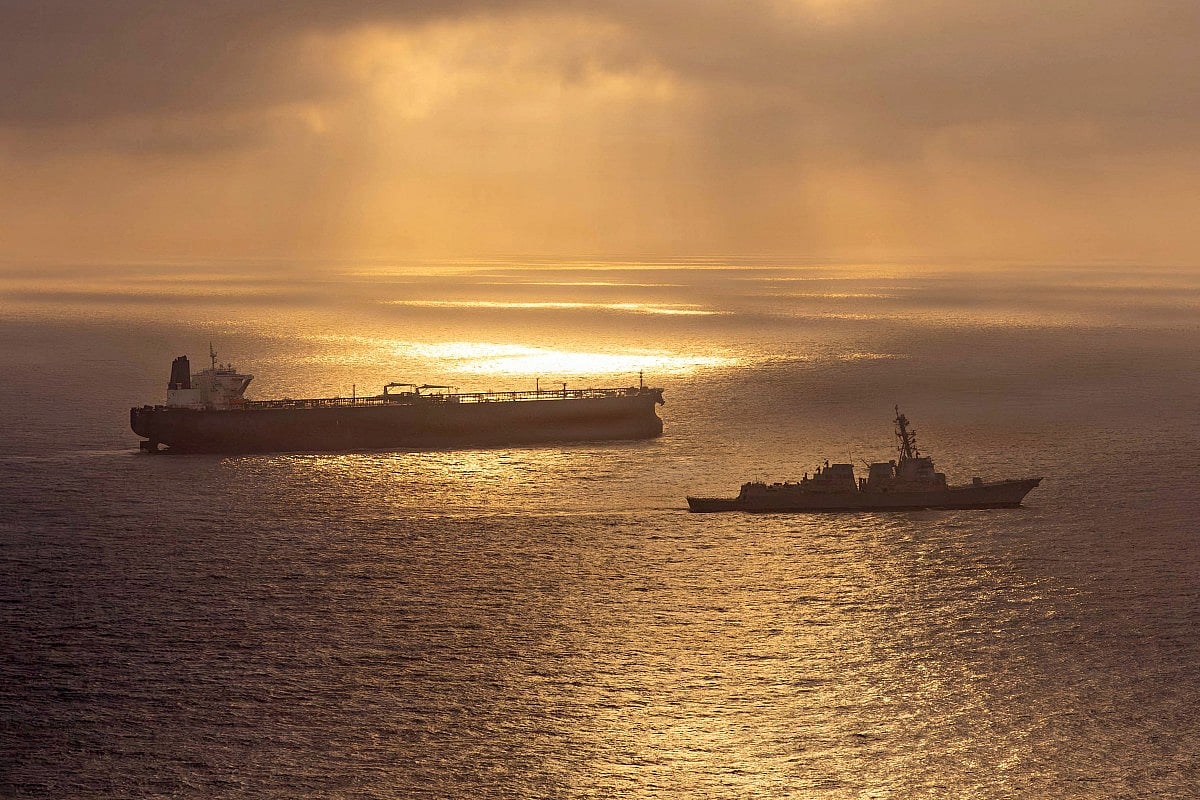
The US naval blockade of Iran has effectively halted the regime's oil exports as well as local fuel supplies.
Washington and allied analysts frame it as an economic weapon — a pressure campaign intended to either compel a change in Tehran’s policy on the Strait of Hormuz or contribute to broader political change inside the Islamic Republic.
US Energy Secretary Chris Wright has confirmed record post‑war volumes of oil transiting the strait, underscoring that the blockade is focused on stopping Iranian cargoes rather than closing the waterway to global trade.
Get it: Fast, verified news for FREE ... download the Gulf News app — simply click here
At the same time, tanker data show Iran’s crude loadings have collapsed to a fraction of pre‑war levels, with some weeks recording virtually no meaningful shipments through Hormuz for the first time on record.
Blockade 'succeeds where sanctions failed'
Unlike earlier sanctions eras, when Iranian crude continued to reach buyers via shadow fleets and opaque trading networks, the current US naval cordon has physically cut off fresh cargoes to China, Tehran’s largest remaining customer.
Analysts at the Institute for the Study of War (ISW) note that the US is now explicitly targeting sanctions‑evasion networks to deepen Iran’s isolation.
The rial’s depreciation and the blockade’s impact on export revenue are putting immense economic pressure on households and even security forces reliant on state salaries.
Reuters reported that Iran has gone about seven weeks without shipping meaningful crude through Hormuz, a historic first that is starving the government of foreign currency at a time when oil prices are elevated.
One former senior US Treasury official told US media that the blockade could destabilise the regime "within months" by squeezing elite patronage networks and the IRGC’s funding base.
Economic warfare as 'endgame'
Three think-tanks highlight how the blockade fits into a broader US strategy of economic warfare aimed at altering Iran’s strategic calculus:
Center on Global Energy Policy (CGEP) at Columbia University frames the war as having moved “beyond crude” to disrupt refined products and regional energy security. `
Sustained maritime pressure on Iran’s exports is part of a wider contest over who controls Gulf energy flows and at what price.
Institute for the Study of War (ISW) assesses that the US naval blockade is imposing high costs on Iran’s oil exports and broader economy, but so far has not softened Tehran’s maximalist position on Hormuz. ISW argues increased economic pain may strengthen internal arguments for a deal. Currently, hardline factions still dominate.
Analyses published by Foreign Policy and the Gulf States Newsletter have suggested that Iran’s appointment of Mohsen Rezaei as secretary of the Supreme National Security Council in August could signal preparations for a prolonged conflict.
Rezaei, a former senior IRGC commander and close ally of Supreme Leader Mojtaba Khamenei, is a prominent hard-liner.
After taking the post, Rezaei told Iranian media that the Strait of Hormuz would be reopened only if six conditions were met. They include the withdrawal of US forces from areas near Iran, an end to the US naval blockade, the release of Iran’s frozen overseas assets, a “forever” end to conflicts involving Gaza, Iraq, Lebanon and Yemen.
Some of those conditions were not explicitly included in the June memorandum of understanding.
There are currently no direct US-Iran talks.
On August 25, however, Pakistan said that it had made “significant progress” in its engagement with Iran, suggesting that diplomatic channels remain open despite the absence of formal negotiations between Washington and Tehran.
Together, these analyses portray the blockade not merely as a tactical naval operation but as the centrepiece of a campaign designed to erode Iran’s war‑financing capacity and test the regime’s resilience under sustained fiscal stress.
Tehran’s response: new maritime zones and cost‑imposition
In response, Iranian officials have announced plans for a new maritime “exclusion” or “restricted” zone near and outside the Strait of Hormuz, effectively expanding the area in which Tehran claims it can regulate shipping.
Rezaei said the zone would be established along the area covered by the US naval blockade, signaling an attempt to impose reciprocal costs on Gulf traffic.
ISW and Critical Threats Project reporting indicate Iran is increasingly using missile and drone attacks against US positions in the region as part of an effort to raise the cost of the American campaign and pressure Gulf states to push Washington toward an "off‑ramp".
Risk premium
The blockade’s success in curtailing Iranian exports has helped keep a larger share of Hormuz traffic flowing under US escort, with officials citing more than 40 vessels and over 17 million barrels in a single day moving through the strait.
Yet the wider conflict continues to lift freight rates, tighten refined‑product markets and embed a geopolitical risk premium in oil, reinforcing the view that this is as much an economic and maritime war as a military one.
For investors and policymakers, the key question is whether the economic squeeze will reach a "tipping point" that forces Iranian leaders to trade concessions on Hormuz access for relief, or whether prolonged pressure instead hardens Tehran’s stance and raises the risk of further escalation.
Network Links
GN StoreDownload our app
© Al Nisr Publishing LLC 2026. All rights reserved.