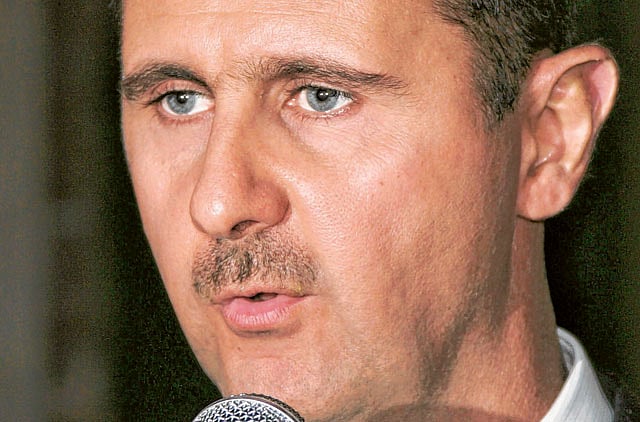
Washington/Geneva: President Barack Obama called directly Thursday for Syrian President Bashar Al Assad to resign, saying the brutal crackdown on anti-government protesters makes the heir to a long Middle East family dictatorship unfit to lead.
It was the administration's first explicit demand for Al Assad to step down and was accompanied by an executive order freezing all Syrian government assets in the US and targeting the country's lucrative energy sector.
The move was coordinated with the United Nations and with US allies in Europe and the Middle East and followed an intense diplomatic campaign to increase pressure on Al Assad. The European Union issued an identical call shortly after Obama's statement, followed quickly by similar words from the leaders of France, Britain, Germany and Canada.
And just before Obama made his demand, UN rights investigators said Syria's crackdown "may amount to crimes against humanity" and should be referred to the International Criminal Court.
In a written statement released by the White House, Obama said Al Assad had failed to follow through on promises to reform and instead escalated a brutal crackdown on pro-reform activists that rights groups say has killed nearly 2,000 people since an uprising against his regime began five months ago.
"His calls for dialogue and reform have rung hollow while he is imprisoning, torturing, and slaughtering his own people," Obama said. "We have consistently said that President Al Assad must lead a democratic transition or get out of the way. He has not led. For the sake of the Syrian people, the time has come for President Al Assad to step aside."
"It is clear that President Al Assad believes that he can silence the voices of his people by resorting to the repressive tactics of the past. But he is wrong," Obama said.
In New York, UN investigators said Thursday Syria's crackdown on anti-government protesters may be grounds for prosecutions for crimes against humanity at the International Criminal Court (ICC), adding that they had evidence against 50 suspects.
Syrian forces have fired on peaceful protesters throughout the country, often at short range and without warning, killing at least 1,900 civilians, including children, the investigators said in a report to the UN Human Rights Council. Their wounds were “consistent with an apparent shoot-to-kill policy.”
Some were reportedly finished off with knives. Tanks, grenades, snipers, heavy machine guns and helicopters have been used in the assault aimed at quashing opposition to the rule of President Bashar Al Assad.
Pattern of violations
"The mission found a pattern of human rights violations that constitutes widespread or systematic attacks against the civilian population, which may amount to crimes against humanity," the report said. The UN Security Council should consider referring the situation in Syria to the International Criminal Court (ICC), it recommended.
Syria has signed but not ratified the treaty, meaning that the ICC has no jurisdiction for international crimes committed there unless the Security Council specifically refers Syria to the Hague-based court. The Security Council referred Libya to the ICC in February for its violent crackdown.
The team led by deputy UN High Commissioner for Human Rights Kyung-wha Kang, whose report covers mid-March to mid-July, was not allowed into Syria but interviewed victims and
Witnesses in four countries, including some still in Syria.
It compiled a confidential list of 50 people at various levels of government allegedly linked to the crimes and said it may present it “in the context of future investigations and possible indictments by a competent prosecutor”.
The report catalogued alleged atrocities by Syria’s security and intelligence agencies but said they were immune from prosecution within Syria.
Syrian authorities did not dispute the death toll of 1,900 but said it included police and security officers, and said the protests were a cover for saboteurs aiming to overthrow the regime, according to the 22-page report.
The report's publication coincides with a Security Council session being held later on Thursday in New York, where UN High Commissioner for Human Rights Navi Pillay is to announce a higher toll reflecting escalating casualties since mid-July.
Children tortured
"Reports from witnesses indicate that there was a widespread modus operandi to kill civilians by using a) forces on the ground, b) snipers on rooftops and c) air power. Consistent with an apparent shoot-to-kill policy, most of the victims' bullet wounds were located in the head, chest and general upper body area," the report said.
"Children have not only been targeted by security forces, but they have been repeatedly subject to the same human rights and criminal violations as adults, including torture," it said.
Torture, including severe beatings and electric shocks, has been widespread, while the fate of hundreds of others swept up in mass arrests is unknown, the investigators said.
The team had corroborative eyewitness statements regarding "numerous summary executions, including 353 named victims", that took place outside of the context of the demonstrations.
On the protests, it said: "The majority of killings reported were due to live ammunition, coming from security forces, the military and Shabbiha elements, using Kalashnikovs and other guns." Shabbiha is an Alawite civilian militia close to the government that is accused of widespread abuses.
Former soldiers testified that they had received clear orders to use live ammunition against protesters. “Those who did not shoot civilians were shot from behind by other security officers and Shabbiha units,” the report said.
"There was a clear pattern of snipers shooting at demonstrators, including reports that officers were specially trained to be used against civilian demonstrations," it said.
UN investigators interviewed more than 180 people in four countries, including many in Turkey. Witnesses included Syrian soldiers who had defected, "some of whom had refused to follow orders to shoot civilians", according to the report.
Soldiers forced to fire
In Hama on June 3, where security officers told protesters not to approach a security perimeter, it said: "A few protesters managed to get through and handed flowers to some of the security officers.
"As they turned back, security forces fired on the protesters, causing them to either disperse or lie flat on the ground ... Tens of demonstrators were reportedly killed, while others who were wounded were said to have died due to absence of adequate or timely medical treatment."
In the village of Al Mastuam, south of Idlib, it said: "Witnesses described a peaceful march with demonstrators carrying olive branches but that they were fired upon with live ammunition without warning ... An estimated 200 people were injured and 30 others killed, some of them reportedly being 'finished off' with knives as they lay on the ground."
In Jisr Al Shughour in June, witnesses said security forces used tear gas and helicopters to fire at crowds, but 17 soldiers who refused the orders were killed by a senior security official whose fate was not clear, the report said.
US officials acknowledged that Obama’s call is not likely to have any immediate impact on the Syrian regime's behavior. But they said it would send a powerful signal that Al Assad is no longer welcome in the international community. And they noted that the additional sanctions would further boost pressure on Al Assad and his inner circle.
To that end, Obama also authorized the administration to impose tough new sanctions aimed at choking off Syrian revenue from its lucrative oil and gas exports. The authority allows the Treasury Department to freeze the assets of Syrian state-run petroleum companies in the US and bans Americans from doing business with them.
The sanctions "further tighten the circle of isolation" and "strike at the heart of the regime," Secretary of State Hillary Rodham Clinton said in televised remarks from the State Department.
The order immediately bans the import into the United States of any Syrian petroleum or petroleum products. Syria is not a huge source of oil for the US, anyhow. But if European allies join the effort, it could significantly affect one of the regime's top sources of revenue. Syrian crude oil exports go mostly to European countries such as Germany, Italy, and France, according to the US Energy Information Agency.
Obama's order also denies Syria access to the US financial system, freezing all Syrian government assets that are subject to US jurisdiction. It also prohibits any US citizen from engaging in transactions with the regime, investing in the country or exporting services to Syria. Under the order, the Treasury Department also could impose sanctions against persons who give support to Al Assad’s government.
The US had already hit more than 30 Syrian regime officials, including Al Assad himself and members of his inner circle, and firms, with sanctions. It has also lobbied other nations to take similar steps, something Clinton predicted would come soon. "It is time for Al Assad to get out of the way," she said.
Sign up for the Daily Briefing
Get the latest news and updates straight to your inbox
Network Links
GN StoreDownload our app
© Al Nisr Publishing LLC 2026. All rights reserved.