An EA-18G Growler landing on the flight deck of the Nimitz-class aircraft carrier USS Abraham Lincoln in the Indian Ocean on Jan. 23, 2026
Trump mulls strikes on Iran security forces, sites to spark renewed protests
US weighs military pressure to create conditions for ‘regime change’
Last updated:
4 MIN READ
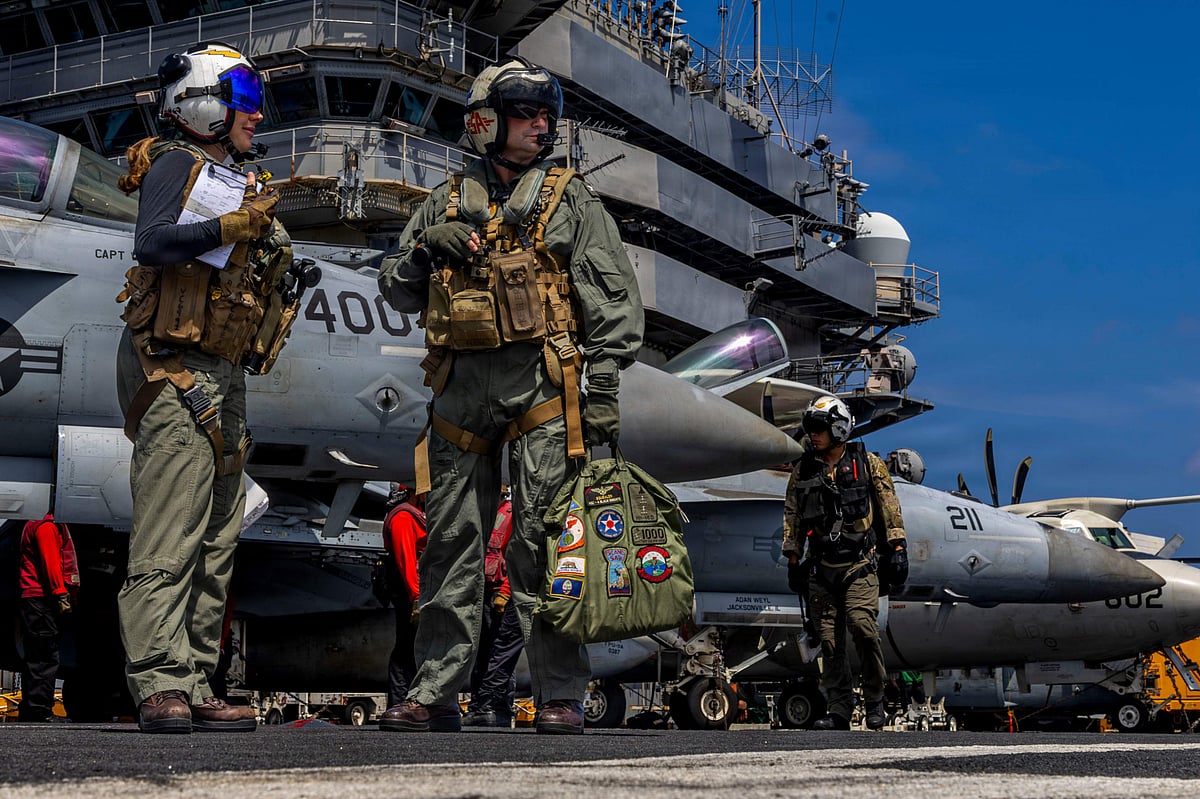
This handout image from the US Navy shows Capt. Daniel Keeler, the commanding officer of the Nimitz-class aircraft carrier USS Abraham Lincoln, as he prepares to fly an MH-60R Sea Hawk helicopter in the Indian Ocean on Jan. 23, 2026.
AP
Dubai: US President Donald Trump is weighing military options against Iran — including targeted strikes on senior security commanders and key institutions — in a bid to shake the country’s leadership and embolden protesters after a brutal crackdown on nationwide unrest, Reuters reported.
Multiple sources familiar with the discussions said Trump wants to create conditions for what aides describe as “regime change,” following weeks of demonstrations that authorities crushed with force, killing thousands.
Two US officials told Reuters that the White House is considering precision strikes against figures and organizations Washington holds responsible for the violence, with the aim of boosting public confidence to seize government and security buildings.
Another option under review is a much broader military operation with long-term impact — potentially targeting Iran’s ballistic missile capabilities or its nuclear enrichment facilities.
However, Trump has not made a final decision, one source said.
The arrival of a US aircraft carrier strike group and accompanying warships in the Middle East this week has expanded Washington’s ability to act militarily, after Trump repeatedly warned Iran over its crackdown.
Yet Arab officials, Western diplomats and Israeli sources cautioned that air power alone would not topple Iran’s clerical leadership — and could instead weaken an already shaken protest movement.
Alex Vatanka of the Middle East Institute described Iran’s demonstrators as “heroic but outgunned,” saying major military defections would be needed to shift the balance of power.
Sailors taxiing an F/A-18E Super Hornet on the flight deck of the Nimitz-class aircraft carrier USS Abraham Lincoln in the Indian Ocean on Jan. 25, 2026.
An Iranian official said Tehran was preparing for possible confrontation while still pursuing diplomacy, accusing Washington of showing little openness to talks.
Iran insists its nuclear programme is civilian and says it is ready for dialogue based on “mutual respect,” but warned it would defend itself “like never before” if attacked.
Trump’s earlier demands have reportedly included banning Iran from enriching uranium, curbing its ballistic missile programme, and limiting Tehran’s regional proxy network.
Limits of military force
A senior Israeli official involved in planning discussions with Washington said airstrikes alone would not bring down the Islamic Republic.
“If you’re going to topple the regime, you have to put boots on the ground,” the official said, adding that even killing Supreme Leader Ayatollah Ali Khamenei would only result in a replacement leader.
US intelligence assessments reportedly echo that view, concluding that while protests have weakened Iran’s leadership, no major fractures have emerged within the ruling system.
Another Western source said Trump appears focused on engineering a leadership shift — similar to US efforts in Venezuela — rather than dismantling the entire government structure.
Khamenei has acknowledged thousands of deaths during the unrest, blaming the US, Israel and what he called “seditionists.”
Rights group HRANA estimates nearly 6,000 people have died, including over 200 security personnel, while official figures place the toll above 3,000. Reuters said it could not independently verify the numbers.
Power concentrated in the Guards
At 86, Khamenei has reduced public appearances and is believed to be operating from secure locations after Israeli strikes last year killed several senior Iranian military figures.
Regional officials said day-to-day control has increasingly shifted to leaders tied to the Islamic Revolutionary Guard Corps (IRGC), which dominates Iran’s security forces and large sectors of the economy.
Despite this, Khamenei retains final authority over war decisions, nuclear strategy and succession — making political change unlikely while he remains in power.
Diplomats warned that there is no clear successor, raising fears that the IRGC could tighten its grip if a transition occurs, deepening regional tensions.
Any leader seen as emerging under foreign pressure would likely be rejected domestically and could strengthen hardliners, they said.
Regional fallout fears
Across the Middle East, US allies fear the consequences of a wider conflict.
Regional states — including Saudi Arabia, Qatar, Oman and Egypt — have urged Washington against striking Iran, worried they would be prime targets for retaliation.
Saudi Crown Prince Mohammed bin Salman has reportedly told Iran’s president that Riyadh would not allow its airspace or territory to be used for attacks on Tehran.
“The United States may pull the trigger,” one Arab official said, “but we will live with the consequences.”
Analysts warned that destabilising a nation of 90 million could trigger civil war, refugee flows, militant violence and disruption of oil shipments through the Strait of Hormuz.
Vatanka said the gravest risk is Iran fracturing into a Syria-like conflict, with rival factions fighting for territory and resources.

A Senior Associate Editor with more than 30 years in the media, Stephen N.R. curates, edits and publishes impactful stories for Gulf News — both in print and online — focusing on Middle East politics, student issues and explainers on global topics. Stephen has spent most of his career in journalism, working behind the scenes — shaping headlines, editing copy and putting together newspaper pages with precision. For the past many years, he has brought that same dedication to the Gulf News digital team, where he curates stories, crafts explainers and helps keep both the web and print editions sharp and engaging.
Sign up for the Daily Briefing
Get the latest news and updates straight to your inbox
Network Links
GN StoreAbout Gulf NewsTerms & ConditionsReach by GNSitemapContact usPrivacy PolicyGN FocusHave your sayWork with usAdvertise with usGulf News epaperPrinting Services
Download our app
© Al Nisr Publishing LLC 2026. All rights reserved.