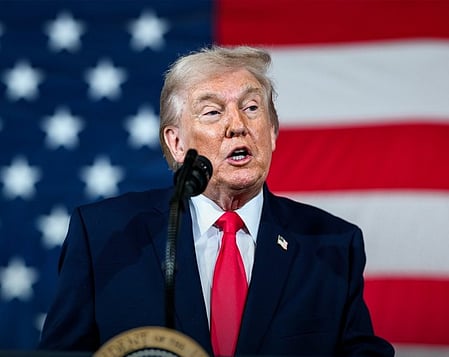
President Donald Trump said late on Monday that negotiations with Iran will conclude rapidly “one way or the other,” prioritising the full reopening of the Strait of Hormuz as early as Tuesday before addressing Tehran’s nuclear program.
“They’re going to go quickly one way or the other. It’s not very complex,” Trump said in remarks shared by the White House Rapid Response account.
“We’re talking about the opening of the Strait, having it open literally by tomorrow (Tuesday, August 4, 2026) — completely open. That’s phase one, and phase two is we then will talk about the nuclear… we’re very strong on it: they cannot have a nuclear weapon.”
Get it: Fast, verified news for FREE ... download the Gulf News app — simply click here
The comments, delivered from the Oval Office with officials standing behind him, come amid fragile diplomacy in a conflict that has disrupted global energy markets for months.
Trump says US will not allow Iran to charge Strait of Hormuz transit fees President Donald Trump said the United States would not allow Iran to impose fees on ships using the Strait of Hormuz, insisting navigation through the strategic waterway must remain free. He said Washington retained "total control" and warned that any attempt by Tehran to charge vessels would not be accepted. Trump also referred to what he described as a potential US blockade capability, dismissing the prospect of Iran collecting transit fees. "There won't be charging," he said. "We are not talking about charging at all."
'Last chance for Iran'
Trump indicated talks were underway and described them as Iran’s “last chance” to reach an acceptable agreement.
The statement follows Trump’s decision over the weekend to pause planned US military strikes on Iran.
He said the delay came at the request of Saudi Arabia, the United Arab Emirates, Qatar and Iran itself, citing expectations of a deal focused on the strategic waterway and broader issues including denuclearisation.
Iran asserts control over Hormuz
The Strait of Hormuz, a critical chokepoint through which roughly one-fifth of the world’s oil typically passes, has seen sharply reduced traffic since the fighting intensified.
Iran has asserted control over routes and engaged in discussions with Oman about establishing a temporary safe corridor for vessels, while denying it is holding direct negotiations with the United States.
US officials have described ongoing indirect contacts.
Trump has repeatedly insisted any arrangement must ensure Iran cannot obtain a nuclear weapon, a longstanding American red line.
Oil prices fell earlier Monday on optimism around potential diplomacy, though shipping through the strait remains limited compared with pre-conflict levels.
Gulf allies have urged restraint to avoid further escalation that could worsen regional instability and energy supply disruptions.
The conflict, which escalated significantly in early 2026 after earlier strikes involving the United States and Israel, has featured cycles of military action, temporary pauses and failed or partial understandings on maritime access and nuclear issues.
Previous frameworks, including a June memorandum, aimed at reopening the strait and addressing hostilities but faced repeated setbacks over compliance and sequencing of nuclear talks.
Trump has framed the current effort as giving Iran a final opportunity to avoid further military consequences while emphasising U.S. readiness to act if needed. Iranian officials have publicly rejected claims of direct U.S. talks and stressed mediation through Oman.
Further developments in the negotiations were expected as of Monday afternoon and into Tuesday in the Gulf.
Sign up for the Daily Briefing
Get the latest news and updates straight to your inbox
Network Links
GN StoreDownload our app
© Al Nisr Publishing LLC 2026. All rights reserved.