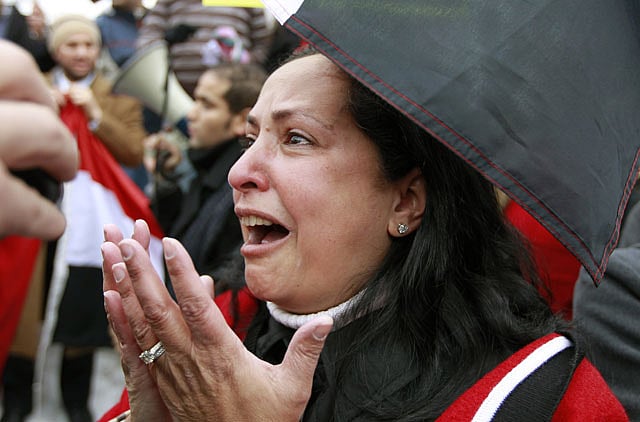
Dubai: Chaos prevailed in Egypt Saturday as attempts by President Hosni Mubarak to quell the anger in the streets fell on deaf ears.
In two unprecedented appointments, Omar Sulaiman was sworn is as vice-president of Egypt and former aviation minister Ahmad Shafiq was appointed prime minister.
Analysts view the appointments as an attempt by Mubarak to compromise with protesters and the first signal that he is preparing to step down.
Sulaiman's military background has won him the wide respect of the population. However, his appointment as Egypt's first vice-president in 30 years is seen as a stalling tactic.
"It is one last attempt to stop the inevitable," an Egyptian citizen commented on Al Jazeera.
US critical
In another unusually critical reaction from the US, a State Department official reacted to the news of the appointment by saying that "Mubarak cannot simply reshuffle the card deck".
Mubarak's placatory move came on a day when angry Egyptians took to the streets in the thousands demanding his resignation.
Mubarak's announcement on Friday to sack his cabinet angered Egyptians even more and protesters say they will not stop until he leaves office.
The Ministry of Interior was reportedly stormed by an angry mob. Mubarak deployed the army to quell the protests, but troops backed by tanks made no attempt to break up the demonstrations.
Protesters encouraged them to support their cause and some soldiers obliged. The scene contrasted with Friday when police and protesters fought pitched battles with teargas, rubber bullets and stones. Up to 100 people have been killed in clashes across the country.
While the police are generally feared as an instrument of repression, the army is seen as a national institution.
Senior official resigns
In a related development, Egyptian senior ruling party member Ahmad Ezz, widely seen as a lynchpin of a corrupt regime, resigned from the National Democratic Party yesterday.
Meanwhile, the Arab world's influential cleric Yousuf Al Qaradawi yesterday urged Mubarak to step down, saying that his resignation was the only solution to Egypt's crisis.
In an interview with Al Jazeera, Al Qaradawi said: "President Mubarak ... I advise you to depart from Egypt ... There is no other solution to this problem but for Mubarak to go."
The protests are not only unprecedented in Mubarak's 30-year tenure, but have many Arab nations watching nervously as Egypt is the most populous and arguably the most important Arab country in terms of regional politics.
Sign up for the Daily Briefing
Get the latest news and updates straight to your inbox
Network Links
GN StoreDownload our app
© Al Nisr Publishing LLC 2026. All rights reserved.