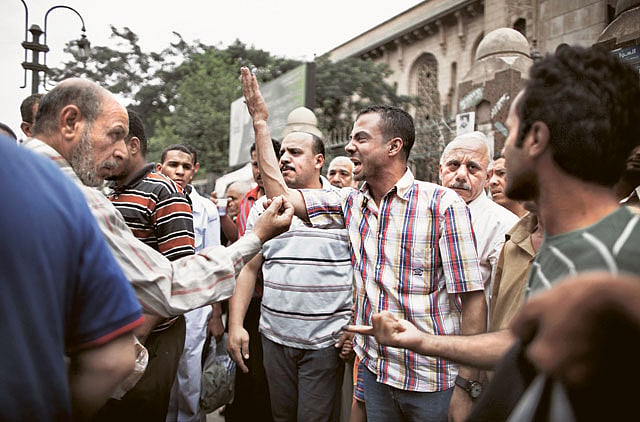
Cairo: Faced with the stark choice in Egypt’s presidential run-off vote between a conservative Islamist and a former secular-minded military general, Paul Khalil, a Christian medical student, knows to whom he will vote.
“Since they dominated the political scene in Egypt after Hosni Mubarak’s toppling [in February last year], Islamists have only succeeded in fuelling our fears about our freedoms in this country,” he said. “They are now planning for the creation of a religious state in Egypt. And they must not be allowed to do this. A strong president, believing in equality and civic rights, will be able to stop them,” he added.
The June 16-17 run-offs are pitting the powerful Muslim Brotherhood’s candidate Mohammad Mursi against Ahmad Shafiq, Mubarak’s last prime minister and a former air force commander.
“Although he is part of the Mubarak regime, Shafiq will be better than the Brotherhood. I’ll vote for Shafiq,” said Khalil.
Several Islamist groups, including the ultra-conservative Salafists, have pledged support for Mursi, an engineering professor known for his loyalty to the Brotherhood’s ideology.
Mursi, 61, promised at a press conference on Saturday in Cairo, to be “a president for all Egyptians”—echoing a pledge made earlier in the day by his 70-year-old rival.
The Brotherhood controls the parliament, with critics saying that the group will tighten its grip on ruling institutions if its candidate wins the top post in this predominantely Muslim country.
“If Islamists take power, they will not leave it because they do not believe in power rotation,” said Ebrahim Nasr Eddin, a political science professor. “With them at helm, Egypt will become something like Somalia, Afghanistan or Pakistan,” he added.
Analysts predict that the Christian minority, accounting for around ten per cent of Egypt’s 82 million population, will most likely vote for Shafiq.
“The Coptic votes will go to Shafiq because Christians refuse to see a religious state in Egypt, which will be created if the Brotherhood lays their hands on the presidential post too,” said Kamal Zaker, a Christian writer. He believes that the Brotherhood’s current attempts to project a moderate image is unlikely to make the Coptic change their minds.
Following Shafiq’s surprise success in securing a run-off place, several Coptic clerics vehemently denied that Christians had voted for the ex-army general, viewed as an extension of the Mubarak regime.
“The Copts did not vote for a certain candidate in the first round of the election,” said Bishop Basenti in Cairo. “There were those who also voted for Hamdeen Sabahi and Amr Mousa,” he told Gulf News, referring to two secular-minded contenders who failed to make the run-offs.
Boasting a large grassroots base, mainly in Egypt’s countryside, the Brotherhood is almost sure that its candidate in the run-off will obtain the votes given to the two other Islamists in the first round — Abdul Moneim Abu Al Fotouh and Salim Al Awwa. The group, meanwhile, seeks votes of the country’s liberals by portraying the looming election as a battle between the revolutionaries and the Mubarak holdovers.
Mustafa Abdul Nabi, who voted for Abu Al Fotouh in the first round, intends to vote for the Brotherhood’s contender. “I’ll do this not only because Mursi has pledged to enforce Islamic sharia [law], but also to thwart the bid by the Mubarak regime to return to power through Shafiq,” he said.
“Shafiq’s win will also be an affront to the martyrs who sacrificed themselves to remove Mubarak and his corrupt regime,” he said, referring to more than 840 killed in the revolt against Mubarak.
“Our Coptic brethren should not allow their exaggerated fears to push them to the side of Shafiq and the hateful regime he represents,” he added.
Sign up for the Daily Briefing
Get the latest news and updates straight to your inbox
Network Links
GN StoreDownload our app
© Al Nisr Publishing LLC 2026. All rights reserved.