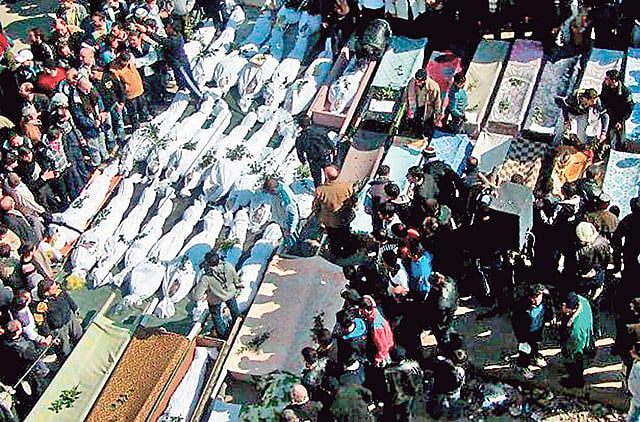
UNITED NATIONS: Russia and China vetoed on Saturday a UN resolution that backed an Arab plan calling on Syrian President Bashar Al Assad to quit, stalling global efforts to end his bloody crackdown on unrest after hundreds were reported killed in the city of Homs.
The high-level diplomatic setback came after world leaders and Syrian opposition activists accused Assad's forces of a massacre in a sustained shelling of Homs, the bloodiest episode in 11 months of upheaval in the pivotal Arab country.
Russia and China joined in a double veto to bar a Western- and Arab-driven resolution at the UN Security Council endorsing the Arab League plan for Assad to hand power to a deputy to make way for a transition towards democracy.
The other 13 council members voted for the resolution that would have said the council "fully supports" the League plan aimed at stopping Syria's bloodshed, whose sectarian overtones threaten stability in the wider Middle East region.
Russia complained that the draft resolution was an improper and biased attempt at "regime change" in Syria, which is Moscow's sole remaining sphere of influence in the Middle East and an important destination for Russian arms exports.
With an eye to events in Homs, US Ambassador to the U.N. Susan Rice dispensed with the usual diplomatic courtesies and declared she was "disgusted" by the Russian-Chinese veto, adding that "any further bloodshed that flows will be on their hands".
Shortly before the Security Council voted, US President Barack Obama denounced the "unspeakable assault" on Homs, demanded that Assad leave power immediately and called for U.N. action against Assad's "relentless brutality".
"Yesterday the Syrian government murdered hundreds of Syrian citizens, including women and children, in Homs through shelling and other indiscriminate violence, and Syrian forces continue to prevent hundreds of injured civilians from seeking medical help," Obama said in a statement. "Any government that brutalises and massacres its people does not deserve to govern."
He and other Western and Arab leaders exerted unprecedented pressure on Assad's veto-wielding ally Russia to allow the Security Council to pass a resolution backing an Arab League call for Assad to relinquish his autocratic powers.
SECOND VETO IN FOUR MONTHS
But Russia, and China following Moscow's lead, weighed in to torpedo U.N. action on Syria for the second time in four months. In October, they vetoed a European-drafted resolution condemning Syria and threatening it with possible sanctions.
US Secretary of State Hillary Clinton said on Saturday it had not been possible to work constructively with Russia ahead of the vote, even though military intervention in Syria - fiercely opposed by Moscow - had been absolutely ruled out.
"I thought that there might be some ways to bridge, even at this last moment, a few of the concerns that the Russians had. I offered to work in a constructive manner to do so. That has not been possible," she told reporters at a Munich security conference.
Clinton warned that the risk of more bloodshed and civil war in Syria had risen after the collapse of the U.N. resolution.
"If we do not begin the process, I know what will happen: more bloodshed, increasing resistance by those whose families are being killed and whose homes are being bombed, and a greater likelihood that Syria will descend into civil war."
The uprising pits Syria's majority Sunni Muslims against Assad's minority Alawites, an offshoot of Shi'ite Islam, who have dominated the country's power structure for decades.
After what U.S. officials called "vigorous" talks between Clinton and Sergei Lavrov, Moscow announced that its foreign minister and its foreign intelligence chief would fly to Syria on Tuesday to meet Assad. The purpose of their trip was not given.
Residents of Homs' battered Baba Amro district, speaking by telephone, denounced the Russian-Chinese veto, some chanting "Death, rather than disgrace".
One resident who identified himself as Sufyan said: "Now we will show Assad. We're coming, Damascus. Starting today we will show Assad what an armed gang is." Assad has called his opponents "armed gangs" and "terrorists" steered from abroad.
Mohammed Loulichki, the U.N. ambassador of Morocco, the sole Arab member of the 15-nation council, voiced his "great regret and disappointment" at the Russian-Chinese veto. French Ambassador Gerard Araud said: "It is a sad day for this council, a sad day for all Syrians, and a sad day for democracy."
US and European officials had earlier rejected a series of Russian amendments to the draft resolution.
WEST REJECTS EQUAL BLAME
The changes, seen by Reuters, would have introduced language assigning blame to Syria's opposition, as well as the government, for violence in which the United Nations says more than 5,000 people have died. Western nations reject the idea of equal blame, saying Assad's government is mainly responsible.
Moscow objected that the resolution contained steps against Assad, but not against his armed opponents, Lavrov said. "Unless you do it both ways, you are taking sides in a civil war."
Russia had also insisted on dropping a demand that the Syrian government withdraw its security forces from cities, but US and European delegations rejected that.
Moscow said before the vote that the resolution was not "hopeless", but its wording needed to be altered to avoid "taking sides in a civil war". Lavrov said it was still possible to reach consensus.
France called the Homs assault a "massacre" and a "crime against humanity". Turkey said hundreds had been killed and the United Nations must act. Tunisia expelled the Syrian ambassador, and the flag above its embassy was brought down.
Death tolls cited by activists and opposition groups ranged from 237 to 260, making the Homs attack the deadliest so far in Assad's crackdown on protests and one of the deadliest episodes in the "Arab Spring" of revolts that have swept the region.
Residents said Syrian forces began shelling the Khalidiya neighbourhood at around 8 p.m. (1800 GMT) on Friday using artillery and mortars. They said at least 36 houses were completely destroyed with families inside.
"We were sitting inside our house when we started hearing the shelling. We felt shells were falling on our heads," said Waleed, a resident of Khalidiya.
"The morning has come and we have discovered more bodies, bodies are on the streets," he said. "Some are still under the rubble. Our movement is better but there is little we can do without ambulances and other things."
An activist in the neighbourhood contacted by Reuters said residents were using primitive tools to rescue people. They feared many were buried under rubble.
"We are not getting any help, there are no ambulances or anything. We are removing the people with our own hands," he said, adding there were only two field hospitals treating the wounded. Each one had a capacity to deal with 30 people, but he estimated the total number of wounded at 500.
"We have dug out at least 100 bodies so far, they are placed in the two mosques."
Sign up for the Daily Briefing
Get the latest news and updates straight to your inbox
Network Links
GN StoreDownload our app
© Al Nisr Publishing LLC 2026. All rights reserved.