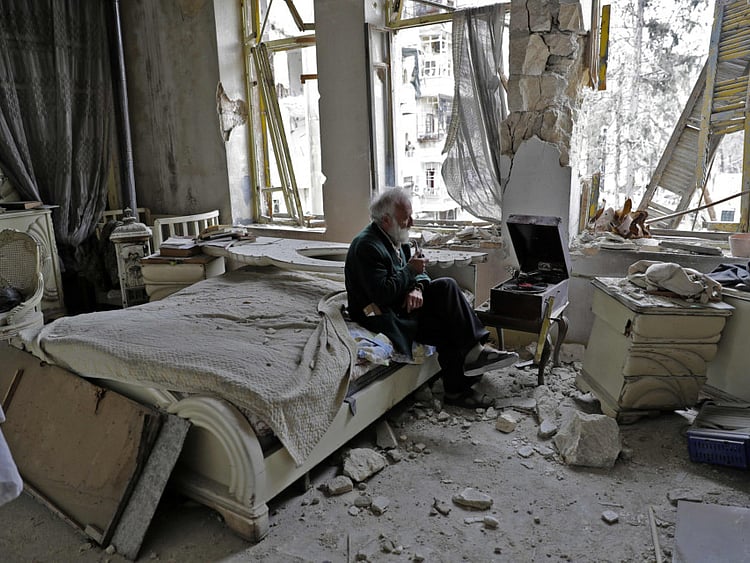
Damascus: Batteries have become a necessity in Syria to combat the country’s worsening electricity shortage.
While cuts in upper-end Damascus districts like Malki and Abu Rummaneh are no more than 4 hours per day, other areas of the country face cuts of up to 16 hours a day.
In other parts of Damascus, like the commercial Shaalan and Salhieh quarters and the entire Old City, power cuts sometimes reach up to 20 hours daily.
A popular joke making the rounds in Syria goes like this: “A man calls the minister of electricity and tells him ‘I am the minister of Smurfs’. The minister laughs and replies: ‘There are no Smurfs for them to have a minister’. The man replies: ‘Well there is no electricity either for it to have a minister’”.
An employee at the ministry of electricity told Gulf News that four power plants have been out-of-order since 2012, explaining why the power cuts remain high and are increasing by the day.
Remaining power plants have not been able to keep up with electricity demands due to a fuel shortage in the country.
When electricity goes off, residents used to switch to power generators running on diesel or petrol, but now are forced to turn to batteries.
Mustafa Tinawi closed down his pajama factory two months ago due to power shortages.
“I wasn’t able to operate at even half-capacity,” he told Gulf News.
“The cost of production doubles due to power generators and the high price of fuel that I have to pay to get my machines running. I can no longer compete in the market, especially not with the fluctuating currency rates of the Syrian pound to the US dollar, which changes by day and makes it impossible to price any product.”
The power cuts have even taken a toll on diehard regime backers who are growing increasingly frustrated with the lack of basic amenities in the country.
“We waited for six years and this is what we get? Water shortage, gasoline shortage, heating fuel shortage and days without electricity — for what; corruption and bad government” said Ali Abu Mustapha, a 40-year old engineer-turned second hand phone salesman because of the war.
“In our parts of the city in Mezzeh 86 (a neighbourhood inhabited mostly by army personnel) we barely see electricity anymore, whereas where the rich people live in Malki, they get almost round-the-clock of electricity! My children spent the winter in darkness and coldness, and nobody seems to care. We are living again in the stone age!” “Even the batteries are becoming useless. They need four hours to re-charge and we aren’t getting four hours of electricity anymore. Just two hours, followed by five hours of blackout, during which the batteries go dead!”
Bilal Al Khatib, a Damascus-resident and father of five, told Gulf News: “I am a government employee at a managerial level and my salary, with perks, is $150 per month. During the first two months of this year, I had to spend $50 each month to buy water for my family from the black market, because Damascus was left with no running water. That left me with $100 per month. I cannot afford to to go to work by taxi as it will cost me $80 per month, I cannot fill up my car because of the gasoline shortage, so I have to take overcrowded public buses to reach my office. My phone bill is $20 per month. That leaves me with $80, which are barely enough for daily necessesities.
"I haven’t been to a restaurant in five years as three of my children are studying in university. I cannot afford it anymore. For the first time in six years, I am ready to pack up and leave; I don’t know where to go but I have to get out of here at any cost. Neither mortars forced me out of my city, nor the kidnappings, thefts and the US strikes. I am leaving the city because of the bad government.”
Sign up for the Daily Briefing
Get the latest news and updates straight to your inbox
Network Links
GN StoreDownload our app
© Al Nisr Publishing LLC 2026. All rights reserved.