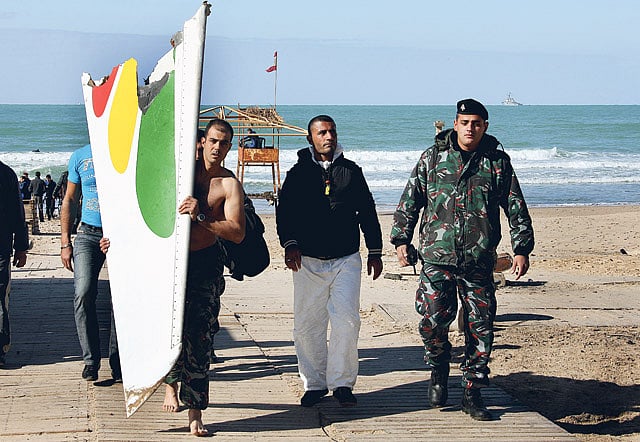
Beirut: The pilot of an Ethiopian Airlines plane that crashed into the sea shortly after takeoff from Beirut performed "a very fast and strange turn before disappearing from the radar", Lebanon's transportation minister said on Tuesday.
All 90 people on board were feared dead after the plane went down in flames at about 2:30am on Monday, during a night of lightning and thunderstorms.
Transportation Minister Ghazi Aridi told The Associated Press that the pilot flew in the opposite direction than recommended by the Beirut control tower after taking off.
The tower "asked him to correct his path but he did a very fast and strange turn before disappearing completely from the radar", Aridi said.
It was not clear why that happened or whether it was beyond the pilot's control. Like most other airliners, the Boeing 737 is equipped with its own onboard weather radar which the pilot may have used to avoid flying into thunderheads.
Lebanese officials have ruled out terrorism or "sabotage". The plane was headed to the Ethiopian capital, Addis Ababa.
An aviation analyst familiar with the investigation said Beirut air traffic control was guiding the Ethiopian flight through the thunderstorms for the first 2-3 minutes of its flight.
Standard procedure
The official, who asked not to be identified because of the sensitivity of the matter, said this was standard procedure by Lebanese controllers to assist airliners departing from the airport in poor weather conditions.
It is unclear exactly what happened in the last two minutes of flight, the official said.
Patrick Smith, a US-based airline pilot and aviation writer, said there were many possible causes for the crash.
"Had the plane encountered extreme turbulence, or had it suffered a powerful lightning strike that knocked out instruments while penetrating strong turbulence, then structural failure or loss of control, followed by an in-flight breakup, are possible causes."
Ethiopian Airlines said late on Monday that the pilot had more than 20 years of experience. It did not give the pilot's name or details of other aircraft the pilot had flown. It said the recovered bodies included those of Ethiopians and Lebanese.
The Lebanese army and witnesses say the plane was on fire shortly after takeoff.
Sign up for the Daily Briefing
Get the latest news and updates straight to your inbox
Network Links
GN StoreDownload our app
© Al Nisr Publishing LLC 2026. All rights reserved.