Voters wait in a queue to cast their ballots at a polling station in Jerusalem on October 27, 2026, on the day of Israel's legislative election.
Netanyahu's future on the line as Israel votes today: What you need to know
About 7.3m voters choose a new parliament amid war, security and political uncertainty
Last updated:
5 MIN READ
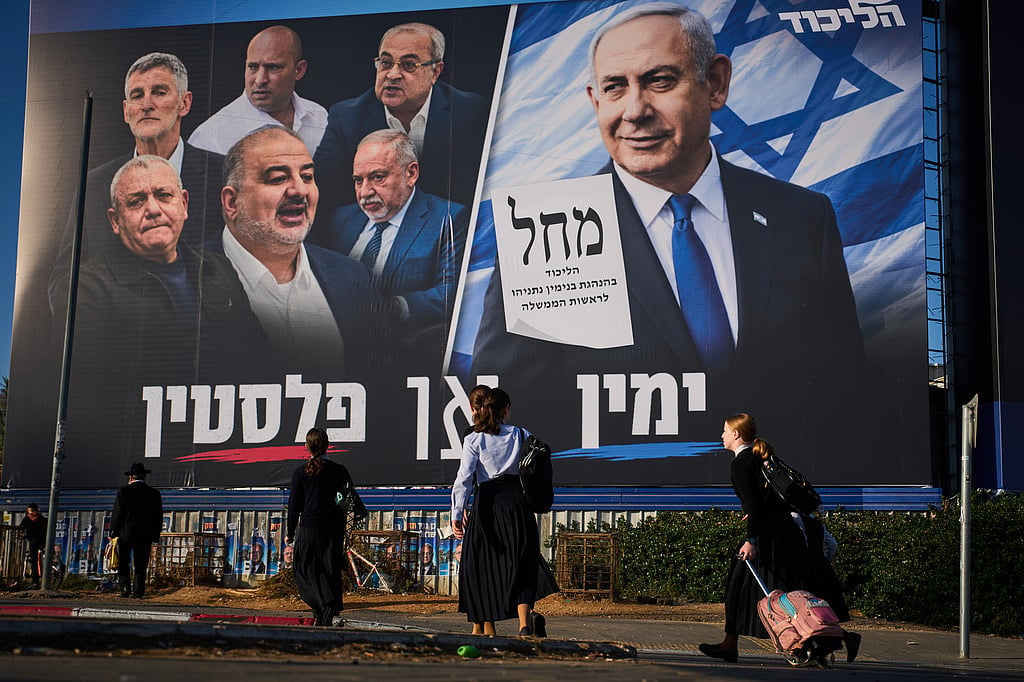
People walk past a Likud party campaign billboard featuring Israeli Prime Minister Benjamin Netanyahu alongside opposition party leaders and bearing the Hebrew slogan "Right or Palestine," ahead of Israel's general election. File photo taken in Beni Brak, Israel, Sunday, (Oct. 18, 2026).
AP File photo
Israelis vote on Tuesday (Oct. 27, 2026), from 7am.
About 7.3 million people are eligible to cast their ballots to pick the next government.
The vote is widely seen as a verdict on Prime Minister Benjamin Netanyahu.
It's a pivotal election: the first chance of the Israeli electorate to hold leaders accountable for the security failures around the October 7, 2023 attacks, to decide who leads the state through its regional conflicts, and to weigh in on the contentious issue of military service.
Arab capitals, both those that normalised ties with Israel and those that haven’t, are treating the vote as a critical decision point.
Here's a look at the basics and major parties/candidates in Israel's election Tuesday (Oct. 27, 2026).
Get it: Fast, verified news for FREE ... download the Gulf News app — simply click here
The basics
Type of government: Israel is a parliamentary democracy.
Knesset: Voters elect the 120-seat Knesset (the unicameral national legislature/parliament) of the State of Israel) located in Jerusalem.
The prime minister: The PM is head of government, and is the person who can build a majority coalition.
The president: Currently Isaac Herzog, is head of state and largely ceremonial but plays a key role in choosing who tries to form a government.
When it was founded: Israel declared independence on May 14, 1948.
Basic Laws: Israel has no single written Constitution. It operates under a flexible constitutional framework, similar to countries like the UK and New Zealand. Its system relies on a collection of core constitutional statutes known as the Basic Laws (Chukei Yesod), alongside judicial precedence and fundamental legal principles.
How often does Israel vote?
The Knesset normally serves a four-year term, but early elections are common when coalitions collapse.
Between 2019 and 2022, Israel held five elections because parties repeatedly failed to form stable governments.
This Knesset formally dissolved on July 17, 2026.
7.3 million
Total number of registered voters eligible to vote in the Israeli elections on Tuesday (Oct. 27, 2026)
Thirty-six (36) parties are running, but most won’t clear the 3.25% threshold.
Election Day Timeline
7 am (Jerusalem time): Most polling stations open nationwide (5:00am GMT | 9am UAE)
8 am: Special polling stations open in smaller communities, hospitals, prisons and care homes.
Through the day: Turnout figures come out at regular intervals, and leaders cast their ballots.
8 pm: Special polling stations close.
10 pm: Main polling stations close, and anyone already in line can still vote.
Exit polls: TV networks release exit polls, which are projections and can differ significantly from actual results.
Overnight: Votes are counted and preliminary results emerge.
Nov. 4, 2026: Official results are due by November 4, and the deadline for appeals is November 18.
A woman waits before casting her ballot to vote at a polling station in the Arab-Israeli town of Umm al-Fahm on October 27, 2026, on the day of Israel's legislative election.
Arab Members in the Knesset
In the 25th Knesset, 13 Arab members currently serve in the 120-seat parliament.
Arab residents and citizens in Israel are estimated at 2.17 million, making up about 21.7% of the country's total population, Jewish Virtual Library data show.
The Arab representation includes members of Muslim, Christian, and Druze communities.
These members represent both independent, Arab-majority political factions and broader cross-party lists:
Ra'am (United Arab List): 5 seats (led by Mansour Abbas)
Hadash–Ta'al: 5 seats (led by Ayman Odeh and Ahmad Tibi)
Zionist / Mainstream Parties: 3 seats (representing Likud, Yesh Atid, and Yisrael Beiteinu)
Israel's outgoing government (clockwise from top left): Benjamin Netanyahu (Prime Minister and Likud leader), Bezalel Smotrich (Finance Minister and Religious Zionism leader), Itamar Ben-Gvir (National Security Minister and Otzma Yehudit leader), Avigdor Liberman (Leader of Yisrael Beiteinu), Yitzhak Goldknopf (Leader of United Torah Judaism, UTJ), and Yair Lapid (Leader of the opposition Yesh Atid Party).
The Role of Israeli Arabs in the Knesset
Historically, Arab political parties operated primarily in the political opposition, acting as advocates for Arab minority rights rather than governing partners.
However, their role has evolved substantially. For example, Arab Members of the Knesset (MKs) advocate for municipal funding, infrastructure improvements, civil rights, combating organised crime in Arab towns, and ending housing discrimination.
They also serve as a vocal platform opposing policies toward Palestinians in the occupied territories.
Mansour Abbas, head of Israel's conservative Islamic Raam party, meets his supporters during a campaign rally in the Arab-Israeli village of Abu Gosh on October 21, 2026.
Who's running this time
Likud (Benjamin Netanyahu): The main right-wing party. Netanyahu, 77, is seeking a seventh term.
Yashar (Gadi Eisenkot): A centrist party and Netanyahu’s main challenger. Eisenkot is a former military chief of staff who quit the war cabinet in June 2024.
Together/B’Yachad (Naftali Bennett and Yair Lapid): A joint list of two former prime ministers, generally polling third.
Far-right and religious allies of Netanyahu: Otzma Yehudit (Itamar Ben-Gvir), Religious Zionism (Bezalel Smotrich), and the ultra-Orthodox Shas and United Torah Judaism.
Others: The Democrats, Yisrael Beytenu, and the Arab-led parties, including the Joint List and Ra’am.
What the polls show so far
A 10-poll average has Likud and Yashar tied at 22 seats, with Together at 13.
Netanyahu’s bloc polls at 49 to 55 seats, short of the 61 needed. The opposition bloc sits at 54 to 56, and Eisenkot led Likud in eight of nine final polls.
Polling is banned from Friday until election day.
Why it matters
Accountability: Opposition voters rank the October 7 failure first at 28%, per CNN. Netanyahu rejects responsibility and points to gains against Iran’s proxies.
The draft: Opposition parties are campaigning on getting ultra-Orthodox Jews to serve, which Netanyahu has resisted to keep his religious allies. Per Channel 12, voters rank the economy first at 21%, then the draft at 17%, October 7 at 14% and the Iran war at 10%.
War and diplomacy: Netanyahu argues Israel’s campaigns in Gaza, Lebanon and Iran aren’t finished.
Netanyahu’s legal troubles: He is on trial for corruption, which he denies, has asked President Herzog for a pardon, and faces an ICC warrant over Gaza.
Arab turnout: It was 53.2% in 2022, versus 70.6% overall. Higher turnout would likely add seats to parties that won’t sit with Netanyahu.
The Palestinian statehood: The issue looms little in the campaign, since most Jewish-majority parties, including the leading challengers, reject it.
What's next
Not final tonight: Election results won’t automatically determine the next prime minister, and coalition talks can take weeks or months.
Herzog’s role: Once results are confirmed, he will task a member of parliament, usually the leader seen as best able to win parliamentary support, with forming a government.
Minority government: A minority government is possible with enough backing.
Kingmakers: Without a majority, Eisenkot would need the Haredi or Arab parties, and neither is an easy fit.
Stalemate risk: If no coalition can form a majority, Israel could face another election, with Netanyahu leading a caretaker government in the meantime. NPR notes that would leave him in power with full authority, including on decisions like going to war.
Sources: CNN, NPR, Newsweek, AIJAC, thestateofisrael.com poll tracker, CBS News, HNGN, The National.
Network Links
GN StoreAbout Gulf NewsTerms & ConditionsReach by GNSitemapContact usPrivacy PolicyGN FocusHave your sayWork with usAdvertise with usGulf News epaperPrinting Services
Download our app
© Al Nisr Publishing LLC 2026. All rights reserved.