Cairo's design week books a colour obsessive and a Kilimanjaro climber
Designing beyond borders: Cairo's ascent in the global creative scene
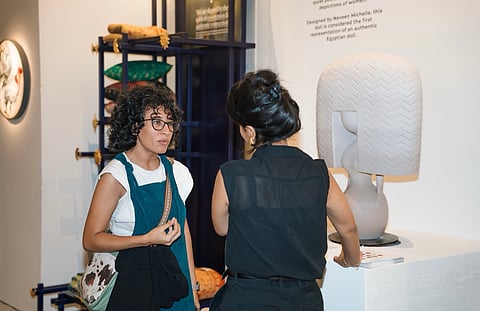
One designer spent a month finding the perfect pink. Another took six days to climb Africa's highest mountain. This November, India Mahdavi and Omar Al Gurg bring two very different creative obsessions to Cairo, where design week is beginning to think beyond its borders.
A month. That is reportedly how long India Mahdavi spent searching for the precise shade of pink for the Gallery at Sketch in London. Not the right sofa, not the right lighting, not even the right architecture. Pink. According to Sketch owner Mourad Mazouz, the search consumed a third of the project's three-month schedule. The resulting room became an Instagram sensation and outlived its original two-year brief by six years. Apparently, getting a colour right can take considerably longer than keeping a restaurant interior fashionable.
Mahdavi understands something that much of the design industry occasionally forgets: colour is never just decoration. It can be theatrical, emotional and even architectural. The Iranian-French designer has built an international reputation on spaces that refuse to behave themselves, from the Gallery at Sketch to Ladurée and Rome's Villa Medici. When the Sketch interior was reimagined in 2022, Mahdavi collaborated with artist Yinka Shonibare on a new scheme of copper, gold and yellow, accompanied by Shonibare's artistic intervention. The new colour was neither yellow nor gold, Mahdavi suggested. It was warmth.
Her fellow Cairo Design Week guest makes for a rather different proposition. Omar Al Gurg is a Dubai-born designer whose interests extend well beyond the furniture studio. In 2021, he spent six days documenting Kilimanjaro's landscapes, photographing the journey from its forests and moorlands to its higher reaches. The resulting images became Everyman's Mountain, his 2025 solo exhibition at Dubai's Lawrie Shabibi gallery. It is not the usual route to a design career, although perhaps more designers could benefit from getting away from their mood boards occasionally.
From 19 to 28 November, the two join the fourth edition of Cairo Design Week, taking part in a programme of talks and creative conversations. Their practices could hardly be more different, but both are interested in the relationship between objects, spaces and the stories we attach to them. One works through colour and atmosphere; the other through material, craftsmanship and cultural memory.
Al Gurg founded MODU Method, a studio whose work brings together functionality and craftsmanship. His collaborations include Vacheron Constantin, Gucci and BMW. He has also used his position as curator of the UAE Designer Exhibition at Downtown Design to champion emerging talent and make design feel less like an exclusive club. In an industry that can sometimes mistake a high price tag for a point of view, accessibility is a worthwhile ambition.
The international guest list is part of a larger project. Cairo Design Week was founded by Hisham Mahdy, who runs the festival through Creative Districts with Yosra Sherra. Its ambition is not simply to import international names or give local designers another exhibition space. It is to put Cairo more firmly on the international design map, while giving Egyptian creativity a stronger presence in conversations that have too often happened elsewhere.
It is an interesting proposition. Egypt's design story did not begin with the arrival of international festivals. Its architectural heritage, craft traditions and contemporary creative industries provide a much deeper context for what is happening in Cairo today. The more interesting question is whether platforms such as Cairo Design Week can help local designers translate that cultural capital into lasting international recognition.
This year's expansion suggests the organisers understand that a design week is as much about the city as the objects on display. Rather than concentrating everything in one location, the programme stretches across Downtown, Heliopolis and Zamalek. Exhibitions, installations, talks and creative experiences will occupy all three districts, giving the festival a more dispersed urban character.
There are three new initiatives. YADD Community puts Egyptian craftsmanship in the foreground, while TheMENAEdit looks towards creative exchange across the Middle East and North Africa. Then there is inMotion, which explores the increasingly complicated relationship between design, mobility and technology. Its programme includes a five-day collaborative design marathon at Sultan Hussein Kamel Palace in Heliopolis, organised by KAIROS CDC with PHOTONX and Cairo Design Week. It is an interesting change of scenery for a discipline that too often confines its ambitions to the showroom.
The returning programmes include CDW Stage, Makerspace and Fashion Design District, maintaining a mix of discussion, experimentation and commercial creativity. Together, they suggest a festival trying to accommodate more than one definition of design: not simply the expensive and collectible, but also the practical, experimental and handmade.
Visitors can purchase an All Access Pass covering all three districts or opt for individual district access. Downtown opens on 20 November, followed by Heliopolis on 21 November and Zamalek on 22 November. All three remain open until 28 November. There will also be nine guided Design Walks, with three in each district, available through separate tickets.
The larger question is whether Cairo can turn a growing international profile into something more lasting: an ecosystem in which local designers, craftspeople and independent studios gain visibility well beyond the ten days of the festival. A famous designer's appearance can attract attention. Building an industry that sustains that attention is another matter.
Mahdavi may have spent a month finding the right pink, and Al Gurg may have spent six days documenting his way up Kilimanjaro. Cairo, meanwhile, is taking on a rather different kind of ascent. The view from the top will depend on what happens after the visitors go home.


