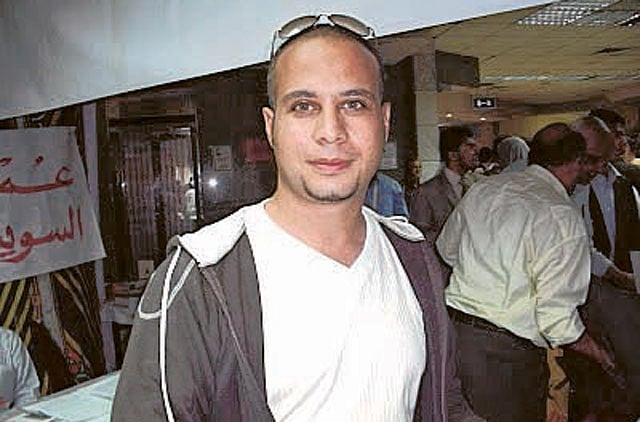
Cairo: In a space of five years he was detained three times for helping organise opposition protests against Egypt's former president Hosni Mubarak. But Ahmad Maher, a co-founder of the opposition April 6 Youth Movement, was confident that "this ruthless regime will be removed one day''.
Maher, an engineering graduate, is one of the young Egyptians who led the nation's unprecedented protests, which eventually swept aside Mubarak after 30 years in power.
"On the surface, politics may appear alien to engineering and vice versa. In fact, both combined to get me engaged in politics,'' says Maher.
"I like reading history books a lot. While reading about the history of Egypt before the 1952 revolution, I found that young people in those years were strong-willed and politically engaged enough to have a say in their country's affairs and bring down incompetent governments,'' he told Gulf News in an interview. "I thought my generation should do the same.''
Contradiction
He added that upon his graduation from the Faculty of Engineering in 2004, he discovered that what he had studied as an engineer did not relate to real life.
"This contradiction was because we lived under a corrupt regime that was opposed to progress and blocked any development that might be beneficial to the Egyptians. I came to the conclusion that the Mubarak regime must go.''
Maher started dabbling in politics by joining Kefaya (Enough), an umbrella movement of liberals, leftists, Islamists and secularists, which was created in late 2004 to vociferously demand an end to Mubarak's rule.
Later, Maher co-founded the April 6 Youth Movement, which took its name from a strike staged in the Delta industrial town of Al Mahla Al Kubra in 2008, which he helped publicise through a group he set up on the social networking website Facebook.
In May 2008, he was detained and tortured, then released without charges.
"My political activism drew mixed reaction from my family. My father encouraged me while my mother was afraid and used to burst into tears, especially when the police arrested me.''
Like around 60 per cent of Egypt's 80 million people, Maher had not witnessed any president other than Mubarak during his 30 years of life. "When we started our protests on January 25, I was sure that the days of the Mubarak regime were numbered," he says.
Desperate bid
"This was because thousands of Egyptians responded positively to our call for protests despite the police's brutality.''
Maher's greatest moment was when Mubarak stepped down on February 11 after he and thousands of protesters had defiantly refused to leave Tahrir Square before "the regime falls down."
"My worst moment, however, was when scores of Mubarak's loyalists riding camels and horses descended on us in Al Tahrir armed with machetes in a desperate bid to break our will. Their brutal raid was a sign of a regime that would stop at nothing to cling to power.''
Despite the current instability in Egypt, Maher remains optimistic.
"For sure Egypt has a bright future ahead. The Egyptians, now free from despotism, have all it takes to rebuild their country and make it great."
Sign up for the Daily Briefing
Get the latest news and updates straight to your inbox
Network Links
GN StoreDownload our app
© Al Nisr Publishing LLC 2026. All rights reserved.