Why a stabbing has plunged Northern Ireland into unrest
A brutal attack in Belfast has sparked riots and reignited immigration tensions
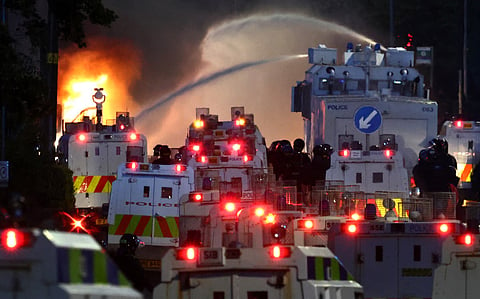
A second night of unrest in Northern Ireland has deepened concerns about rising anti-immigrant sentiment after a stabbing in Belfast sparked riots, attacks on homes and clashes with police.
Police deployed water cannons against masked protesters who hurled bricks, rocks and bottles at officers, while fires were set in several areas and homes believed to be occupied by immigrants were targeted. More than two dozen people have been displaced and at least a dozen police officers injured.
The violence followed the court appearance of a Sudanese asylum seeker charged in connection with a brutal knife attack that left a local man seriously injured.
But while the stabbing may have been the trigger, officials say the unrest reflects broader tensions over immigration, misinformation and identity that have been building for some time.
What happened?
The violence began after a knife attack in Belfast that was captured on video and rapidly spread online.
Police say 30-year-old Hadi Alodid attacked Stephen Ogilvie, a man in his 40s, with a kitchen knife, inflicting severe injuries to his head, face and back and leaving him blind in one eye.
According to evidence presented in court, Alodid was found at the scene armed with a knife and later allegedly told hospital staff: “I’ve killed someone, I don’t know if they are dead.”
He has been charged with attempted murder, possession of a knife and threatening to kill another person. He has not entered a plea and remains in custody pending further court proceedings.
Police have said there is currently no evidence suggesting the attack was terrorism-related.
How did the riots begin?
Graphic footage of the stabbing spread rapidly on social media, where anti-immigration activists seized on the incident.
Within hours, demonstrations began in Belfast and quickly escalated into violence.
Masked groups attacked police, set fire to vehicles and homes, and targeted properties they believed housed immigrants. Firefighters rescued families from burning buildings, including households with young children.
“I’ve lived on my street for almost 10 years,” Belfast resident Anselme Shima, originally from Congo, told AP. “We don’t know what to do. I’m scared. Seeing this, I’m wondering if I’m next.”
Police Chief Constable Jon Boutcher described the attacks as “vile behaviour” and said there was “absolutely no excuse for it.”
Northern Ireland Secretary Hilary Benn condemned what he called “racist thuggery”, while political leaders from across the region united in denouncing the violence.
First Minister Michelle O’Neill described scenes of families being driven from their homes as “disgusting cowardice”.
Why has immigration become part of the story?
Although police have not established a political or ideological motive for the stabbing, the suspect’s immigration status quickly became a focus of public debate.
Authorities confirmed that Alodid entered Northern Ireland from the neighbouring Republic of Ireland in 2023 after applying for asylum.
That detail fuelled criticism from anti-immigration activists and some politicians who argued that the case exposed weaknesses in migration controls.
The debate has unfolded against a backdrop of growing concern in Britain and parts of Europe about asylum seekers, irregular migration and pressure on public services.
Officials say social media has amplified those concerns, often mixing legitimate public anxieties with misinformation and inflammatory rhetoric.
Northern Ireland Justice Minister Naomi Long warned that online agitators were exploiting local fears.
“If you’re driving people from their homes based on nothing but the colour of their skin, you can’t dress that up any other way — it’s racism,” she told the BBC, according to AP.
Why are comparisons being made with other attacks?
The Belfast unrest did not occur in isolation.
Officials have linked it to a broader pattern seen across the UK, where violent crimes involving minority suspects have been used by far-right activists to promote anti-immigration narratives.
Just days before the Belfast violence, protests erupted in Southampton, England, after the sentencing of a man convicted of murdering university student Henry Nowak.
Last year, riots swept parts of England and Northern Ireland following the fatal stabbing of three girls in Southport. False claims circulated online that the attacker was a Muslim asylum seeker, even after police established he was a British citizen born in Wales.
In each case, social media played a significant role in spreading misinformation and mobilising protests.
London Metropolitan Police Commissioner Mark Rowley recently warned that misinformation and disinformation are now “right at the centre” of public-order challenges facing authorities.
Why is the Irish border being discussed?
The violence has also revived debate over one of the most sensitive issues in modern Irish politics: the open border between Northern Ireland and the Republic of Ireland.
Northern Ireland is part of the United Kingdom, while the Republic of Ireland is an independent EU member state. Yet there are no routine border checkpoints between them.
That arrangement is a cornerstone of the 1998 Good Friday Agreement, the peace deal that largely ended decades of sectarian conflict known as The Troubles.
Some politicians argue the Belfast case should prompt a review of border arrangements because the suspect entered Northern Ireland after arriving in the Republic.
Others warn that any attempt to tighten the border risks undermining one of the foundations of the peace process.
The issue remains politically explosive because The Troubles, which involved Irish republican militants, pro-British loyalist groups and UK security forces, claimed nearly 3,600 lives before the peace agreement brought relative stability.
What happens next?
Police have increased patrols and called in reinforcements amid fears of further unrest.
Political leaders continue to appeal for calm, while Ogilvie’s family has urged people not to use the attack as a reason to target migrants.
In a statement quoted by AP, the family said immigrants “make a deeply valuable contribution to our country” and added: “We do not want this terrible tragedy to be used to divide people or fuel hostility.”
- with inputs from AP


