How US used Navy divers, underwater drones to clear Strait of Hormuz mines
Covert 4-month mission saw US teams hunt explosives on seabed, mostly under cover of nigh
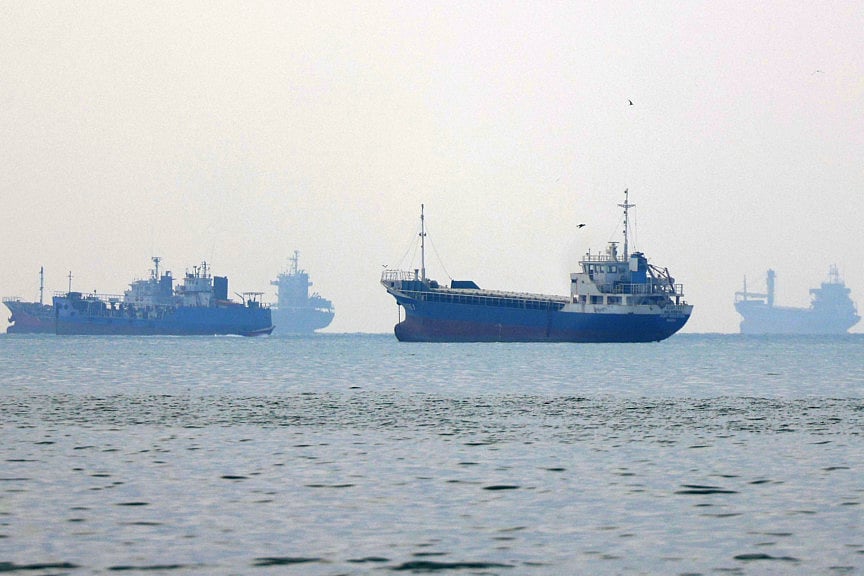
Dubai: For four months, largely under the cover of darkness, small teams of US Navy divers and SEALs carried out one of the most dangerous missions in the battle for the Strait of Hormuz: Hunting for mines beneath the water.
Backed by robotic boats and specialised underwater craft equipped with high-resolution sonar, the teams searched the seabed for explosives Iran said it had planted in international and Omani waters after the US-Israeli war with Tehran began in February.
Details of the covert operation, reported by the Financial Times, reveal how Washington has quietly tried to remove one of Iran’s most potent weapons for controlling a waterway through which about a fifth of the world’s oil and gas passed before the war.
But clearing the mines is only part of the challenge. Iran can try to lay more, missiles and drones can still threaten vessels, and Washington must convince shipowners that the route is safe enough to return.
How did the US hunt the mines?
The operation combined divers with unmanned technology.
According to people familiar with the mission cited by the FT, unmanned surface vessels and underwater vehicles carrying high-resolution sonar searched the seabed for suspicious objects.
Once a suspected mine was detected, small teams of divers operating from inflatable boats could enter the water, approach it and attach an explosive charge before detonating it.
Robotic underwater craft could also be used to destroy mines.
The operation was conducted mostly at night and involved small teams rather than a large conventional mine-clearing force. No US casualties have been reported.
The International Maritime Organization said in June that about 80 mines had been placed in key shipping lanes, according to the FT.
The US had publicly acknowledged its mine-clearing effort in April, when Central Command said underwater drones would be among the forces deployed to help establish a new passage through Hormuz.
Is the Strait now clear?
That depends on which part.
Shipping executives and security advisers told the FT they were confident that the southern section near Oman — where US forces have been directing commercial vessels — had been cleared.
But there is less certainty about the entire Strait of Hormuz.
Iran has sought to exploit that uncertainty, with a senior official claiming only Tehran knows where all the mines are located.
Maritime authorities have reported no confirmed mine strikes during the conflict, while analysts cited by the FT said satellite imagery showed no clear evidence supporting some Iranian claims about mining the waterway. The only confirmed mine sighting cited in the report was by a Pakistani survey vessel in May.
Iran’s Revolutionary Guards nevertheless claimed on August 31 that a supertanker caught fire and stopped after striking two naval mines while attempting to use what Tehran described as an unauthorised route south of Hormuz.
Washington also faces another problem: A cleared route can be mined again.
US forces struck Iranian rocket launchers on Larak Island on August 30 as they were preparing to fire mines into the strait, according to the US military. Washington has warned it will attack vessels attempting to deploy new mines.
Fear can be as effective as a mine
The battle is therefore partly psychological.
Even if US forces clear a shipping lane, shipowners and insurers must believe it is safe.
War-risk insurance costs have risen dramatically. The FT reported that insurance can now cost as much as 10 times prewar levels, potentially reaching about $10 million for a typical supertanker.
That means Iran does not necessarily have to sink a vessel to disrupt Hormuz. The possibility that mines remain — combined with the threat of missile and drone attacks — can be enough to keep commercial operators away.
A second US front
At the same time as Washington is trying to make Hormuz safer for international shipping, it is making the region more dangerous for Iran’s own oil trade.
US forces struck three Iranian oil tankers on September 5 after Tehran fired ballistic missiles at American warships.
CENTCOM said two tankers were permanently disabled and a third destroyed, describing them as part of a multibillion-dollar network supporting the Islamic Revolutionary Guard Corps.
The attacks marked an important shift.
For years, Washington relied largely on sanctions and pressure on buyers, banks and shipping networks to make Iranian oil harder to sell. Since mid-July, a naval blockade has added a physical barrier.
Now the tankers themselves are military targets.
Iranian crude loadings had already fallen to about 220,000-255,000 barrels per day in August, compared with roughly 740,000 bpd in July and peaks close to 2 million bpd before the conflict.
The US gamble
Together, the operations reveal Washington’s broader strategy.
The US is using divers, underwater drones, naval escorts and military force to make the southern Hormuz corridor safer for international commerce while using sanctions, blockade and tanker strikes to make exporting Iranian oil increasingly costly.
But the strategy carries a risk.
The harder Washington squeezes Iran’s oil-export system, the greater Tehran’s incentive to retaliate against shipping and the wider Gulf energy network.
The battle for Hormuz is therefore no longer simply about removing explosives from the seabed.
Washington must persuade the world’s ships that the strait is safe enough to return — while preventing Iran from making it dangerous all over again.

Sign up for the Daily Briefing
Get the latest news and updates straight to your inbox
Network Links
GN StoreDownload our app
© Al Nisr Publishing LLC 2026. All rights reserved.