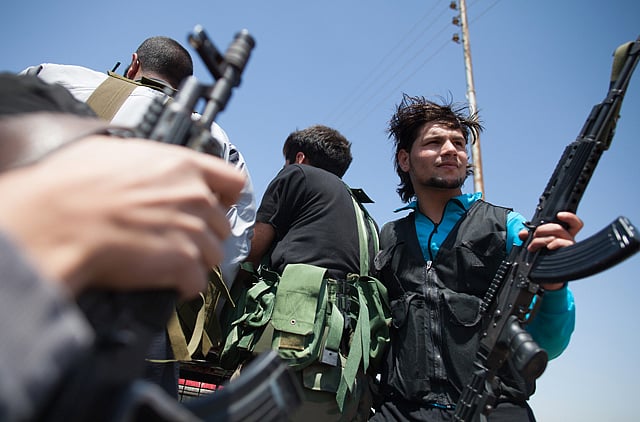
Amman Fighting between rebels and President Bashar Al Assad's forces erupted in an oil producing province in eastern Syria, residents and activists said Sunday, the eve of a parliamentary election the authorities say shows reforms are under way.
Rebels armed with rocket-propelled grenades attacked tank positions in the east of the provincial capital Deir Al Zor, in response to an army offensive against towns and villages in the tribal area bordering Iraq that has killed tens of people and stopped others reaching supplies and medical care, they said.
"We do not have a death toll because no one is daring to go into the streets," said Gaith Abdul Salam, an opposition activist who lives near Gassan Abboud roundabout that has become a flashpoint for the fighting in the city.
Trapped
"The population has been trapped and anger has been building up," he said, adding the fighting subsided early in the morning after erupting overnight.
The army still has tanks and heavy weapons in cities and towns in violation of ceasefire being monitored by a UN team and rebels are continuing their guerrilla attacks on military convoys and army roadblocks that have cut off swathes of the country, according to witnesses and opposition sources.
Fifty out of a planned total of 300 UN observers are now in Syria to monitor the ceasefire declared on April 12, but their presence has not halted 14 months of violence. The authorities say they are fighting what they call foreign backed terrorists in Deir Al Zor and across the country who are bent on sabotaging what state media describe as a comprehensive reform programme being led by Al Assad that is more advanced than in Western democracies.
Anti-government demonstrations have expanded in Aleppo after Al Assad's forces killed seven student protesters at Aleppo University last month. Witnesses say street demonstrations demanding his removal have been expanding across the country after the monitors' arrival.
Backed by old ally Russia, and with support from Iran's clerical Shiite rulers, Al Assad, who belongs to Syria's Alawite minority, an offshoot of Shiite Islam, has relied on the Alawite dominated military to try to put down the uprising against his repressive rule, which is being mostly led by members of the country's Sunni majority.
Enough support
Unlike the autocratic leaders of Tunisia, Egypt, Libya and Yemen, who have been toppled by Arab Spring revolts, Assad has retained enough support among the military and among his Alawite sect, which dominates the army and security apparatus, to withstand the popular revolt.
Sign up for the Daily Briefing
Get the latest news and updates straight to your inbox
Network Links
GN StoreDownload our app
© Al Nisr Publishing LLC 2026. All rights reserved.