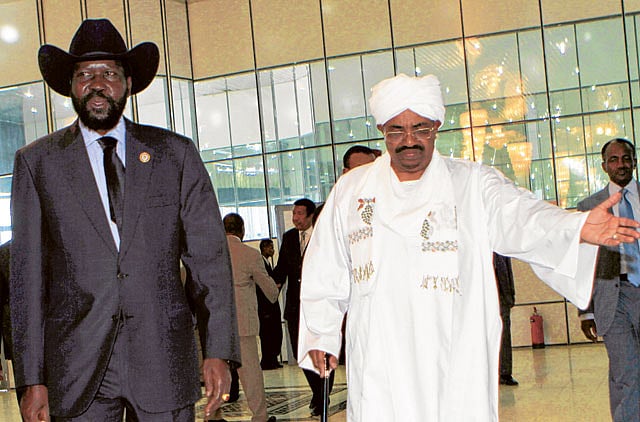
Khartoum:Sudan and the breakaway nation of South Sudan are locked in an exceedingly dangerous game of brinkmanship over billions of gallons of oil, seizing tankers, shutting down wells and imperilling the tenuous, US-backed peace that has held — just barely — between the two countries after decades of war.
Not for years have north-south relations been so poisonous, aggravated by spreading rebellions on both sides of the border and a proxy war between the two nations that has flared into direct Sudan-South Sudan clashes.
The jagged, disputed border separating Sudan from its newly independent neighbour is probably the most combustible fault line in Africa, with big armies that fought each other for generations massing on either side.
"I, personally, expect full-fledged war," said Mariam Al Sadiq Al Mahdi, a leading opposition politician in Khartoum, Sudan's capital. "This is like the previews before a film."
Both sides desperately need the oil to run their governments, feed their people and stamp out insurrections. And theoretically, both sides need each other. The conundrum of the two Sudans is that 75 per cent of the oil lies in the south, but the pipeline to export it runs through the north. Because of this, oil was once thought to be the glue that would hold the two nations together and prevent a conflict. Now, it seems, oil is becoming the fuse.
Negotiations
The African Union, the United States and China, which is a major oil partner for both Sudans, are pressing the two nations to move beyond the language and tactics of mutual destruction. Oil negotiations have been scheduled to resume this weekend, and though the two sides have stepped back from the brink many times before, few analysts are optimistic that a compromise will be reached easily.
When South Sudan broke off from Sudan last year, after years of guerrilla struggle, its independence was heralded as the triumphal capstone ending one of Africa's deadliest civil wars. But the question of how exactly the two sides would share oil profits loomed ominously over the separation, unresolved. Now that both nations are struggling to make it on their own, the issue has proved to be as prickly — and perilous — as many had feared.
It was South Sudanese oil that drove Sudan's economic boom of the past decade and made the repression by Sudan's Islamist government (which is still heavily penalised by the United States) tolerable to many Sudanese.
When South Sudan declared independence, it took billions of dollars' worth of oil with it, gutting Sudan's economy and creating one of the deepest crises that President Omar Hassan Bashir has faced in his more than 20 years in power.
Bashir is now battling high inflation, a shrinking economy, student protests and several simultaneous rebellions — in Darfur, the Nuba Mountains and Blue Nile state — as well as genocide charges related to the massacres several years ago in Darfur.
At the same time, South Sudan, one of the poorest countries on earth, is facing a major food crisis and heavily armed and ethnically based militias that have been sweeping parts of the countryside, killing hundreds and making a mockery of the South Sudanese security forces.
Stoking the tensions, Sudan and South Sudan are covertly backing rebels in each other's back yards, leading to border clashes and relentless aerial bombings. The more than 1,500-kilometre border between them is now effectively closed, with millions of pounds of emergency food and just about all trade held up in a two-way stranglehold.
In the current fight over oil, the south has refused to turn over royalties for using Sudan's pipelines. Sudan upped the ante in late December by seizing oil tankers filled with South Sudanese crude. Then, the south took the drastic and possibly self-destructive step of abruptly shutting down all of its oil wells, which could quickly bring the economies of both north and south to their knees.
Southern Sudanese officials openly admit they are now using their oil to squeeze Khartoum to make concessions on all sorts of issues, including the disputed area of Abyei, insisting that oil production will resume only after "all the deals are signed".
Kenya alternative
The south is even threatening to sit on its oil for years while it builds an alternative pipeline through Kenya. But it is not clear how the new country would survive that long; oil provides about 98 per cent of government revenue.
Experts question whether the Kenya pipeline is even feasible. It would have to run uphill, requiring many expensive pumping stations, and most likely slice across Jonglei, a South Sudanese state that, with all its marauding militias, is essentially a war zone these days.
In Khartoum, many people are still struggling to swallow the fact that the south is gone. Nobody likes the new map of Sudan. It used to be Africa's biggest country. Now it looks as if it has been crudely amputated, with the ragged edges of a raw wound.
"I still can't get used to it," said Nada Gerais, a sales manager in Khartoum. "It looks, looks ..." she struggled for the right word. "Weird."
Gerais is a perfect example of the nose dive Sudan's economy has taken. She works in a meticulously polished Nissan dealership that used to sell 50 cars a month. Now, sometimes, it is down to five. She is thinking of switching to pharmaceuticals or food.
"People can stop buying cars, but they can't stop eating," she said.
Plans shelved
During the past decade, Sudan's oil wealth fuelled new factories, roads, countless shish kebab joints and plans for a futuristic mini-city, a billion-dollar airport and the entire reconfiguring of this capital to include a breezy promenade along the Nile.
But so many of these plans have been shelved. High-rise buildings stand half-finished, and the plummeting value of the Sudanese pound has pushed electronics, books and even tomatoes out of reach for many.
Officials in Khartoum say the south owes nearly $1 billion (Dh3.67 billion) in pipeline fees, money needed to keep their economy from collapsing, and they recently sold some of the oil from the seized tankers before releasing them.
South Sudan's president, Salva Kiir, said the amount Khartoum wanted, $32 per barrel, was "exorbitant" and "completely out of international norms."
— New York Times News Service
Sign up for the Daily Briefing
Get the latest news and updates straight to your inbox
Network Links
GN StoreDownload our app
© Al Nisr Publishing LLC 2026. All rights reserved.