In this handout photo provided by the Lewis Pugh Foundation, British endurance swimmer and UNEP Patron of the Oceans Lewis Pugh adjusts his goggles before diving into the Strait of Hormuz off the Musandam Peninsula, Oman, Sunday, Nov. 15, 2026. (Lewis Pugh Foundation via AP) (Photo: Lewis Pugh Foundation via AP)
Video: British athlete swims Hormuz to highlight war’s impact on wildlife
Pugh warns oil spills from damaged tankers threaten marine life, coral reefs, mangroves
Last updated:
5 MIN READ
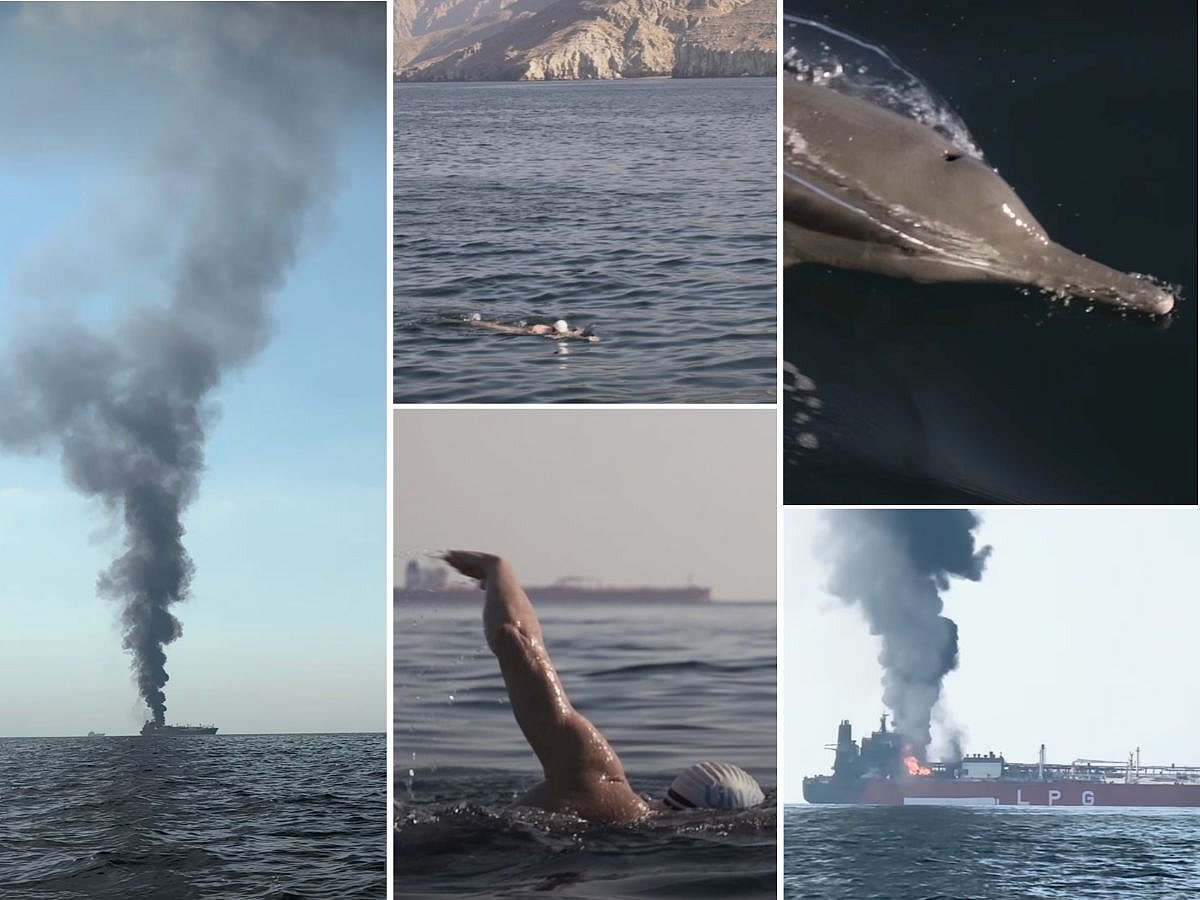
Lewis Pugh, a 56-year-old British endurance swimmer, completed a three-day swim through the Strait of Hormuz to draw attention to the environmental consequences of the Iran war. He set out on November 15, and the Lewis Pugh Foundation photos date a dive to Nov. 18, 2026. He is believed to be the first person to attempt a long-distance swim there since the war began.
Instagram | @LewisPugh
British endurance swimmer Lewis Pugh has swum in the North Pole and Antarctica to draw attention to environmental causes.
But battling freezing waters and extreme conditions hasn’t prepared him for his latest challenge: swimming the Strait of Hormuz while tankers are attacked and blown up nearby.
UN Patron of the Oceans
Pugh, who is a United Nations Patron of the Oceans, spent three days this week swimming parts of the dangerous waterway to highlight how the war with Iran threatens the area’s habitat and wildlife.
Get it: Fast, verified news for FREE ... download the Gulf News app — simply click here
Wearing only swimming trunks, goggles and a cap bearing the UN logo, the athlete started from the Musandam peninsula, on the southern tip of the strait, and ended by rounding the Cape of Hormuz, completing about 15km in total.
Pugh is believed to be the first person to undertake a long-distance swim there since the war started.
Who: British endurance swimmer Lewis Pugh, a UN Environment Programme Patron of the Oceans. He is 56.
What: A three-day swim through the Strait of Hormuz to highlight the environmental consequences of the Iran war.
Distance: About 9.3 miles in total. Some outlets give it as 15 km.
Route: From the Musandam Peninsula, at the southern tip of the strait, around the Cape of Hormuz.
When: He set out on November 15, according to AFP. The Lewis Pugh Foundation photos date a dive to Nov. 18, 2026.
First of its kind: He is believed to be the first person to attempt a long-distance swim there since the war began.
Dangers: On day one, a tanker was hit about four kilometres away, and he heard two explosions and fighter jets. On day two, he passed close to the burning LPG carrier Tara Gas.
Pollution: He could smell chemicals and smoke in parts of the swim.
Wildlife: He reports turtles and ospreys in the strait.
His message: "We've got to open the strait, and we've got to clean up the pollution."
Track record: He was the first athlete to swim across the North Pole and the first to complete a long-distance swim in all five oceans.
2 loud blasts
The swimmer said that minutes after he entered the water on Monday, he heard two loud explosions that rocked the sea.
“I looked up and I could see that an oil tanker about four kilometers away had been hit,” he told The Associated Press after he returned to London. “The explosion was so loud, two booms, and then fighter jets coming in. And at that moment I realized we have to get out of here right now.”
Pugh, 56, managed to finish his feat after more stops and starts, including passing another vessel that sent fireballs into the sky after it was attacked.
“Most people, when they think about the Strait of Hormuz, they think of a shipping lane,” he said. “But it is also one of the most beautiful places I have ever been … it’s one of the treasure troves of the natural world.”
'Severe threat'
“With all these ships being sunk, this area is under severe threat,” he added. “It’s going to take years, decades for this area to recover.”
Oil pollution from damaged tankers threatens dolphins and mangroves
Iran has in recent weeks increased attacks on vessels that it claimed traveled along unauthorised routes in the strait as it seeks to impose its control on the crucial waterway, where a fifth of all oil traded passed through before the US and Israel launched the war on February 28.
Several tankers have also struck sea mines laid by Tehran, in some cases exploding and bursting into flames, among them one that was carrying over 2 million barrels of oil last month.
Pugh warned of how oil leaking from the dozens of tankers damaged since February could create lasting problems for the region’s animals, as well as its coastlines, coral reefs and mangrove forests.
Dolphins follow his boat
He described seeing large numbers of dolphins following his boat as he sailed in, as well as turtles and ospreys. He also marveled at the hundreds of turtles he saw during a swim along the Omani coast before the war.
“When oil gets in there, when chemical pollution gets in there, it becomes very, very difficult to clean up that type of mess,” he said. “It lasts for generations.”
Swim challenge took place as vessels were attacked
Pugh has had plenty of experience facing extreme temperatures and predators, including great white sharks. But swimming in a conflict zone presented entirely new dangers.
To stay safe, the challenge was done in sections over three days, with a total of about six and a half hours of swimming. The athlete recalled seeing a gas carrier being struck as he returned to the harbor on the second day.
“I’ll never ever forget going past that gas carrier, the smell of the chemicals and then the flames, they were literally like fireballs going up into the sky. Around the ship, the water was on fire,” Pugh said.
“And to think of the impact which a casualty like this has on nature - it was very, very acute.”
Using sport to lobby for green causes
Pugh has spent much of the past 40 years swimming in places from Antarctica to the Red Sea and the English Channel to urge more action to protect marine environments from climate change, pollution and loss of biodiversity.
He was the first athlete to swim across the North Pole and complete a long-distance swim in every one of the world’s oceans. In 2023, he swam all 507km of the Hudson River to highlight the importance of clean rivers.
His foundation says the challenges have helped secure official agreements to protect more than 3.5 million square kilometers (about 1.35 million square miles) of vulnerable ocean.
Some have dubbed Pugh’s blend of epic swimming and political outreach as “Speedo diplomacy.”
“Sport opens doors, it creates dialogue, it enables people to start thinking about these important issues,” Pugh said.
“My message is very simple,” he added. “We’ve got to stop the war. We’ve got to open the strait, and we’ve got to clean up the pollution.”
In this handout photo provided by the Lewis Pugh Foundation, a crew member aboard a boat accompanying endurance swimmer Lewis Pugh looks toward a burning liquefied petroleum gas tanker in the Strait of Hormuz off the Musandam Peninsula, Oman, Tuesday, Nov. 17, 2026. (Lewis Pugh Foundation via AP) (Photo: Lewis Pugh Foundation via AP)
Network Links
GN StoreAbout Gulf NewsTerms & ConditionsReach by GNSitemapContact usPrivacy PolicyGN FocusHave your sayWork with usAdvertise with usGulf News epaperPrinting Services
Download our app
© Al Nisr Publishing LLC 2026. All rights reserved.