US NAVAL BLOCKADE: Three Iran-linked crude tankers attempting to breach the US naval blockade were stopped in the Gulf of Oman as US forces disabled them with strikes from F/A-18 Super Hornet jets before they could reach Iranian ports. US Navy aircraft fired precision munitions and cannon rounds to impair the vessels’ propulsion and steering systems, enforcing the maritime blockade.
Breakthrough in Hormuz? Asian oil tankers ‘moving again’
Markets eye cautious reopening of vital Hormuz corridor for Asian crude flows
Last updated:
2 MIN READ
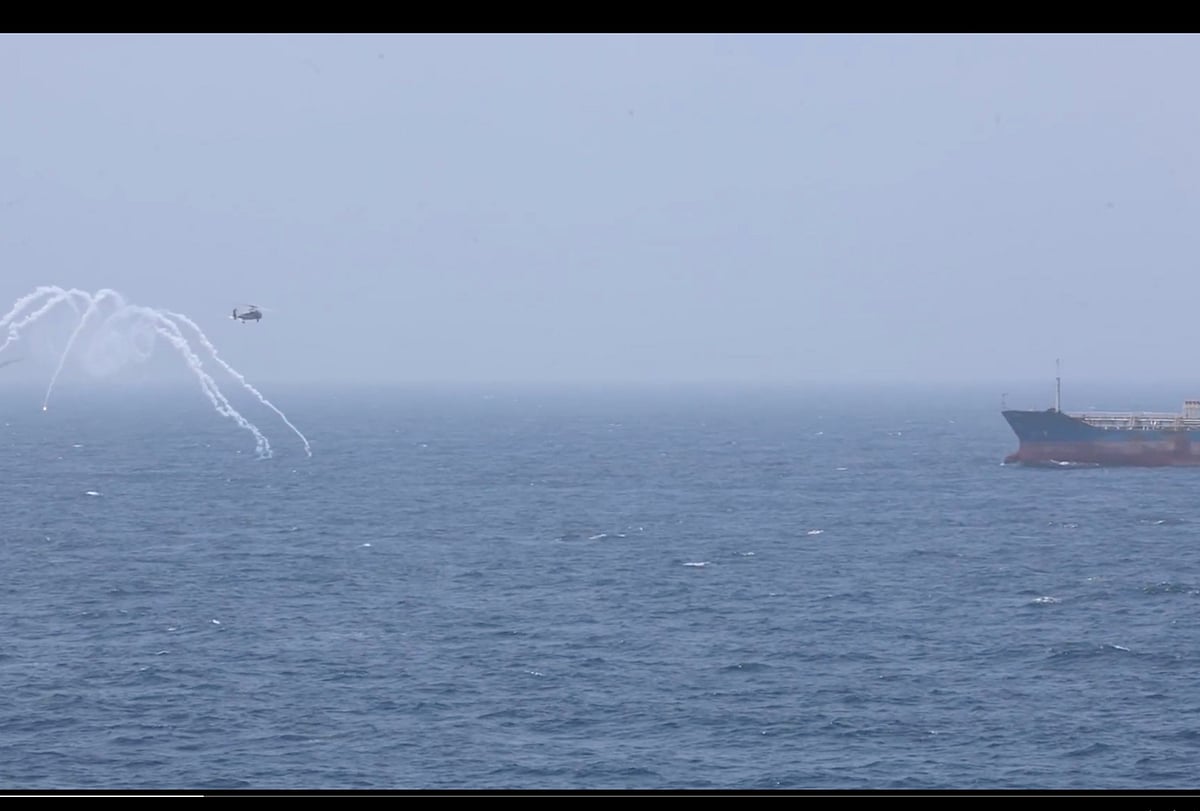
Analysts say a renewed tanker traffic may reflect growing optimism around backchannel diplomacy as US President Donald Trump suggested progress in talks with Tehran and hinted that the conflict could de-escalate and oil prices could go down “very quickly.” A screengrab shows US Central Command military operations to enforce the naval blockade on Iran, in place for nearly six weeks now.
X | @CentCom
Three crude oil supertankers bound for East Asia are reportedly attempting to transit the Strait of Hormuz on Wednesday, signaling a possible easing of one of the world’s most dangerous energy chokepoints.
Bloomberg reported that a South Korean-flagged VLCC appears to be making a crossing through the strait — potentially the first successful transit by a South Korean supertanker since the escalation of the US-Israeli conflict with Iran began.
At the same time, Reuters, citing LSEG and Kpler shipping data, reported that two Chinese crude tankers carrying roughly 4 million barrels of oil have already exited the Strait of Hormuz en route to China.
Closely-watched movement
Asian refineries are mostly built for crude oil sourced from the Gulf.
The movement is being closely watched by global markets because the Strait of Hormuz handles nearly 20% of the world’s oil and LNG flows, according to the International Energy Agency (IEA). Any disruption there can send shockwaves through global energy prices, inflation and supply chains.
Analysts say the renewed tanker traffic may reflect growing optimism around backchannel diplomacy after President Donald Trump and Vice President JD Vance suggested progress in talks with Tehran and hinted that the conflict could de-escalate and oil prices could go down “very quickly.”
Shipping intelligence firms note that tanker activity through Hormuz remains far below normal levels.
Yet even limited movement is being interpreted by traders as a sign that energy exports from the Gulf may gradually resume after months of volatility and military risk.
FACT FILE
Around 90% of Iran's own oil exports pass through the Strait. Oil constitutes 40%+ of Iran's total export revenue.
With the US naval blockade on Iranian ports, the country’s economy is haemorrhaging.
China, Iran's top trading partner and buyer of ~90% of its exported oil, receives 37.7% of ALL Hormuz crude flows. Half of China's entire oil import supply runs through this strait.
Qatar produces ~20% of global LNG, almost all of it transiting Hormuz. QatarEnergy has already declared “force majeure”. Iraq and Kuwait, with no bypass routes, face a crunch in oil revenues.
For Iran itself, virtually all of the country corn imports (its primary feed grain) arrive through Arabian Gulf ports. Iran imports ~30% of its wheat and 80–90% of pharmaceutical raw materials are imported.
Reports cite that food inflation is already exploding inside Iran, so any easing of the US naval blockade is also good news for consumers inside the Islamic Republic.
US naval blockade
The US side is keeping up the pressure on Iran, even as the IRGC's proxies are staging their own attacks including attempted drone strikes on the Barakah Nuclear Power Plant in the UAE.
Now, following US President Donald Trump's earlier announcement to put a "planned attack" on Tehran on hold after appeals from Qatar, Saudi Arabia and United Arab Emirates (UAE), the US leader stressed that they are "prepared to go forward with a full, large-scale assault" on Iran.
Sign up for the Daily Briefing
Get the latest news and updates straight to your inbox
Network Links
GN StoreAbout Gulf NewsTerms & ConditionsReach by GNSitemapContact usPrivacy PolicyGN FocusHave your sayWork with usAdvertise with usGulf News epaperPrinting Services
Download our app
© Al Nisr Publishing LLC 2026. All rights reserved.