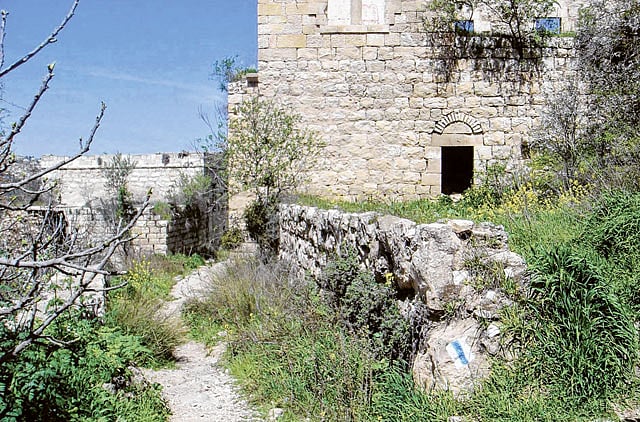
It is easy to conjure the village that once was, hidden deep in a picturesque valley at the western gateway to Occupied Jerusalem, almost buried by blooming almond trees, tangled grapevines and a carpet of yellow wildflowers.
The roofs and window shutters are long gone from the old stone houses but decorative brickwork around the doorways and broken staircases bear witness to a bygone prosperity.
The spring was paved over years ago but the water still gurgles down the main road, just as it did more than 60 years ago. Homeless addicts sleep in the former mayor's house and sunlight floods through arched mosque windows, illuminating trash and debris. They called it Lifta.
The abandoned village is the last intact pre-1948 Palestinian town in Israel. Hundreds of similar Palestinian communities were razed after residents fled during Israel's 1948 war.
For reasons lost to history, Lifta's homes, cemetery and olive press were left standing, though its farmland was confiscated and is now the site of Israel's Supreme Court; its parliament, the Knesset; and Hebrew University.
After being forgotten for decades, Lifta is now the focus of conflicting visions of its future and of its past. Israel wants to develop luxury apartments at the old village while Palestinians hope to turn the ruins into an open-air museum devoted to their mass displacement in 1948, an event Palestinians call the nakba, or catastrophe.
Bone of contention
The ghost town has become an embodiment of one of the most intractable issues in Middle East peace talks: whether Palestinians should have the right to return to ancestral homes inside Israel and what this would mean for Israel's survival as a Jewish state.
During the creation of Israel and the subsequent attack by the neighbouring Arab nations, 700,000 Palestinians became refugees when they fled the fighting or were chased from their homes by Jewish militias that prevented them from returning.
Some Israelis say Palestinians left voluntarily and therefore gave up rights to their land. Today those towns exist only as dots on Palestinian maps and in the stories of ageing refugees.
Though many mosques were preserved, most of the homes, shops and roads were torn down to build Jewish cities. Others were turned into forests and parks, which explains why hikers sometimes stumble upon what appear to be abandoned mosques in the middle of nowhere. The remains of Lifta were swallowed by the expansion of Occupied Jerusalem.
On one side of the former village, cars speed past on Begin Highway. The canyon below houses a secret military installation, believed to contain an underground bunker for Israeli lawmakers in the event of a nuclear attack. At the top of the hill, bulldozers are clearing land for a high-speed rail line to Tel Aviv.
Hebrew University professor and sociologist Daphna Golan said the dispute over Lifta touches a nerve with many Israelis, who, like many Palestinians, sometimes see the conflict as a zero-sum struggle between duelling narratives. In the minds of some Israelis, acknowledging the Palestinians' loss competes with their own struggle for statehood, she said.
"It's hard for people of the older generation, the ones who did this, to accept what happened," she said. "As time passes and that generation disappears, maybe it will be easier. The question is whether anything will be left."
Israel's Lands Administration announced in January it would begin selling plots of land in Lifta for a project to develop 212 luxury apartments, a hotel and retail shops. The government has given the old Palestinian village a Hebrew name: Mei Naftoah.
Former Lifta residents, many of whom live in Occupied East Jerusalem, have joined Israeli conservationists and planners seeking to block the project, arguing that Lifta should be preserved as a historical site.
Opponents recently won a temporary injunction to halt the project. "This is about our memory, our heritage and our culture," said Zacharia Odeh, whose parents lived in Lifta until 1948. "Many of us still have the deeds to our homes. But even if we are not allowed to return, it should be preserved."
Emotional attachment
Odeh, executive manager of a civil rights coalition in Occupied Jerusalem, is helping to organise the effort to save Lifta. He said the housing project, which would probably cater to wealthy American and European Jews, would erase much of the last surviving evidence that Palestinians once occupied much of what is now Israel.
"They are trying to get rid of any signs of refugees and preventing us from keeping any memories for the future," said Odeh, who visits his family's old house on weekends with his children for picnics.
Opponents of the proposed development have appealed for historical recognition by Unesco and assistance from the UN Relief and Works Agency, a Palestinian refugee-assistance group, and the Arab League.
Officials at the Lands Administration, the Israeli Interior Ministry and the Occupied Jerusalem municipality all declined to comment. A spokesperson for the mayor of Occupied Jerusalem said in a statement that the proposal calls for preserving Lifta's structures, a contention activists dispute.
Neither Israelis nor Palestinians can claim to be particularly respectful of each other's histories. The Knesset recently passed a law that would impose fines on groups or authorities that commemorate the Palestinian displacement.
Yacoub Odeh, 71, Zacharia's older brother, was born in Lifta and lived there until he was 8. For him, the best he can hope for is to save the village from destruction. "This isn't about stealing a house or land," he said. "It's about stealing a life and memories."
Sign up for the Daily Briefing
Get the latest news and updates straight to your inbox
Network Links
GN StoreDownload our app
© Al Nisr Publishing LLC 2026. All rights reserved.