As US warships mass near Iran, is Russia helping Tehran prepare for another American-Israeli attack?
Russian satellites may help Iran anticipate fresh US strikes amid major military buildup
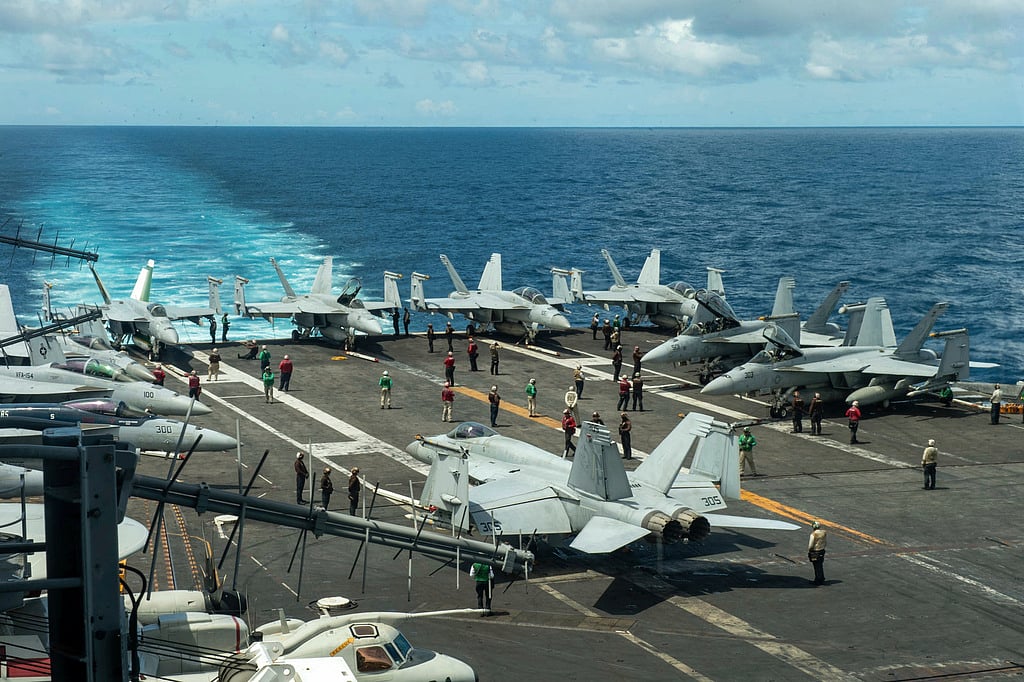
Dubai: The arrival of a third US aircraft carrier in the Middle East has intensified concerns over renewed American strikes on Iran, raising a critical question: Could Russian satellite intelligence help Tehran anticipate an attack and prepare its response?
The USS Theodore Roosevelt has arrived in the region, joining the USS George H.W. Bush and USS George Washington as Washington maintains a substantial naval presence amid continuing tensions with Tehran.
The New York Times reported the deployment, citing a US military official, while news agencies subsequently confirmed the carrier’s arrival.
However, the military buildup has been accompanied by conflicting signals from Washington. Reuters reported on November 14 that President Donald Trump was considering holding off on further strikes unless Iran or its allies launched new provocations.
Against this backdrop, recent investigations by Associated Press and CNN have raised questions about the extent of Russian intelligence assistance to Iran, while a new analysis published on Monday warns that Moscow’s sophisticated satellite surveillance capabilities could complicate any renewed US military campaign.
The issue comes as Reuters reported on November 14 that Trump had told advisers he might hold off on further attacks unless Iran or its Houthi allies provoked Washington. However, American forces remain prepared for escalation.
What have recent investigations uncovered?
An AP investigation published on October 27 examined satellite activity associated with 40 missile and drone attacks by Iran-backed groups between July and October.
According to an Associated Press investigation, researchers from AURORAH, a geospatial intelligence project, tracked Russian reconnaissance satellites over Saudi oil and military installations before and after attacks carried out by Yemen’s Houthis and Iraqi militias. The targets included sections of the kingdom’s East-West oil pipeline and military installations.
Saudi officials, a senior Houthi figure and intelligence analysts told AP that Russian intelligence had assisted Iran-backed groups.
However, AURORAH acknowledged that it had not directly intercepted or verified the transfer of satellite intelligence to Iran or its allies.
Did Russian satellites help Iran strike a US base?
A CNN investigation published on September 16 provided another significant account.
The network reported that 14 Russian reconnaissance satellites passed over Prince Sultan Air Base in Saudi Arabia two days before an Iranian attack on March 27.
The strike injured 12 American personnel and damaged or destroyed important military equipment, including a US airborne warning and control aircraft.
CNN cited two US officials and other intelligence sources who said Russian satellite data had helped Iran conduct precision attacks.
Russia rejected the allegations, describing the reporting as fake news.
What is the latest warning?
In an opinion article published by Al Jazeera on November 16, Nawaf Obaid, a senior fellow at King’s College London’s Department of War Studies and founder of AURORAH, argued that Russian surveillance capabilities could give Tehran advance warning of another American offensive.
Obaid said his project had identified at least 20 Russian spacecraft in the Kosmos-2600 series, including satellites capable of gathering imagery, radar information and electronic signals.
He argued that such intelligence could help Iran identify military deployments, monitor changes in US force positions and prepare retaliatory operations.
His assessment goes beyond the evidence publicly established by satellite tracking, however. It has not been independently confirmed that Russia is currently providing Iran with intelligence specifically intended to prepare for another US attack.
Why does this matter for Gulf countries?
The implications extend beyond American military installations.
Satellite intelligence could potentially help identify vulnerable oil facilities, export terminals, electricity infrastructure and desalination plants.
Saudi Arabia’s East-West pipeline has particular strategic importance because it allows crude oil to reach Red Sea export facilities without passing through the Strait of Hormuz.
Any renewed attacks on such infrastructure could disrupt regional energy supplies and affect international markets.
The AP investigation highlighted how intelligence support, if confirmed, could increase the effectiveness of attacks by groups that do not possess sophisticated reconnaissance capabilities of their own.
Could Russian intelligence change Trump’s calculations?
The possibility of improved Iranian surveillance adds another complication to Washington’s military planning.
An Israeli security assessment published on November 15 described continued US force deployments alongside Iranian threats and reported attacks in the Gulf.
But whether Russian intelligence assistance is influencing Trump’s decisions remains unknown.
Reuters reported that the president was considering restraint amid concerns over the effectiveness and consequences of further strikes.
For now, the available evidence points to a potentially important intelligence dimension of the conflict, rather than proof that Moscow and Tehran are jointly preparing for an imminent confrontation.
The central question is whether Russian surveillance could reduce America’s ability to launch a surprise attack while giving Iran more time to organise its response.

Sign up for the Daily Briefing
Get the latest news and updates straight to your inbox
Network Links
GN StoreDownload our app
© Al Nisr Publishing LLC 2026. All rights reserved.