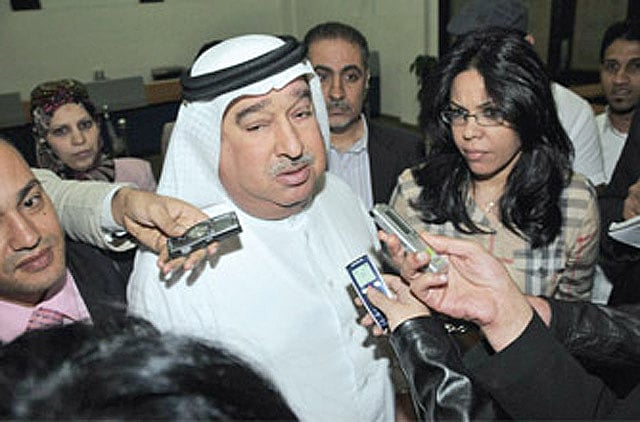
Manama: Former state minister Mansoor Bin Rajab reiterated his innocence after the public prosecutor officially charged him with money laundering, committing illegal acts involving money laundering operations and hiding the nature of those activities.
He faced seven hours of interrogation on Tuesday.
"We have denied all the charges and there is no single evidence against us," Bin Rajab said when he left the public prosecution building later.
"I am one million per cent innocent. The evidence presented by the public prosecution has nothing to do with me, but rather with other people. I repeat that I have no link with foreign parties and I do not have assets that have been frozen," he said, surrounded by his five lawyers.
Bin Rajab was also interrogated on Thursday and sacked as state minister on Sunday. He said that he was in high spirits and that he did not suffer from "interrogation effects".
"As for claims that this case is politically motivated, you should ask those who are behind it. I am innocent and I have no link with money-laundering operations or with Iran's Revolutionary Guards," he said.
The former minister, who has been released on house arrest, is due to appear again before the prosecutor on Wednesday afternoon.
Investigation into the case reveals that the money laundering scheme has spanned countries and involves several people.
The public prosecutor said that Bin Rajab, 55, was being interrogated after investigations revealed he was involved in several money laundering activities in Bahrain and overseas.
"In one operation, he is suspected of striking a deal with a Gulf woman to get a commission for helping her transfer and cash a cheque issued by a European bank and worth six million euros gained from trafficking in drugs and smuggling weapons," said public prosecutor Ali Al Buainain. "The accused opened an account in an overseas bank with the help of other suspects from Arab countries."
Bahrain had been working closely with other countries to gather further evidence about the suspects' criminal activities in money-laundering, he said.
Bin Rajab's lawyers said he is innocent. "None of the accusations leveled at our client had the solid evidence of a crime. He has no link with any of the charges and all the talk about this case is pure speculation and has nothing to do with facts," the five-member defence team said.
"The accusations do not reflect the reality on the ground. What has been published by the media is a gross exaggeration and the existing evidence cannot be attributed to Mansoor Bin Rajab," they said.
The lawyers said that Bin Rajab has been implicated in the case without any evidence and that his dismissal as state minister aimed to ease legal procedures.
The defence team, comprising two women, said that three people in Bahrain who were mentioned in the investigations could be summoned by the public prosecutor.
The team said that their client was not "in any way involved in the cheque," an increasingly important piece in the case.
"It does not have his name or signature and was not deposited in Bahrain. He has denied any link with it," they said.
According to Fatima Al Hawwaj, one of the lawyers, the cheque was forged and dated February 11, 2009, "way past the six-month validity period under the law."
"The cheque is in the possession of a Kuwaiti woman, so our client has nothing to do with it," she said.
Mohammad Ridha Bu Husain, another lawyer, said that Bin Rajab did not benefit from the cheque and did not deal with it.
In an interview published on Wednesday by Al Ahd, the weekly newspaper he owns, Bin Rajab said that the case against him could be motivated by people who did not wish him to succeed.
"Some people might not like the charity and community work that we perform," he said in the interview he gave before heading to the public prosecutor on Tuesday. He however did not give names.
He said that the Kuwaiti woman, referred to in the Kuwaiti media as Amal or Um Talal, and who is being investigated by Kuwaiti police for her alleged role in the money-laundering scheme, had been introduced to him by a Bahraini called Khalid.
"He told me that she wanted to buy lands in Oman and we discussed the matter, but we did not agree. The woman also told me that she wanted to partner with me for a business to provide food for the US army in Kuwait and Iraq. However, I declined her offer, explaining that I was a minister and could not engage in commercial activities," Bin Rajab said.
The former minister said that he had met Khalid in his weekly majlis. "He came to my majlis which is open to all people and requested my help in a case with the police in Muharraq, and I offered my assistance. He visited my majlis and office and often suggested the names of girls and women, including the Kuwaiti national and an Egyptian, to work with us, but I grew suspicious and thank God, I never employed any of them," he said, adding that he had reported him to the police, but no action was taken.
The former minister said that he was not aware of the $31.6 million amount allegedly amassed in money-laundering activities mentioned by the Bahraini media. He also rejected claims that he had ties with Iran's Revolutionary Guards, the alleged beneficiaries of the international drugs-based money-laundering scheme.
"They are as distant from me as the earth from the sky. This is a blatant lie. I never took pictures and I do not even know how to deal with the Internet. I do not know how to write or send an email," he said.
In Kuwait, the media said that the public prosecutor was still investigating possible links between the Kuwaiti woman and Bin Rajab and the truth about the six million euro cheque.
According to Al Watan, the woman wanted to open an internet café and launch other projects in Bahrain.
She reportedly said that she called Bin Rajab twice, once to offer her sympathy on the death of his only son in 2009 and a second time to discuss the possibility of opening the café. The paper said that she denied any links with the Revolutionary Guards.
The woman, thought to be 45 years old, said that she knew the head of the Bin Rajab office and that a stateless man who was with her on a trip offered BD30,000 to the minister to help him obtain the Bahraini nationality for him and his family, the paper said.
Al Siyassah daily said that the Kuwaiti woman, a frequent visitor of Bahrain, did not want to be implicated in the cashing of the cheque for 6 million Euros even though she was allegedly promised a five per cent commission.
The paper said that attempts by a Bahraini and an Egyptian also failed to cash the cheque in Beirut had failed, prompting the two men to go to their separate home countries.
Sign up for the Daily Briefing
Get the latest news and updates straight to your inbox
Network Links
GN StoreDownload our app
© Al Nisr Publishing LLC 2026. All rights reserved.