London
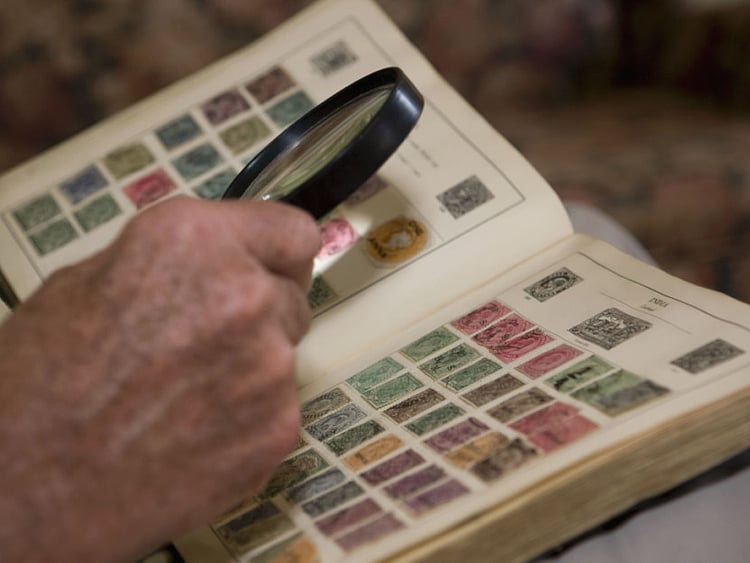
In an exhibition centre just north of London’s financial district, a queue is snaking round the block, ready for the doors to open. It does not sound an unfamiliar scene for the edgy Angel district, except that this is Stampex, the UK’s biggest stamp jamboree, which takes place once a year.
Dealers, collectors and auction houses are showcasing the best of their collections, while enthusiasts are hoping for a rare find to add to their prized collection. Others will be wondering if they have been sitting on a priceless gem for decades.
“People look at stamps and think, ‘That’s just a silly hobby.’ But actually it’s a huge hobby, and a very global one,” says Guy Croton of Spinks, a London-based 350-year-old auction company that specialises in arranging sales of stamps, coins, medals and other collectibles. Buyers are coming from all over the world, particularly the US, South America, Hong Kong and China, Mr Croton says.
Recently there has also been a surge of interest from Indian collectors keen to purchase items dating from British colonial rule.
“Stamps from Indian feudatory states that you couldn’t give away 30 years ago are going through the roof. For the Indian stamp collection in an auction, you can easily have up to 20 phone bidders calling from India,” he says.
Collectors make up the bulk of the stamp market, with some spending anything between a few pounds to a few million on individual stamps.
An ultra-rare British Guiana One-Cent Magenta postage stamp from 1856 was sold by Sotheby’s for $9.5m (Dh34.8 million) less than two years ago. Not only was it the most expensive stamp ever sold, the one-inch by one-and-a-quarter-inch square became the most valuable product on the planet by weight.
Increasing in value
The amount stamp collectors are willing to pay makes the industry an attractive prospect for investors.
Bill Gross has reportedly spent between $50m and $100m on stamps, describing the postage marks as a better bet than the stock market.
Stamps are increasing in value because there are relatively few valuable ones in existence, and there are always eager buyers willing to pay.
Collectors, who participate purely for the love of stamps rather than making money, still form a thriving community. While the number of young participants has declined, it remains a popular hobby among older people. Brian Reeves, owner of the South London-based auction company Brian Reeves, says there are new collectors consistently coming through from the growing middle classes in emerging markets, while the internet has also caused numbers to swell.
Stanley Gibbons, the UK’s top stamps, coin, and antiques dealer, claims that the number of clients on its books have trebled to 3,000 since 2009.
It currently has around £120 million (Dh620 million) of rare stamps. Keith Heddle, head of investment at Stanley Gibbons, says: “During the recession, rare stamps and coins actually increased in value while pretty much every other asset was heading south. Most investors come to us saying they don’t know anything about stamps, and they don’t need to. Our average investment period is seven years, and people see it as quiet wealth.” However, the company has not been shielded from global economic events.
The recent Chinese stock market crash halted several multimillion pound investments coming through from China, prompting Stanley Gibbons to issue two profit warnings in three months.
Others question whether investors in the niche alternative investment area are potentially setting themselves up for a fall.
Ian Lowes, managing director at Lowes Financial Management, argues that stamp investing is unregulated and must always be treated as risky.
“I wouldn’t suggest stamps as an appropriate investment unless you really know what you’re doing. The market is based purely on demand. It’s an unregulated industry where the price is not really properly managed. Also you’ve got to consider the cost of ownership — paying for storage and insurance and so forth. So the costs could become quite significant,” Lowes says.
Among serious stamp enthusiasts, investing is frowned upon. The industry body, the Philatelic Traders’ Society, the organiser of Stampex, discourages stamp investing and does not support companies that are involved with it.
Four fifths of people travelling to the exhibition will be collectors, says spokesman Lucie Warren.
Possible to find gems
Edward Klempka, a financial consultant from Leeds, has been collecting stamps for 40 years and is displaying his own collection in the middle of the exhibition floor.
Among his collection he has a rare Penny Red worth around £50,000, plus several others that would sell for thousands on the open market.
Klempka explains the most popular stamp among new collectors is the Penny Black, the world’s first adhesive stamp, which was issued in May 1840 but discontinued less than a year later due to concerns about forgeries.
However he thinks the Penny Red, the follow-up to the Penny Black, is a more interesting prospect.
He points to a set of Penny Reds printed with an imperfection that would sell for £50,000, compared to a similar-looking block that would only sell for £2,000.
“A philatelist would spot how the stamp was printed, the type of paper it was printed on, the watermark, the colour of the ink and so on. You have to know what you’re doing. The ordinary person wouldn’t see a difference,” he says.
While most amateur stamp collections are not worth more than a few hundred pounds, it is still possible to find gems in a childhood collection gathering dust on the shelves.
Croton says some of the most famous stamps in the world have come from amateur collections, such as the Swedish Treskilling Yellow, which was discovered by a schoolboy in 1886 and sold a century later for $1m. There have been other significant finds more recently, Croton says.
“So it’s always worth getting your collections checked out.”
Famous five Sealing the deals:
$9.5m 2014 British Guiana One-Cent Magenta
$3m 2005 Benjamin Franklin Z Grill,
$2.3m 2010 Treskilling Yellow
$1.47m 2011 ‘Post Office Mauritius’ Two Penny Blue
$977,500 2007 Inverted Jenny, $977,500
— The Telegraph Group Limited, London 2016
Sign up for the Daily Briefing
Get the latest news and updates straight to your inbox
Network Links
GN StoreDownload our app
© Al Nisr Publishing LLC 2026. All rights reserved.