Burnham with his wife Marie-France Van Heel and their daughter Rosie after winning the Makerfield by-election.
Who is Andy Burnham? The ‘King of the North’ eyeing No. 10
Twice defeated in Labour contests, regional powerhouse now sees a path to Downing Street
Last updated:
3 MIN READ
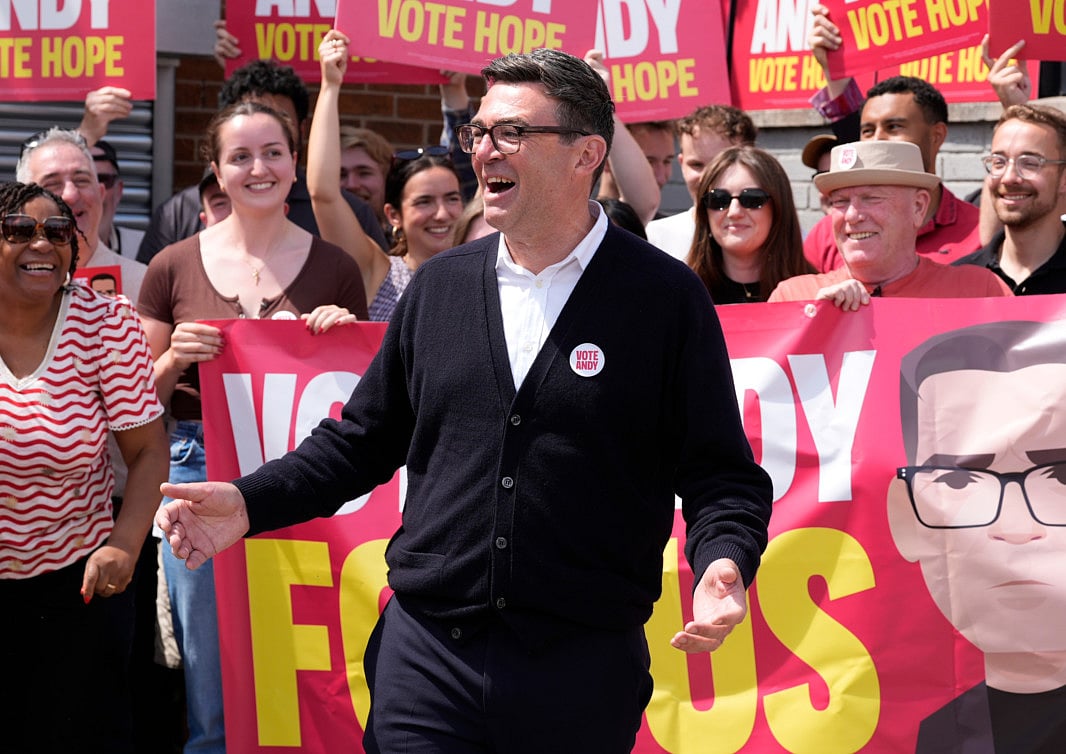
Andy Burnham is surrounded by supporters at the Stubshaw Cross Community and Sports Club in Ashton-in-Makerfield, England, on June 18, 2026
AP
Dubai: Andy Burnham has spent much of his political life being seen as a contender rather than a winner. Now, following Prime Minister Keir Starmer’s resignation, the Greater Manchester mayor believes his moment may finally have arrived.
The 56-year-old Labour politician has confirmed he will seek to succeed Starmer, placing himself at the centre of what could become one of the most consequential leadership contests in recent British politics.
Burnham’s journey to national prominence has been anything but straightforward. Born and raised in northwest England between Liverpool and Manchester, he is the son of a British Telecom engineer and a receptionist. He joined the Labour Party as a teenager, studied at Cambridge University and entered Parliament in 2001.
His rise through Labour’s ranks was swift. Under former prime ministers Tony Blair and Gordon Brown, Burnham held several senior government posts and served in Brown’s Cabinet between 2007 and 2010. Yet his ambitions to lead the party appeared repeatedly frustrated after heavy defeats in Labour leadership contests in 2010 and 2015.
Who is Andy Burnham?
Age: 56
Current role: Mayor of Greater Manchester since 2017
Party: Labour
Education: Studied at Cambridge University
MP: Served in Parliament from 2001 to 2017
Cabinet experience: Held senior posts under Prime Ministers Tony Blair and Gordon Brown
Leadership bids: Lost Labour leadership contests in 2010 and 2015
Nickname: "King of the North" for championing northern England
Known for: Clashes with Boris Johnson during the Covid-19 pandemic and backing the Hillsborough justice campaign
Political vision: Promotes "Manchesterism" — focusing on regional growth, local control and public services
Leadership race: Has announced he will seek to replace Keir Starmer as Labour leader and prime minister
Personal side: Known for his relaxed style, love of football and occasional DJ appearances playing 1990s music
Quote: "What we've built in Greater Manchester needs to go national."
Unusual path
Rather than remain in Westminster, Burnham took an unusual path. In 2017, he left national politics to run for mayor of Greater Manchester, a move many viewed as a retreat from the national stage. Instead, it became the platform that revived his political career.
Over nearly a decade as mayor, Burnham transformed himself into one of Britain’s most recognisable regional leaders. He championed Greater Manchester’s interests, pushed for more local control and oversaw major regeneration projects across the city region. His decision to bring public transport under greater public control and create the Bee Network won praise from supporters who saw it as evidence that local government could deliver tangible improvements.
Nickname
His profile grew dramatically during the Covid-19 pandemic when he publicly clashed with then-prime minister Boris Johnson over restrictions and financial support for northern England. The confrontation earned him the nickname “King of the North”, a reference to the television series Game of Thrones and a reflection of his reputation as a defender of regions often overshadowed by London.
Burnham has also been widely praised for supporting the long campaign for justice for the victims of the 1989 Hillsborough disaster, in which 97 Liverpool football fans died. His backing of bereaved families helped cement his image as a politician willing to challenge powerful institutions.
Politically, Burnham is viewed as being to the left of Starmer and has built his appeal around what he calls “Manchesterism” — a philosophy that prioritises communities, regional investment and practical solutions over party ideology. He argues that the model used to regenerate Greater Manchester can be replicated across Britain.
Supporters see him as one of Labour’s strongest communicators, capable of connecting with voters in a way many Westminster politicians struggle to do. Critics, however, question whether his largely regional success can translate into national leadership and whether his ambitious promises can be funded.
Those questions may soon be tested. Once written off after two failed leadership bids, Burnham now finds himself closer than ever to the office he has long sought — 10 Downing Street.
-- With AP inputs

A Senior Associate Editor with more than 30 years in the media, Stephen N.R. curates, edits and publishes impactful stories for Gulf News — both in print and online — focusing on Middle East politics, student issues and explainers on global topics. Stephen has spent most of his career in journalism, working behind the scenes — shaping headlines, editing copy and putting together newspaper pages with precision. For the past many years, he has brought that same dedication to the Gulf News digital team, where he curates stories, crafts explainers and helps keep both the web and print editions sharp and engaging.
Sign up for the Daily Briefing
Get the latest news and updates straight to your inbox
Network Links
GN StoreAbout Gulf NewsTerms & ConditionsReach by GNSitemapContact usPrivacy PolicyGN FocusHave your sayWork with usAdvertise with usGulf News epaperPrinting Services
Download our app
© Al Nisr Publishing LLC 2026. All rights reserved.